
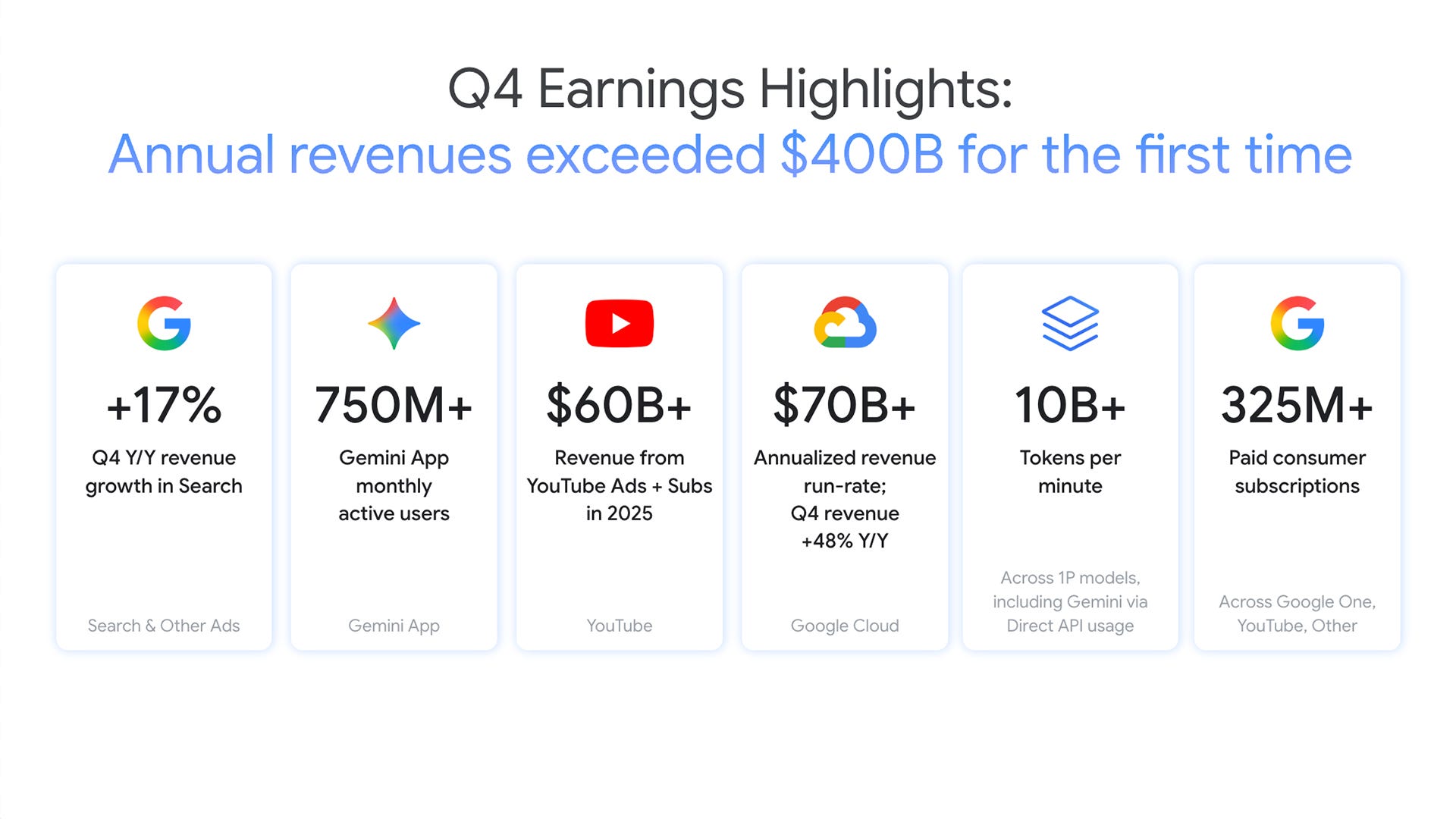
Google just crossed $400 billion in annual revenue for the first time.
The market cheered. Sundar got his bonus. But buried in the earnings deck is a story about the difference between adoption and monetization; and why Google is winning one battle while quietly losing the war that actually matters.
The Numbers That Matter (And The Ones That Don’t)
Let’s start with what Google wants you to see:
Search ads: +17% YoY. Still the money printer. Still working. The 25-year-old cash cow refuses to die, and honestly, respect.
YouTube: $60B in revenue from ads and subscriptions. An absolute monster. This is a Fortune 50 company hiding inside another Fortune 50 company.
Google Cloud: $70B annualized run rate, up 48% YoY. Real growth. Real infrastructure. Real margins improving.
And then there’s Gemini: 750 million monthly active users.
Sounds impressive until you realize that Google has 325 million paid consumer subscriptions across all Google products.
YouTube Premium. Google One. Google Workspace for consumers. Everything.
Do the math.
If even half of those 750M Gemini users were paying $20/month, that’s $7.5 billion in monthly revenue; $90 billion annualized. But Google didn’t break out Gemini revenue. Not in the deck. Not in the call. Not anywhere.
When a company shows you user numbers but hides revenue, you know exactly what that means.
The Adoption
750 million monthly active users is a vanity metric wrapped in AI hype. Here’s what ‘active’ probably means in Google’s internal dashboard: someone who opened Gemini once, asked it to write an email, got a mediocre response, and went back to ChatGPT.
Because here’s the truth Google isn’t saying out loud:
Gemini’s reasoning is weaker than GPT-5. The voice interface feels like it was designed by a committee that never used Siri. The product experience is clunky. And users can feel it.
This isn’t speculation. This is what the market is telling Google through revealed preference. People try Gemini because it’s free, it’s integrated into their Google account, and Google shoves it in their face across Search, Gmail, and Docs. But they don’t stay. And they definitely don’t pay.
Why Gemini Can’t Win on Product
Let’s talk about the product gaps, because this is where the AI war is actually being fought.
1. Reasoning Quality
GPT-5 and Claude simply reason better than Gemini on complex tasks. Not by a little. By a lot. Ask Gemini to solve a multi-step logic problem, debug code, or analyze a business strategy, and you’ll get an answer that’s... fine. Ask GPT-5 or Claude Sonnet, and you’ll get an answer that makes you think ‘oh, this thing actually understands.’ That gap matters. A lot.
2. Voice Interface Is DOA
Gemini’s voice mode is embarrassingly bad. It’s slow. It’s clunky. It feels like talking to a robot that’s perpetually buffering. Compare that to ChatGPT’s Advanced Voice Mode, which feels like having a conversation with an actual intelligent being. Google built Assistant. They should be winning voice. Instead, they’re getting lapped.
3. Distribution Without Desire
Google has the distribution. Gemini is everywhere; Search, Gmail, Docs, Workspace. Billions of touchpoints. But distribution doesn’t matter if the product doesn’t create desire. And Gemini doesn’t. Users aren’t waking up thinking ‘I need to use Gemini today.’ They’re using it because it’s there, not because it’s better.
This is the innovator’s dilemma in real time. Google has every structural advantage; compute, data, distribution, talent, capital. But they’re getting beat on the thing that actually matters: product quality.
The Business Model Problem
Here’s what makes this even more brutal: Google is fundamentally confused about what Gemini is supposed to be.
Is it a Search replacement? Is it a productivity tool? Is it a consumer AI assistant? Is it an enterprise platform? Is it an API business? Yes. All of the above. Which means it’s none of them well.
OpenAI knows what it is: a reasoning engine you pay $20/month to access. Anthropic knows what it is: the safest, most capable AI for serious work. Google? Gemini is whatever the slide deck needs it to be that quarter.
And that confusion shows up in the monetization. Or lack thereof.
Google could have charged for Gemini Advanced from day one. They didn’t. They could have made it a clear upsell path from free Search to paid AI. They didn’t. They could have integrated it into Workspace with clear pricing and ROI. They kind of did, but half-heartedly.
Instead, they’re giving away 750 million ‘users’ and hoping that somehow, eventually, magically, this turns into revenue.
What Google Is Actually Selling
Let’s zoom out. Google’s actual business in 2025:
Search ads are still printing money. +17% growth on a $200B+ base. This is the foundation. This is what pays for everything.
YouTube is a media empire. $60B in revenue. Growing. Profitable. Underappreciated by the market.
Cloud is the growth story. $70B run rate. Real competition with AWS and Azure. Improving margins. This is where the institutional money is long.
And Gemini? Gemini is the thing Google talks about to convince Wall Street they’re not missing the AI revolution. It’s a narrative, not a business.
Not yet, anyway.
The Incentive Problem
Here’s the deeper issue: Google’s incentives are fundamentally misaligned with building the best AI product.
If Gemini gets too good at answering questions, it cannibalizes Search. If it gets too good at summarizing content, it destroys the ad-supported web that Google’s business depends on. If it gets too integrated into Workspace, it threatens Microsoft’s enterprise dominance; but Google doesn’t want that fight because Workspace is already profitable and growing.
So what does Google do? They launch Gemini everywhere and nowhere. They integrate it into everything without making it the best at anything. They generate 750 million MAUs without a clear path to $1 billion in revenue.
Meanwhile, OpenAI has zero incentive structure conflicts. Their entire business model is ‘build the smartest AI and charge for it.’ Simple. Focused. Aligned.
Anthropic is even cleaner: ‘build the safest, most capable AI for serious work.’ No ads. No legacy business to protect. Just product.
Google? Google is trying to have it all. And you can’t have it all.
The AI Distribution Myth
There’s this narrative in tech circles that Google’s distribution is an unbeatable moat. They own Search. They own Android. They own Gmail. They own YouTube. Billions of users. Surely that matters, right?
Wrong.
Distribution is a moat when you’re selling utility. Search is utility. You use it because it’s there and it works. Gmail is utility. YouTube is utility.
But AI—real AI—is different. AI is about intelligence. And when the product is intelligence, users will route around your distribution to get to the best intelligence.
That’s why ChatGPT went from 0 to 100 million users faster than any product in history. That’s why Anthropic is winning enterprise deals despite having 1/100th of Google’s distribution. That’s why people are paying $20/month for ChatGPT Plus while ignoring Gemini Advanced.
When the product is this good, distribution doesn’t matter. When the product is mediocre, distribution can’t save you.
What This Means for the AI War
Google is not going to lose Search in 2025. Or 2026. The ad business is too entrenched, too profitable, too defended by regulatory moats and user habit.
But Google is losing the future of how people interface with information. And that’s what actually matters.
In 5 years, when a meaningful percentage of knowledge work flows through AI agents instead of search boxes, do you think those agents will be powered by Gemini? Or by the models people are already using; GPT, Claude, and whoever else builds the best reasoning engines?
Google’s Q4 earnings are impressive. $400B in revenue is real. But the story underneath the story is this:
They’re winning with their old products. They’re losing with their new one. And in tech, that’s how you become IBM.
The Path Forward (That Google Won’t Take)
If I were running Gemini; which I’m not, and thank god for that…here’s what I’d do:
1. Pick One Thing
Decide if Gemini is a consumer AI assistant, an enterprise productivity platform, or a developer API business. Then go all in on that one thing. Not three things. Not ‘everything.’ One.
2. Fix the Product
Stop shipping ‘good enough’ reasoning. Stop shipping clunky voice interfaces. Stop pretending distribution solves product-market fit. Build something that makes users think ‘holy shit, this is actually better than ChatGPT.’
3. Charge Real Money
If Gemini Advanced is worth using, charge $30/month. Not $20. Not free. $30. Make it premium. Make it expensive. Make people feel like they’re getting the best AI in the world. Because right now? They don’t.
4. Separate Gemini from Google
Spin it out. Give it a separate P&L. Let it compete without the baggage of protecting Search revenue. Let it win on its own terms.
But they won’t do any of this. Because Google is a $2 trillion company optimizing for quarterly earnings, not decade-long transformation. And that’s fine. That’s rational. That’s what big companies do.
But it’s also how you lose the future.
The Bottom Line
Google’s Q4 earnings are a masterclass in financial engineering and incumbent resilience. They’re squeezing every dollar out of Search, YouTube, and Cloud. They’re growing. They’re profitable. They’re beating expectations.
But Gemini; the thing they’re betting the future on…is a mirage. 750 million users without revenue is not a business. It’s a hope. And hope is not a strategy.
The AI war won’t be won by distribution. It will be won by whoever builds the best reasoning engine, the best voice interface, the best user experience. Right now, that’s not Google.
And until they fix the product; really fix it, not just ship incremental updates…all the distribution in the world won’t matter.
750 million users tried Gemini. How many stayed? How many paid? How many switched from ChatGPT?
Google knows the answer. That’s why they didn’t put it on the slide.
This is Full Stack Capitalist. We explain how AI rewrites incentives, economics, and distribution. Subscribe for ruthless analysis on what’s actually happening in the AI economy—not what the slide decks say.
Great analysis! Why are they so focused on Gemini though? When Google DeepMind won a noble prize and probably have the best AI team at this moment. They've got the best potential now so how come they don't lead with that narrative instead of Gemini?
What's the evidence behind the claim that people try Gemini, and then churn to ChatGPT and other competitors?