

One of the biggest mistakes I made building SearchFit was pricing.
And more specifically, the psychology behind our pricing.
We priced our product at $100 per month because we thought it would make it easier to acquire customers. In reality, we weren’t sufficiently confident in our own product, our positioning or our ability to sell something more expensive.
What followed was an expensive education in the economics of building an AI-native business.
01. Traditional SaaS spoiled an entire generation of founders
The traditional SaaS business model is beautiful.
Build software once.
Sell it a thousand times.
Spread development costs across customers.
Improve gross margins as you scale.
Collect recurring revenue.
Obviously, there are infrastructure, support and maintenance costs. But the incremental cost of another customer using a mature SaaS product can be relatively small.
AI-native businesses operate under a different economic reality.
Every time a customer uses an AI feature, there can be a direct computational cost.
Every prompt. Every analysis. Every automated workflow. Every report. Every agent execution.
Your customer isn’t simply accessing software anymore. They’re consuming an economic resource.
Traditional SaaS sells access. AI-native SaaS often sells consumption as access.
And if you don’t understand that distinction, your most engaged customer could become your least profitable customer.
Imagine explaining to an investor that customer engagement is growing 300% and that this is precisely why you’re running out of money.
Welcome to AI.
02. Tokenomics is your business model, not your infrastructure problem
When we were building SearchFit, pricing conversations inevitably became product conversations.
How many tokens should each customer receive?
How many brands could they track?
How frequently should we run analyses?
How many AI models should we query?
Should unused credits expire?
What happens when a customer exhausts their allocation?
Can they purchase additional credits?
Suddenly, we weren’t just building an AI visibility platform. We were designing a miniature economy.
Consider this simplified, illustrative example:
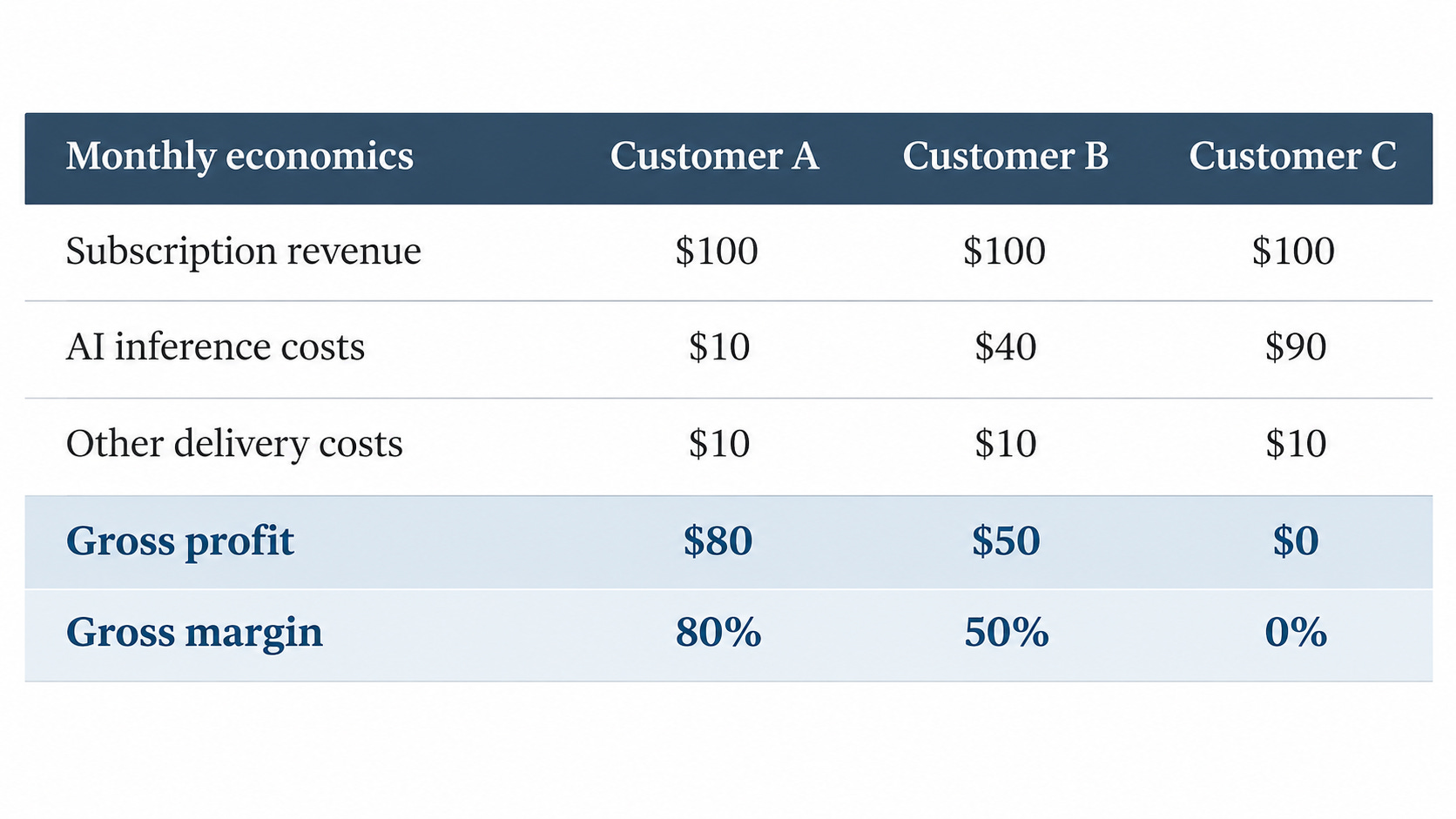
Three identical subscriptions. Three completely different economic outcomes.
Stripe tells you that you have $300 in recurring revenue.
Your infrastructure bill tells you what kind of business you actually have.
This is why I increasingly believe AI-native founders need to design their unit economics before they finalise their product roadmap.
Not afterwards.
03. Your pricing page is an extension of your product architecture
Adding a credit-based pricing system sounds simple.
It isn’t.
Once you introduce usage allowances and top-ups, you potentially need:
Real-time consumption tracking.
Customer-facing usage dashboards.
Credit allocation and expiration logic.
Automated top-up functionality.
Usage alerts and spending limits.
Model-level cost monitoring.
Account-level profitability reporting.
Controls against excessive or abusive consumption.
Congratulations. Your pricing strategy just created another product roadmap.
And none of these features necessarily make your core product better at solving the customer’s original problem.
But without them, you risk building a product that becomes economically worse as customers use it more.
The challenge is protecting your margins without making customers feel like they’re constantly feeding coins into a parking meter.
Customers don’t particularly care how many tokens you’re consuming. They care about the business outcome they’re purchasing.
Sell outcomes externally. Manage consumption internally.
04. The $100 customer trap
Our initial pricing started at $100 per month.
We thought this would reduce friction, accelerate adoption and help us validate the market.
Instead, we attracted a significant number of people who weren’t our ideal customers.
Freelancers. AI enthusiasts. People experimenting with new tools. Small operators without meaningful marketing budgets.
There is absolutely nothing wrong with these customers.
They just weren’t the right customers for the business we were trying to build.
The pattern became familiar.
Monday: A customer registers.
Tuesday: They enter their credit card.
Wednesday: You open Stripe and feel like a genius.
Friday: They email asking for a refund.
By the following Monday, you’re back where you started, minus inference costs, support time and a small portion of your sanity.
The problem was that we were interpreting willingness to experiment as willingness to pay.
And those are fundamentally different things.
A credit card is a signal of interest. A successful payment is a signal of willingness to pay. A renewal is a much stronger signal of sustained value.
Profitable renewals are where the business starts getting interesting.
05. We were pricing our insecurity
Looking back, I don’t think $100 was necessarily the wrong price for every possible customer.
It was the wrong starting point for the company we wanted to build.
We started with what we thought customers would comfortably pay rather than identifying the customers for whom our product could generate substantial commercial value.
We were effectively asking:
How cheap do we need to make this so someone buys it?
We should have been asking:
Who has a sufficiently expensive problem that paying us $5,000 per month makes complete economic sense?
Those two questions lead to entirely different companies.
They determine your:
Ideal customer profile.
Product architecture.
Sales motion.
Customer acquisition strategy.
Feature prioritisation.
Support model.
Long-term profitability.
Pricing is not simply a number on your website.
Pricing is a decision about which business you intend to build.
06. Then the agencies started talking
Some of our most interesting commercial conversations were with marketing agencies.
These businesses weren’t necessarily interested in monitoring a single brand.
They wanted to monitor dozens of brands, manage multiple client accounts, produce reports and potentially white-label the entire experience under their own identity.
One agency conversation involved approximately 50 brands.
At $100 per brand per month, that represented a potential $5,000 monthly account.
The conversation was fundamentally different from someone experimenting with AI visibility for their personal website.
The agency had an existing customer base, an established commercial model and a potential mechanism for generating revenue from our technology.
They weren’t just buying software.
They were potentially buying a new revenue stream.
But this opportunity introduced another set of challenges.
White-label infrastructure. Multi-tenant architecture. Custom branding. Agency dashboards. Consolidated reporting. Permissions. Usage allocation across multiple clients.
Once again, commercial strategy was dictating technical architecture.
The difference was that we were now discussing building those capabilities for customers with potentially meaningful contract values.
That is a much more interesting product investment decision.
07. The economics of 100 customers versus two
Consider three businesses with identical monthly recurring revenue.
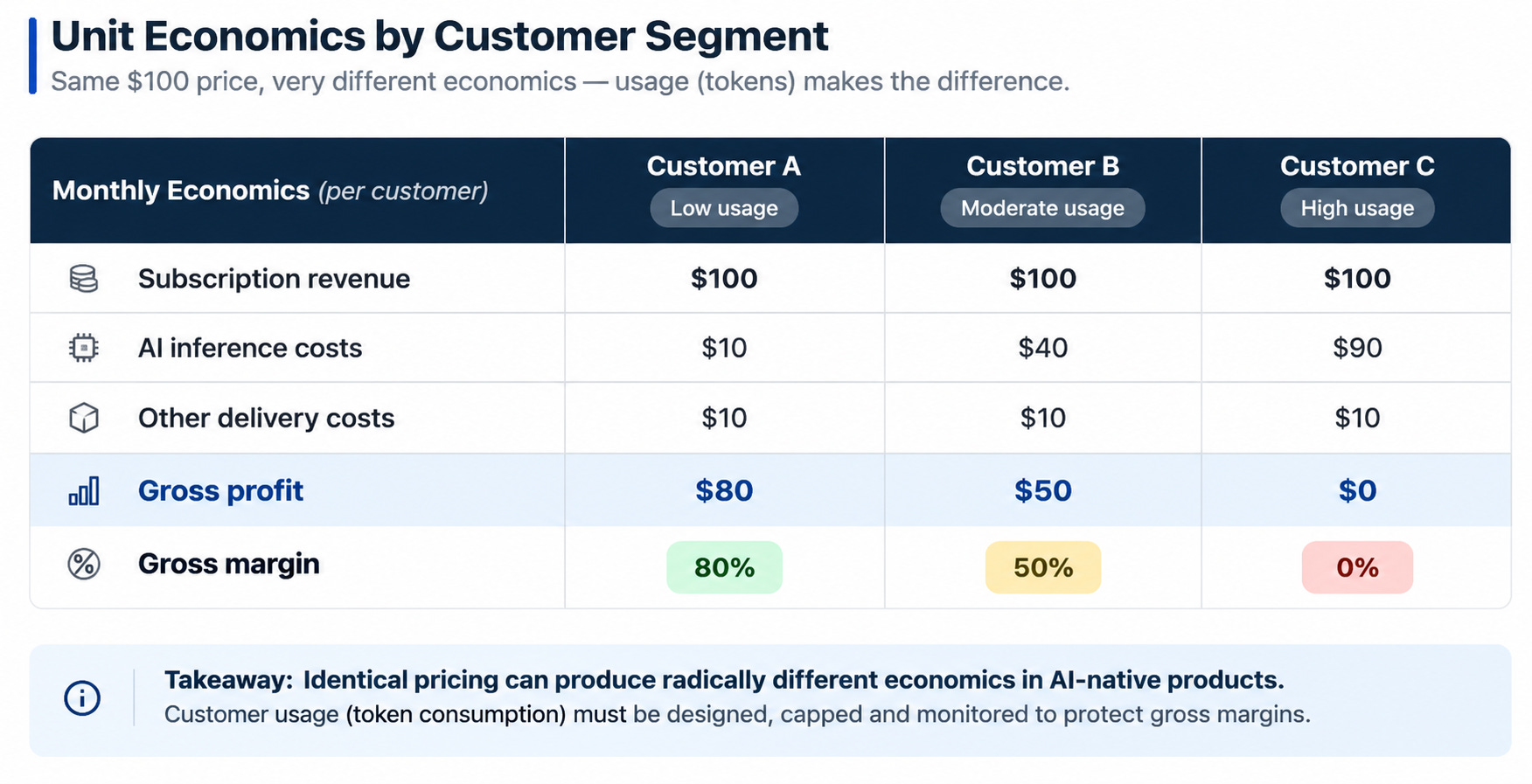
On a revenue dashboard, these businesses look identical.
Operationally, they are completely different.
The low-ticket business requires more acquisition volume, onboarding automation and churn management.
The enterprise business requires more sophisticated sales, deeper integrations, stronger reliability and potentially expensive customer support.
It also introduces customer concentration risk. Losing one of two customers is considerably more painful than losing one of a hundred.
Higher pricing isn’t automatically better economics.
But for a small AI-native startup with limited engineering capacity, the question becomes:
Which customers generate enough gross profit to justify the resources required to acquire, serve and retain them?
That is the question I wish we had spent more time answering from day one.
08. If I were building another AI-native business tomorrow
I would reverse almost everything about our initial pricing approach.
1. Start with the highest-value customer.
Identify the customers who could rationally spend $5,000 or $10,000 per month solving the problem.
Work backwards from their requirements, budgets and commercial incentives.
2. Price against economic value, not competitors.
If your product helps an agency generate $50,000 in additional monthly revenue, your pricing conversation should not revolve around whether a competing AI tool costs $99 or $129.
3. Establish a gross margin floor.
Understand the fully loaded cost of serving each customer before committing to pricing. Stress-test the economics against heavy usage, expensive models and declining margins.
4. Never confuse unlimited access with unlimited consumption.
Create predictable allowances, transparent top-ups and appropriate commercial safeguards.
Unlimited AI usage without understanding consumption economics is not generosity. It’s an unpriced financial liability.
5. Build the product around the best buyers.
Don’t let a hundred low-value trial users collectively dictate a roadmap that makes your product less attractive to ten high-value customers.
6. Measure retention and profitability together.
Registrations, credit cards, MRR and even retention can all conceal weak economics.
I would want to know the gross profit generated by every customer segment, how long those customers stay and how much it costs to acquire them.
That is the dashboard I would look at every morning.
09. The metrics I would care about now
The objective isn’t to build the biggest possible user base.
It’s to build a commercially sustainable customer base.
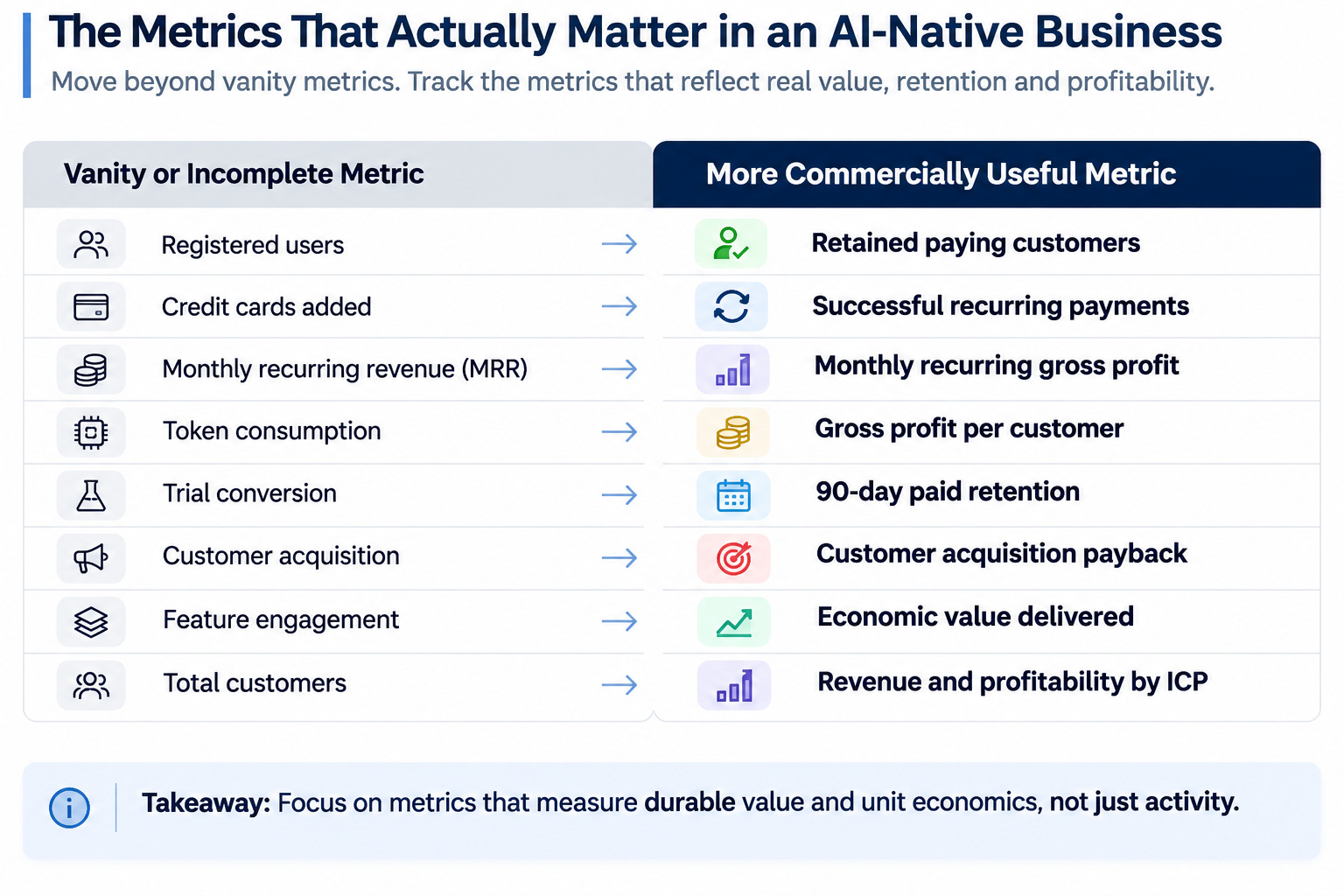
Sometimes those ambitions align. Sometimes they don’t.
A founder needs to understand the difference.
The FSC’s takeaway
Building SearchFit fundamentally changed how I think about pricing.
I used to think pricing was something you figured out once you had built a sufficiently good product.
Now I think pricing is one of the earliest strategic decisions a founder should make.
It influences who you attract, what you build, how much capital you need, what margins you generate and whether growth strengthens or weakens your business.
AI has dramatically reduced the cost of building software.
It has not necessarily reduced the cost of delivering software at scale.
In some business models, it has introduced an entirely new category of variable costs.
The next generation of successful AI founders will need to be as comfortable with unit economics, pricing strategy and capital allocation as they are with APIs, agents and large language models.
And perhaps the most expensive lesson I learned:
Don’t build a $5,000 product for a $100 customer simply because you’re afraid to ask for $5,000.
Full Stack Capitalist explores the intersection of technology, economic power, business models and capital allocation. Lessons from building businesses, not just reading about them.