

AI-native companies will tell you they are building proprietary intelligence.
THEY ARE NOT!
They are renting intelligence from OpenAI, Anthropic or Google. Renting compute from Amazon, Microsoft or Google. Connecting to customer data they do not own. Distributing through channels they do not control. Then placing a workflow, a user interface and a prompt library on top.
That can still create a useful product.
It can even create revenue very quickly.
But usefulness is not ownership. Revenue is not defensibility. And a prompt that produces an impressive result today may become unnecessary after the next model release.
The question for thousands of AI companies is simple:
If the model provider improves the model, the cloud provider controls the infrastructure, the customer owns the data and the incumbent software vendor owns the workflow, what is left for you?
For many companies, the honest answer is: a prompt library, some orchestration code and a monthly API bill.
That is not automatically a bad business.
It is a dangerous business to mistake for a durable one.
The prompt library is the new spreadsheet macro
Prompt libraries are useful. So were spreadsheet macros.
A good prompt encodes judgment. It captures instructions, exceptions, examples and a particular way of turning messy inputs into useful outputs. A collection of prompts can represent hundreds of hours of experimentation.
But prompts have three economic problems.
First, they are easy to copy.
Second, their value depreciates as models improve.
Third, the model provider can absorb the capability into the base product.
Yesterday, getting reliable structured output required elaborate prompting, retries and validation. Today, much of that is a native model or API capability. The better the foundation models become at understanding vague instructions, using tools and handling long context, the less value sits in the exact wording of the prompt.
This creates a strange form of technological depreciation.
In traditional software, accumulated code usually increases the capability of the product. In AI applications, some accumulated logic is deleted by the next model upgrade.
The startup spends six months engineering around a model weakness.
The model lab fixes the weakness.
The startup’s technical achievement becomes redundant.
The customer gets a better product. Society gains. But the company that built the workaround discovers that technological progress can destroy its intellectual property faster than it creates it.
The prompt library is therefore not worthless.
It is closer to perishable inventory than permanent capital.
AI has lowered the cost of creating a company. It has not lowered the cost of building a moat.
Generative AI has compressed the cost of software creation.
A small team can now build a polished application, generate marketing assets, write documentation, support customers and ship integrations at a speed that once required a much larger organisation. Research on new business formation is already pointing in the same direction: generative AI appears to increase the formation of smaller, leaner digital ventures and reduce time to launch.
That is the first-order effect.
More people can build companies.
The second-order effect is harsher:
If everyone can build, building itself stops being scarce.
Product supply expands. Feature differences shrink. Competitors appear faster. Customers face lower switching costs. Every attractive niche attracts ten nearly identical products, often using the same models and producing similar outputs.
The bottleneck moves away from software production and toward distribution, trust, workflow access and customer acquisition.
AI makes the product cheaper to create while making attention more expensive to buy.
That reverses one of the comfortable assumptions of the SaaS era. Software development used to be a meaningful barrier to entry. The engineering effort required to reproduce a product gave incumbents time. AI reduces that protection.
The result is not the death of software.
It is the commoditisation of undifferentiated software production.
The full stack of rented intelligence
To understand the risk, look at the layers of a typical AI-native company.
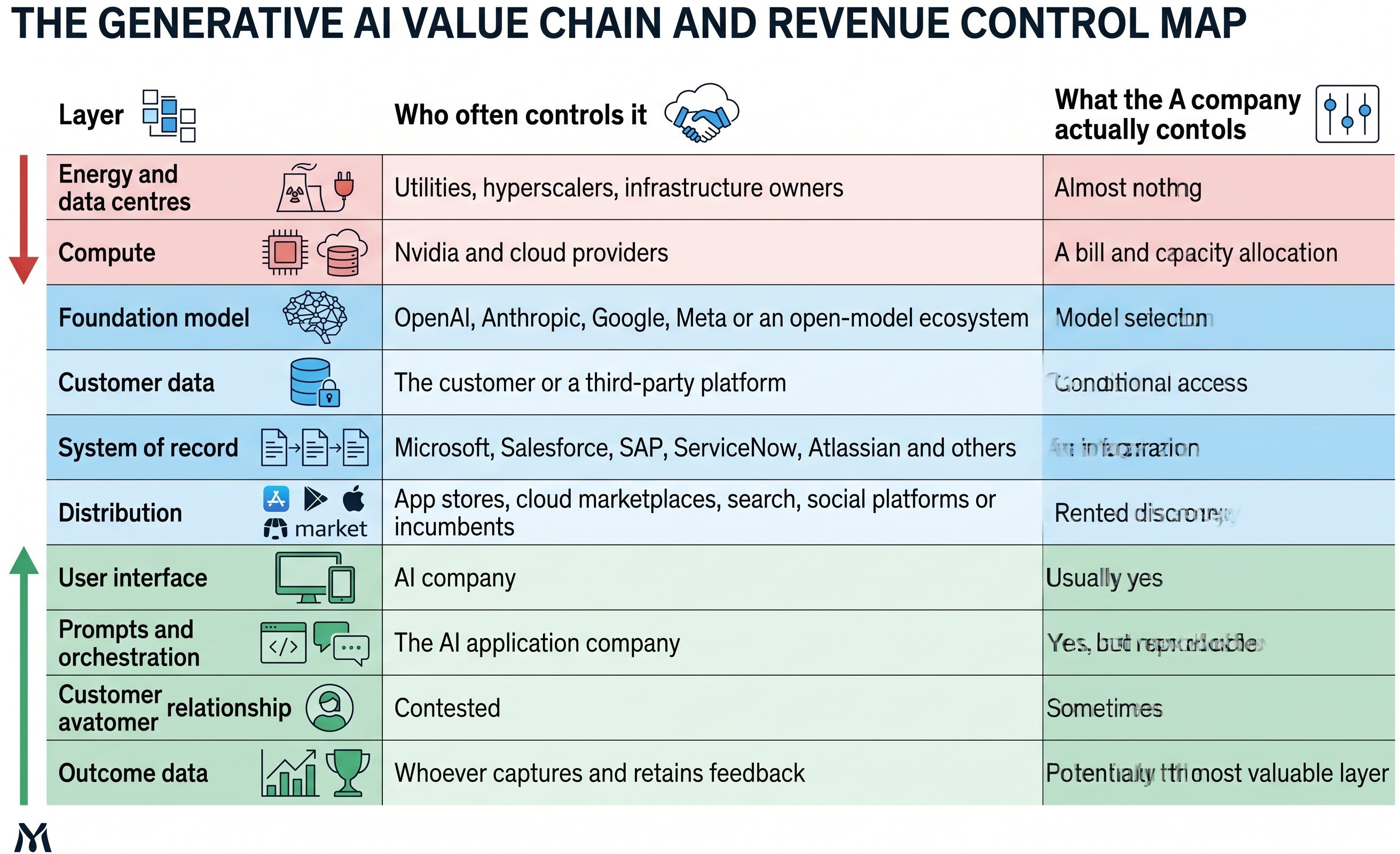
This does not mean every company needs to train a frontier model or own a data centre. That would be economically absurd for most businesses.
Ownership should not be confused with physical possession.
The issue is control.
Do you control a scarce asset?
Does it improve as customers use the product?
Does it survive a model upgrade?
Can the supplier change its price without destroying your economics?
Can the customer replace you without reorganising the way work gets done?
If the answer to all five is no, the company does not have an AI moat. It has temporary access to someone else’s moat.
The startup problem: speed without accumulation
For startups, rented intelligence is initially a gift.
It removes the need to raise hundreds of millions of dollars for compute, model training and research talent. A founder can reach the market before knowing which model will ultimately win. Multi-model architectures can reduce technical dependence. Falling inference prices can improve gross margins.
This is why application-layer AI companies can grow very quickly. The Financial Times has documented AI application startups reaching substantial revenue at speeds that would have looked abnormal in the old SaaS market. Lower model costs make more use cases viable and allow small teams to serve large markets.
But speed creates a false signal.
Fast revenue growth can look like product-market fit when it is partly curiosity, subsidised usage or a temporary capability gap in the foundation model. Customers may pay because the base platforms have not yet packaged the feature, not because the startup has built something the platforms cannot reproduce.
That creates four startup traps.
1. The demo-to-company trap
AI produces unusually impressive demos.
A demo proves that a task can be performed. It does not prove that the company can own the task.
Investors and founders can confuse model capability with company capability. If 90% of the magic comes from the underlying model, the startup must explain why the remaining 10% deserves the margin, the valuation and the customer relationship.
Sometimes it does. Deep workflow integration, verification, permissions, audit trails and proprietary context can be extraordinarily valuable.
But the burden of proof sits there, not in the demo.
2. The negative learning-curve trap
In a strong software business, every customer should make the product harder to replace.
The company learns. Its data improves. Its workflows deepen. Its distribution expands. Its unit economics strengthen.
Many thin AI wrappers do not accumulate much of anything. They send inputs to a model, receive outputs and discard the interaction. The customer receives the value, while the model provider receives the usage and the startup retains little reusable learning.
The company grows without compounding.
Revenue goes up, but strategic ownership does not.
3. The margin illusion
Traditional SaaS trained investors to expect very high gross margins because the marginal cost of serving another user was small.
AI reintroduces variable production costs.
Every request can consume tokens, retrieval, tool calls, external APIs, vector storage, validation and sometimes human review. Agentic systems multiply this because a single user action can trigger many model calls and interactions between agents.
Falling token prices help. They do not remove the structural issue.
When the model is a material part of the product, the supplier sits inside the cost of goods sold. If the application competes mainly on price, falling inference costs may be passed straight to customers rather than retained as margin.
Cheaper intelligence can improve demand while simultaneously destroying pricing power.
4. The distribution trap
When building becomes cheap, distribution becomes the moat everyone pretends is product.
The startup may rely on Google for discovery, LinkedIn for leads, Microsoft for enterprise access, a cloud marketplace for procurement and OpenAI for the underlying capability.
Each gatekeeper can charge rent.
The startup is not one platform decision away from failure. It is several platform decisions away from failure.
The mature-company problem: paying twice for intelligence it already owns
Large companies face the opposite problem.
They already own many of the scarce assets AI startups want:
decades of customer relationships
proprietary operational data
embedded workflows
licences and regulatory permissions
distribution
domain experts
historical outcomes
trusted brands
Yet many incumbents fail to convert those assets into usable intelligence.
Their data is fragmented. Permissions are unclear. Systems do not connect. Institutional knowledge sits in email, presentations and the heads of employees. Procurement buys AI tools department by department. Every vendor creates another interface over the same disconnected organisation.
The mature company then pays an AI vendor to extract value from data and workflows the mature company already owns.
This can be rational. Outside vendors can move faster and bring specialised capability.
But there is a strategic difference between buying a tool and outsourcing the learning loop.
If the vendor observes the prompts, corrections, exceptions, approvals and outcomes, the vendor may learn the workflow faster than the customer does. The enterprise supplies the domain knowledge. The vendor turns it into a repeatable product. The enterprise pays the subscription.
The company has effectively financed the construction of someone else’s intangible asset.
That is the second-order risk for incumbents.
The third-order risk is worse: once a vendor becomes the interface through which employees access corporate knowledge and execute work, the vendor begins to control the organisational operating layer.
At that point, switching is not a software migration. It is institutional surgery.
What actually survives the next model release?
Distribution
A company with trusted access to a customer segment can swap models underneath the product. The model lab cannot instantly reproduce the customer relationship.
Distribution is especially powerful in regulated or fragmented industries where procurement, reputation and local market knowledge matter.
Proprietary context
Raw data is overrated. Context is more valuable.
The useful asset is not a pile of documents. It is the mapping between data, decisions, permissions, exceptions and outcomes. That context tells the system what mattered, what was allowed and what worked.
Workflow control
An AI assistant that comments on work is easy to replace.
An AI system embedded in the transaction, approval or execution path is much harder to remove. The more operational responsibility it carries, the more valuable reliability, integration and governance become.
Outcome data
Generated content is abundant. Verified outcomes are scarce.
Did the contract clause survive litigation?
Did the maintenance recommendation prevent failure?
Did the sales action increase conversion?
Did the medical intervention improve the patient’s condition?
The company that captures the link between recommendation and outcome can build a learning system competitors cannot reproduce with prompts alone.
Trust and permission
In high-stakes markets, the right to act is more valuable than the ability to generate.
Licences, auditability, liability frameworks, security approvals and institutional trust are slow to build. Model capability may commoditise. Permission to use it often does not.
Proprietary economics
Some companies will build an advantage through inference efficiency, routing, caching, specialised smaller models or ownership of critical infrastructure.
The question is not merely whether the product works. It is whether the company can deliver the outcome at a cost structure competitors cannot easily match.
The second-order economics: where the money moves
If thousands of AI companies own little beyond prompts and interfaces, the value does not disappear.
It moves.
More value flows to foundation-model and cloud providers
Every application expands demand for tokens and compute. Even when the application company struggles to defend its margin, its suppliers collect revenue from usage.
This resembles previous platform economies. A crowded field of businesses can compete above the platform while the platform captures the most stable rent below them.
The application layer may generate the experimentation. The infrastructure layer may capture the dependable economics.
Customer acquisition becomes more expensive
When competitors can reproduce features quickly, they compete through advertising, sales teams, partnerships and discounts.
Engineering costs fall. Go-to-market costs rise.
Capital moves from product creation toward distribution warfare.
The irony is brutal: AI lets a five-person company build what once required fifty people, then forces it to spend the savings fighting fifty near-identical competitors for attention.
Services return through the back door
Many AI companies present themselves as scalable software but rely on implementation teams, prompt tuning, data cleaning, integration and ongoing workflow redesign.
That is not necessarily a flaw. The work may be valuable.
But it changes the economics. The company may be a technology-enabled service business carrying a SaaS valuation. Its moat may sit in people and deployment experience rather than code.
Markets will eventually distinguish between recurring software revenue and recurring consulting disguised as software.
Model providers gain bargaining power
Multi-model strategies reduce dependence, but they do not eliminate it. Models are not perfectly interchangeable. Changing providers affects quality, latency, safety behaviour, tool use and customer commitments.
Once the product is optimised around a model, switching becomes costly. The provider can influence the application’s margins, roadmap and service quality without owning a share of the company.
This is vertical power without vertical ownership.
Valuations split between revenue growth and strategic control
Two AI companies may report identical revenue.
One owns distribution, workflow and outcome data.
The other buys leads, calls an external model and returns text through a dashboard.
They should not receive the same multiple.
As the market matures, investors will pay less for revenue that depends on rented capability and more for revenue attached to controlled workflows, proprietary feedback loops and durable customer access.
The third-order economics: what happens after the shakeout
The deeper consequences arrive after the application market becomes crowded.
1. AI markets may consolidate faster than SaaS
SaaS companies could coexist because products accumulated specialised features over many years.
AI compresses feature development and lets platforms move across categories quickly. A general model provider can enter legal research, coding, customer service, analytics or enterprise search without rebuilding intelligence from zero.
That does not mean vertical startups all disappear. It means they must move deeper into the workflow faster than the platform moves outward.
The middle gets squeezed.
At one end sit large platforms with models, compute and distribution.
At the other sit specialised companies with domain data, trust and workflow ownership.
The generic wrapper in between has nowhere safe to stand.
2. Enterprises become the training ground for their future suppliers
Companies adopting external AI tools will generate valuable process data: how decisions are made, where exceptions occur, which recommendations are accepted and which outputs create value.
If contracts do not define ownership and use of this learning, enterprise adoption can transfer institutional knowledge outward.
The strategic procurement question will shift from “Can this vendor access our data?” to “Who owns what the system learns from our organisation?”
That is a much harder question, and most procurement templates are not designed for it.
3. Labour power shifts toward people who control context
If basic software production becomes abundant, value moves toward people who own customer relationships, domain judgment, operational permissions and the authority to change workflows.
The most important employee in an AI transformation may not be the person who writes the prompt.
It may be the person who knows why the process exists, which exceptions matter, who carries the liability and how the outcome is measured.
AI reduces the scarcity of generation.
It increases the value of accountable judgment.
4. National AI sovereignty becomes an application-layer issue
Policymakers often discuss sovereignty in terms of chips, data centres and foundation models.
But a country can host compute domestically and still surrender the interfaces through which its firms make decisions.
If foreign platforms mediate legal work, industrial maintenance, financial analysis, education and public administration, dependency exists above the data-centre layer as well as below it.
The strategic asset is not only domestic compute.
It is domestic control over data, workflows, standards and institutional learning.
5. Regulation may strengthen the largest platforms
Compliance creates fixed costs.
If every AI provider must fund expensive assurance, documentation, security and liability processes, the burden will fall more heavily on smaller companies. Large incumbents can spread those costs across millions of users and bundle compliance into existing enterprise contracts.
Poorly designed regulation can therefore produce the opposite of competitive policy: it can convert trust into another hyperscaler moat.
The answer is not no regulation. It is regulation that distinguishes between model risk, application risk and the actual authority a system has to act.
What investors should ask
Investors should spend less time asking whether a company is “AI-native” and more time asking what compounds.
What does the company control that the model provider does not?
What becomes more valuable after the thousandth customer?
Which data rights are contractual, and which are merely assumed?
Does usage create proprietary outcome data or only higher API costs?
What happens if the model price doubles?
What happens if the model price falls by 90%?
What happens if Microsoft, Google, Salesforce or OpenAI bundles the feature?
Is the company replacing a system of record, becoming one, or merely reading from one?
How much revenue requires human implementation?
Does the company own distribution or continuously repurchase it?
The decisive question is not “How good is the product?”
It is “Which part of the value chain can this company prevent others from taking?”
What operators should build
Operators should treat models as replaceable inputs and learning loops as strategic assets.
Build model portability where it is economically sensible. Capture structured feedback. Measure outcomes rather than output volume. Negotiate rights over interaction and improvement data. Embed the product into execution, not merely advice. Own the customer relationship. Make integrations deep enough to create value but not so dependent that a platform can switch off the company.
Most importantly, decide what the company intends to own before adding more AI features.
If the answer is “better prompts,” the strategy is already expiring.
What mature businesses should protect
Large organisations should not respond by building everything internally.
That usually produces slow, mediocre software and years of governance theatre.
They should decide which learning loops are too strategic to outsource.
The enterprise may happily rent the model, the cloud and many applications. But it should preserve control over identity, permissions, core operational context, decision records, verified outcomes and the ability to switch suppliers.
The goal is not technological independence.
It is bargaining power.
What policymakers should understand
The AI economy will not be shaped only by who invents the best model.
It will be shaped by who captures the learning generated when models enter real institutions.
Competition policy should watch bundling and platform self-preferencing. Procurement rules should define rights over derived learning and workflow data. AI policy should avoid imposing identical obligations on a frontier model, a low-risk application and an agent authorised to move money or make consequential decisions.
Governments should also stop treating the number of AI startups as proof of national capability.
A country can produce thousands of AI applications while importing the models, compute, cloud, distribution and capital.
That is startup activity.
It is not necessarily technological power.
The final test
There is nothing shameful about building on someone else’s model.
Every modern company builds on layers it does not own. Airlines do not manufacture every engine. Banks do not build every server. Software companies do not generate their own electricity.
The problem begins when a company rents every scarce layer and mistakes assembly for ownership.
The best AI companies will use commoditised intelligence to capture something non-commoditised: a customer relationship, a regulated permission, a proprietary learning loop, a critical workflow, verified outcomes or a distribution advantage.
The weakest will keep adding prompts and calling the collection a platform.
When the next generation of models arrives, we will discover which companies built an asset and which ones merely documented the limitations of the previous model.
The model is rented.
The cloud is rented.
The intelligence is rented.
If all you own is the prompt, you do not own the company’s future.