
You’ve probably read a hundred takes about OpenAI vs. Meta vs. Google fighting for AI dominance. Who has the best models. Whose weights are leaking. Which company’s alignment is closest to AGI.
All of it misses the point.
Amazon isn’t competing for model superiority. Amazon is building a monopoly on something far more valuable: the infrastructure that makes models economically viable to run at scale.
And it’s already working.
The Setup: Everyone’s Looking at the Wrong Chessboard
Here’s what you’re seeing in public:
Claude beating GPT-5 on benchmarks
Llama weights freely available
Open models “disrupting” proprietary AI
A future where intelligence is commoditized
Here’s what’s actually happening:
Every meaningful AI workload runs on AWS
The cost of power to run an AI model is the actual economic moat
Amazon controls the layers below the models (chips, cooling, power, co-location)
The “openness” of model weights is irrelevant if the only affordable place to run them is on Amazon’s hardware
Amazon isn’t winning the model war. Amazon is winning the infrastructure war, and that war matters infinitely more.
Think about it this way: If you can get free intelligence but it costs you $2M/month to run inference at scale, you don’t actually have free intelligence. You have a $24M/year tax to Amazon.
That’s not theoretical. That’s literally the operating model for most AI companies right now.
Layer 1: The Electrical Constraint
Let me walk you through the economics, because this is where it gets real.
Training a modern AI model (let’s say Claude-level) costs roughly $5-20 billion in compute. That’s the headline everyone knows.
What people skip over is this: running that model in production costs exponentially more than training it.
Here’s why. Training happens once. You burn electricity for weeks, you get a model, you ship it. Done.
Inference happens every single day, for every user, forever. A 100-million-user AI application running inference at reasonable latency costs more to operate annually than the entire training bill.
OpenAI spent ~$5-10B training GPT-4. They’re spending $700M+ per year just keeping the servers running and handling traffic. Some estimates put inference costs even higher than that.
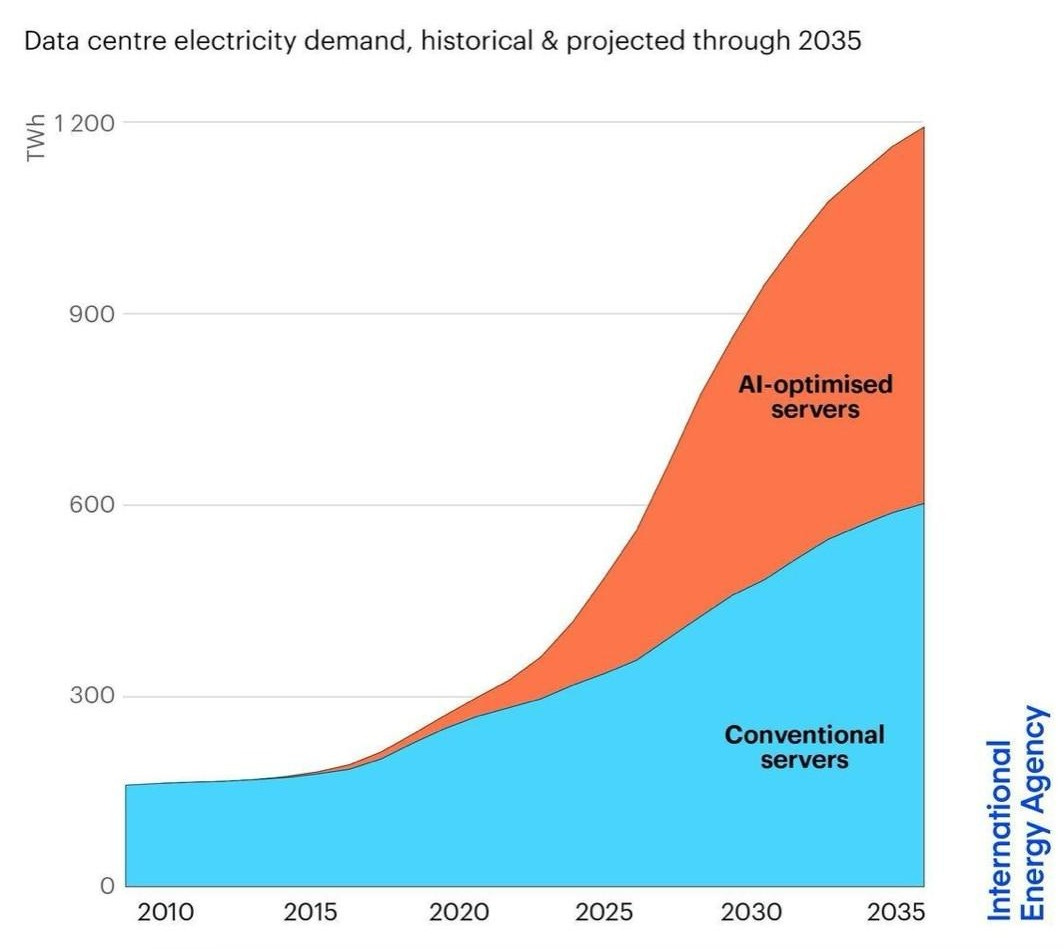
Now, here’s the constraint nobody’s talking about: power supply.
AI inference, especially at the scale required for global applications, requires electrical power infrastructure that takes 5-10 years to build. You need:
Physical land
Grid access (and agreements with utilities for dedicated power)
Cooling infrastructure (most AI datacenters use 50% of energy just for cooling)
Redundancy (you can’t have models offline)
Proximity to water (cooling requires enormous amounts of water)
This isn’t software. This isn’t something a company can spin up in 18 months. This is industrial infrastructure that takes a decade to deploy.
Amazon, via AWS, has been building this infrastructure since 2006. They have:
30+ regions globally
Dedicated power agreements with utilities in dozens of countries
Proven cooling and infrastructure expertise across 200+ datacenters
Spare capacity from their existing cloud business
Everyone else? Building from scratch in a power-constrained market where every region has limited capacity additions.
Layer 2: The Chip Monopoly Within the Monopoly
You know about Nvidia. Everyone does. Nvidia’s H100s and now H200s are the standard GPU for AI.
What you probably don’t know: Amazon is quietly making this irrelevant.
Three years ago, Amazon launched custom silicon for AI:
Trainium (for training)
Inferentia (for inference)
Why would Amazon care? Nvidia chips already work.
Because Nvidia chips have a margin. Nvidia keeps 60-70% gross margin. When you’re running millions of models across billions of users, that margin becomes a structural cost you pay to Nvidia forever.
Amazon’s custom chips have two massive advantages:
Margin capture: Amazon manufactures its own silicon (via TSMC), which means it keeps the margin. A model running on Inferentia costs 2-3x less than the same model on H100s.
Optimization for their stack: Amazon’s chips are built specifically for AWS infrastructure patterns. They’re not general-purpose. They’re not flexible. They’re purpose-built for the workload that matters, inference at AWS scale.
So what happens next?
Every AI company that runs at meaningful scale has an incentive to move to Inferentia, because it saves them millions per year. But Inferentia only lives on AWS. You can’t buy it retail. You can’t host it anywhere else.
This creates lock-in that’s invisible in the product layer but economically absolute in the infrastructure layer.
(By the way, Meta gets this. Meta uses custom chips wherever possible precisely because they don’t want to be perpetually margin-taxed by Nvidia. Amazon’s just doing it at scale and making it a service.)
Layer 3: The Co-Location Play
Here’s a detail that should scare every founder but doesn’t:
Most AI companies don’t just rent compute on AWS. They live on AWS.
Anthropic (who builds Claude) runs on AWS. They’re not shouting it from the rooftops, but AWS infrastructure is core to their operation.
When you’re running a model, you’re not just renting GPUs. You’re renting:
The GPU
The networking (egress costs for moving inference data)
The storage (where the model weights live)
The observability (monitoring, logging, debugging)
The security infrastructure
The co-location (your dataflow never leaves the AWS network)
Each of these has a cost. Each of these creates switching friction.
But more importantly, each of these gives Amazon behavioral data:
What models are being run
What inference patterns are emerging
Which companies are scaling up
What applications are working
Amazon sees the entire stack of AI workloads in real-time. Every competitor is essentially giving Amazon live market research.
Meanwhile, the rest of the industry is fighting over model weights while sitting inside Amazon’s infrastructure.
Layer 4: The Economic Moat (The Part People Miss)
Here’s what I think people get wrong about AI infrastructure:
They assume the moat is capability (better models, smarter reasoning).
It’s not. The moat is cost structure.
Let me show you the math.
Scenario A: Model-Only Competition
Company X builds a better model than Company Y. Company X wins.
Problem: Better models take resources, but the gap closes quickly. In 18 months, Company Y catches up.
Scenario B: Infrastructure + Model Competition
Company X has:
Better model
Lower inference costs (2-3x cheaper because they own the chips)
Better latency (because they own the datacenters)
Lower egress costs (because data stays in-network)
Company Y has:
Slightly worse model
3x higher inference costs
Higher latency
Forced to pay egress for data moving out of the cloud
What happens?
Company X can undercut Company Y by 70% on pricing and still make more margin. Company X can afford to run higher inference volumes at lower cost. Company X can build better products because economics allow for more inference per user.
Company Y is fundamentally uncompetitive, even if their model is 5% worse.
This is where Amazon lives.
And the thing is? This moat gets stronger over time, because AWS’s total revenue funds more infrastructure investment, which drives costs down further, which attracts more workloads, which drives more R&D, which drives more efficiency.
It’s a compounding advantage. Once you’re at a certain scale in infrastructure, you never lose it.
The Hidden Layer: Regulatory Arbitrage
There’s something else happening that almost no one discusses.
Governments are starting to care about AI. Europe is regulating. The US is having debates. China is restricting.
One thing all these regimes will want: control over the infrastructure.
Who do you think the US government is going to trust with classified AI workloads? Who’s going to get preferred access to power during shortages?
The answer is: the company that’s already the primary infrastructure provider and has government contracts on everything from defense to intelligence.
That’s AWS. Not Google Cloud. Not Azure (okay, sort of Azure, but AWS is bigger and older). Definitely not some startup with a novel architecture.
AWS can negotiate with governments from a position of strength. They can offer dedicated infrastructure. They can offer compliance in specific jurisdictions. They can integrate with government supply chains.
Everyone else is a renter who might get shut out tomorrow.
This matters because government workloads, classified AI, intelligence agency models, defense intelligence, will be the largest inference workloads in existence within 3-5 years.
If AWS gets that, the gap widens to something approaching irreversible.
The Discomfort Nobody Wants to State Directly
Here’s the thing that makes everyone squirm when you say it out loud:
The open model narrative is a marketing story that masks Amazon’s infrastructure monopoly.
Not in a conspiratorial way. Not because anyone planned it.
But because it works out that way:
Meta releases Llama weights for free → Every company that wants to use them has to run them on AWS (cheapest, easiest, most compatible)
Smaller companies can’t afford the capital to build competing infrastructure → They rent from AWS
AWS’s dominance in revenue lets them reinvest in infrastructure advantage → They get cheaper, faster, better
This drives more workloads to AWS → The moat deepens
The “open” models make AI more accessible, sure. But they also make AWS more indispensable.
Everyone’s celebrating that the models are free while the infrastructure rent keeps going up.
Why This Matters Right Now
Amazon is doing this so quietly that people don’t realize the game has already been played.
AWS is already the dominant infrastructure provider for AI. Every major AI company is on AWS. The custom chips already exist. The global power agreements are already in place. The cost advantage is already real.
What’s coming next:
Consolidation at the application layer. If your moat is only your model and AWS can match you in 18 months, your company isn’t worth building as an independent entity. You’ll either sell to someone with better distribution or fail.
Price pressure at the application layer. As models commoditize and become running costs, the value of the application layer shrinks. Features that cost $50/user today might cost $2/user in 2027.
Amazon launching AI products at scale. AWS doesn’t need to be the best AI product company. It just needs to be good enough. And it can afford to be good enough because its cost structure is unbeatable. It can run Bedrock (its managed LLM service) at prices no competitor can match.
Regulatory arbitrage playing out. Governments will designate AWS-like infrastructure as “critical national infrastructure.” This will accelerate the moat in some regions and create new lock-in mechanisms.
The model wars are a sideshow. The real war, the infrastructure war, is already over.
So What’s the Move If You’re Building on This?
If I were advising you right now:
Accept that you’re renting. Don’t pretend you’re going to build competing infrastructure. You’re not. That’s a 10-year project with $100B in capex.
Optimize for margin given the rental cost. If inference is your cost, build things where the value delivered per inference is extreme. Don’t build a system that requires 100 inferences per user action.
Build network effects above the infrastructure layer. The one thing Amazon can’t give you is distribution. Compete on that. Compete on users choosing you. Compete on data you gather that makes your product better.
Move fast and sell early. The infrastructure operator will always have a time advantage. If you build something good, sell it to someone with distribution before the cost structure advantages matter.
Or go vertically deep. If you can build for a specific vertical so well that you capture 10x the margin of the generic application, you can tolerate the infrastructure rent and still win. Think embedded AI for healthcare or manufacturing, not horizontal tools.
The Final Truth
Amazon isn’t making headlines because it’s not doing anything technically impressive.
It’s doing something economically sophisticated.
It’s converting commodity infrastructure (compute, power, cooling) into structural advantage by being first at scale and having enough capital to reinvest faster than competitors can catch up.
It’s not a conspiracy. It’s not malicious. It’s just how the lowest-cost producer wins in infrastructure.
The AI industry is celebrating the death of proprietary models while being slowly absorbed into the AWS moat.
The models are free. The freedom to run them at scale costs everything.
And Amazon owns the tollbooth.
The Full-Stack Capitalist takeaway:
In every era of technology, the application layer gets all the attention. But the infrastructure layer makes the money. Right now, founders are focused on model capabilities while the real wealth accumulation is happening in the layers below, power, chips, cooling, co-location.
That’s not changing. Amazon just got there first and is making sure nobody catches up.