

Most people would call that a failure.
I call it a mirror for what mid-sized companies get wrong about AI, innovation, and digital strategy every single day.
Innovation inside a $10M–$100M business is broken. It’s dressed up as AI pilots, innovation labs, internal hackathons…but it’s just corporate cosplay.
So I’m taking this story from a 28-year-old indie hacker, and turning it into a playbook for real business builders.
Let’s go.
1. Your friends will love your idea. Your customers won’t care.
This founder built an app to learn Chinese. Showed it to friends. Got compliments. Built the full product. Shared it on LinkedIn. 100+ likes.
Not a single sale.
Sound familiar?
Lesson for $10M–$100M companies:
Internal validation ≠ market validation.
Your “innovation council” will always say yes. Customers won’t even open the email.
📌 Fix it: Before you build anything, force the customer to pay for the ugly prototype. Not a survey. Not a demo. A real dollar.
2. Do one thing extremely well
This indie hacker added 5 features before hitting 20 users. Built payment integrations, referral system, even a Chrome extension.
Nobody used it.
Mid-market mistake: You’re overbuilding. You’re afraid to ship something "too small," so you build a Frankenstein of features that confuse, not convert.
📌 Fix it: What’s your one AHA moment?
Build only that. Test it. Scale later. The rest is feature theatre.
3. Chasing hype ≠ capturing value
They copied a viral AI tool. Spent money on ads. Crickets.
Built another one for the n8n automation crowd. No traction.
The idea was fine. The execution was fine.
But the distribution? Nonexistent.
Mid-market mistake: You copy what’s hot on LinkedIn and pitch it in exec meetings as “our AI play.” But you don’t know how to actually reach the right users.
📌 Fix it: Distribution is not a follow-up plan … it’s step zero. No distribution = no adoption. I don’t care if it’s AI, SaaS, or a moonshot.
4. Perfect doesn’t matter. Progress does.
This guy spent hours polishing landing pages no one visited.
Blog posts no one read.
Why? Because polishing feels productive.
But nobody cares. Customers don’t reward polish. They reward utility.
Mid-market mistake: You put your smartest team on the POC… then slow it down with governance, polish, process, and perfectionism.
📌 Fix it: Treat internal MVPs like startups. Launch ugly. Ship fast. Get feedback before the steering committee kills it.
5. If you don’t enjoy it, you’ll quit when it gets hard
Most of this founder’s apps were dopamine-driven duds.
Once it got boring? He bailed.
Mid-market mistake: You assign "innovation" to someone without giving them autonomy. No ownership = no motivation.
📌 Fix it: Let your top people pick problems they care about. Don’t assign moonshots like a task list. Fund internal conviction, not compliance.
6. Plug in analytics everywhere
He learned that gut instinct is usually wrong.
PostHog and Umami showed him where people clicked and dropped.
Mid-market mistake: You run pilots but don’t measure them. Or worse, you measure outputs, not outcomes.
📌 Fix it: Every internal product or AI tool needs real-time usage dashboards. No dashboards? It’s dead.
7. AHA > MVP > ROI
One of his hackathon apps barely worked … but had a great AHA moment.
It went semi-viral. 20K visits. 600 signups. From Thailand.
Mid-market mistake: Your teams obsess over “features” instead of “moments.” If there’s no emotional hook, no one sticks.
📌 Fix it: Map the AHA moment before you map the architecture. Every B2B tool needs one. Even internal ones.
8. You won’t win in 30 days. Stop acting like it.
On social media, it looks like everyone builds an AI app in 7 days and hits $30k MRR.
But behind the scenes?
They’ve been building for a decade. Coding since high school. Running micro-businesses quietly.
Mid-market mistake: You expect results in a quarter. You kill experiments if they don’t hit ROI by Q3. That’s startup death inside a corporate shell.
📌 Fix it: Budget for multi-quarter sprints with compounding learning. Treat internal products like seed-stage startups.
9. The journey is the value
Even with $0 MRR, this guy learned to code. Landed a freelance client. Hosted a meetup. Built confidence.
Mid-market mistake: You treat failed pilots like sunk costs. But internal innovation is often capability building, not P&L building.
📌 Fix it: Track capability ROI:
Did we build a new internal skill?
Did we learn something about the market?
Did we shorten time-to-build for next time?
10. Don’t quit before product-market fit
He coded like a beast. But didn’t market. Didn’t talk to users.
Didn’t share in public.
Mid-market mistake: You build internally. Quietly. Secretly. Until it's “ready.”
Then you realize no one wants it.
📌 Fix it: Every new product or process should ship with marketing. Internally and externally. Build in public. Even within your org.
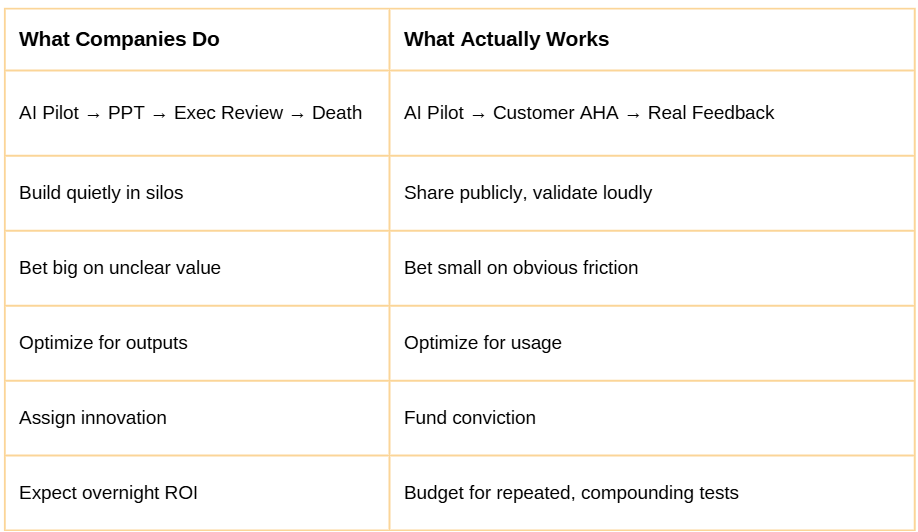
Final Analysis: What Mid-Sized Companies Get Wrong About AI & Innovation
Here’s the brutal truth:
Apple stopped innovating the moment it became allergic to risk.
You don’t have to follow them.
You’re not too big to move fast.
You’re just too scared to waste time. But as this indie hacker showed us … “wasted” time is how you buy speed and insight for the next round.
If you're a founder, exec, or operator at a $10M–$100M company trying to build something real (not just AI theatre), forward this post to your team. Or hit reply. I’ll show you how to actually do it.
Stay sharp,
— Houman Asefi
Full Stack Capitalist