
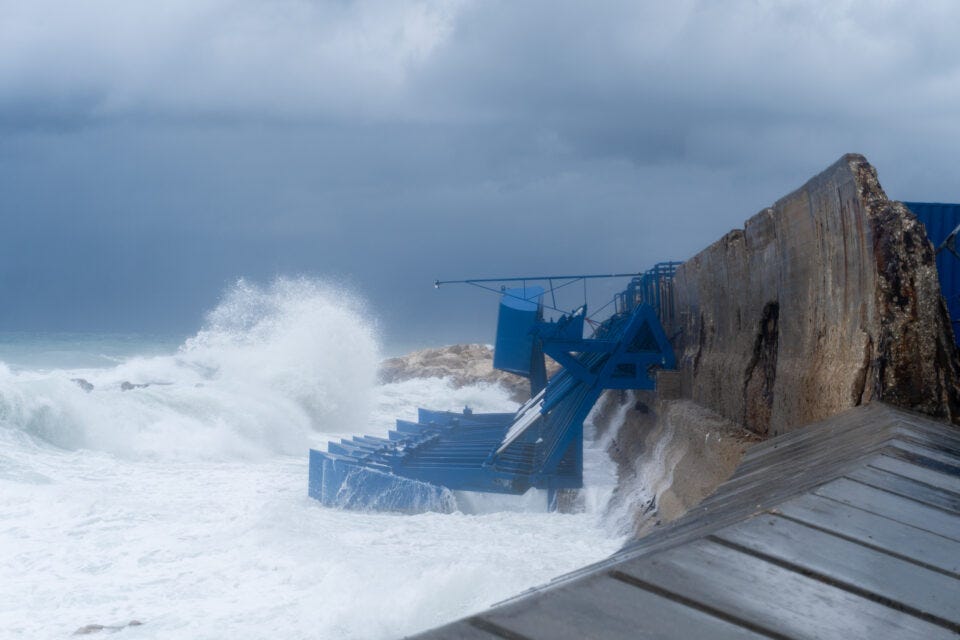
The headline version goes like this: scrappy Tel Aviv startup, founded by a woman who survived Chernobyl as an infant, straps floaters to breakwaters, turns ocean swells into electricity, gets a shoutout from Jensen Huang at two GTC keynotes in three months. Charming. Instagrammable. Filed under “renewable energy human interest.”
The story is that NVIDIA just told you, in public, at its own keynote, what it thinks the actual constraint on its business is. And it isn’t chips.
The tell is where NVIDIA is spending its narrative capital
Jensen Huang doesn’t put things on a GTC main stage because they’re nice. He puts them there because they’re load-bearing to the thesis he’s selling investors. Eco Wave Power showed up at San Jose in March 2026 and again at Taipei in June, the same keynote circuit that usually showcases Blackwell architecture, sovereign AI deals, and robotics platforms. A pre-revenue wave energy company with a $8.98 stock price and a Wall Street “sell” rating got stage time twice in ninety days. That’s not charity. That’s NVIDIA signaling that the compute buildout has hit a wall that GPUs alone can’t solve, and it’s actively recruiting anyone who can move that wall.
This is the pattern I keep hammering on this Substack: every time a hyperscaler or a chip company makes a move that looks like it’s about something else, a partnership, a geography, an “innovation showcase”, the story is almost always about who controls the scarce input underneath. In 2024 and 2025, that scarce input was accelerator supply. In 2026, it’s power.
How the mechanism actually works, and why it’s clever
Eco Wave Power’s technology is deliberately unglamorous. Floaters attach to existing coastal structures, breakwaters, seawalls, port infrastructure already built and permitted, and convert wave motion into hydraulic pressure. Critically, the hydraulic conversion equipment stays onshore, not out in the water where storms have destroyed every previous generation of wave-power hardware. That’s the engineering unlock: it sidesteps the failure mode that killed wave energy as an asset class for two decades.
The AI layer sits on top of that hardware in two distinct jobs, and the distinction matters more than it looks. First, NVIDIA Omniverse builds digital twins of the floating infrastructure and wave conditions, letting Eco Wave simulate deployment scenarios before anyone pours concrete, this is design-time optimization, cutting capital risk before it’s spent. Second, once systems are live, NVIDIA’s accelerated computing runs predictive maintenance, anomaly detection, and environmental forecasting in real time, with models continuously reading ocean conditions and equipment performance to squeeze out efficiency and catch failures early.
Then there’s the piece that should actually make you sit up: at the Port of Los Angeles, in partnership with AltaSea and Shell, there’s a pilot testing whether a data center can run entirely on wave power, with AI software scheduling compute workloads based on forecasted wave strength. That’s not “green energy for a data center.” That’s compute becoming a variable that bends to match energy supply, instead of energy supply being forced to scale up to match compute demand. That inversion is the whole ballgame, and I’ll come back to it.
Question one: what happens to the supply chain
How will the integration of AI in energy production alter existing supply chain dynamics in the energy sector? It flattens the distance between “site selection” and “compute deployment.” Historically, an energy project got built, then someone decided what to do with the power years later. Here, NVIDIA sees a coastal facility and immediately asks whether it can host a data center on the same footprint. The supply chain compresses from a multi-actor, multi-year sequence, utility, grid operator, industrial tenant, into a vertically bundled play where the energy generator, the compute host, and the optimization software could plausibly be the same commercial relationship. Eco Wave’s existing projects at Jaffa Port with EDF Power Solutions and the Israeli Energy Ministry, and at the Port of Los Angeles with AltaSea and Shell, are effectively pre-negotiating that bundle before anyone calls it a data center project.
Question two: what regulation actually needs to change
What specific regulatory changes are needed to support the growth of AI-driven renewable energy solutions? The honest answer is permitting speed, not permitting existence. Wave energy using existing marine infrastructure sidesteps the worst of siting fights, no new coastline construction, no new environmental review of virgin seabed. What it still needs is fast-tracked interconnection agreements that let co-located compute draw power directly rather than round-tripping through grid queues that in some U.S. regions now run four to six years. Government pillar readers should note: the countries and states that write a specific interconnection carve-out for co-located, behind-the-meter AI compute will pull projects like this toward them. The ones that force every megawatt through the standard queue will watch this capital go to Taiwan, Portugal, and Israel instead.
Question three: what happens to consumer energy prices
In what ways could the shift toward AI-enhanced energy systems impact energy prices for consumers? In the near term, minimally, because these are additive generation projects sited to serve new industrial load rather than displace existing residential supply. The 404.7 MW global pipeline Eco Wave has across Israel, the U.S., Portugal, Taiwan, and India is small relative to hyperscale demand, but it’s structurally significant: it’s demand that shows up already matched to its own dedicated supply, rather than demand that competes with households on the existing grid. The risk case is the opposite one, if AI-adjacent generation projects get priority interconnection and residential upgrades get pushed to the back of the queue, you get a two-speed grid where AI compute gets first access to new capacity and consumers absorb the deferred maintenance costs on the old one.
Question four: the second-order consequences nobody’s pricing in
What are the second-order economic consequences of increased energy demand driven by AI technologies on global energy markets? The one worth sitting with is that “renewable energy” stops being a policy category and becomes a compute-siting variable. Once AI workloads can be scheduled around generation forecasts, the way the Port of LA pilot schedules compute around predicted wave strength, intermittent renewables stop being a liability that requires baseload backup and start being an asset that shapes when and where certain classes of compute run. That’s a genuine reversal of the last fifteen years of energy-market logic, where intermittency was always the renewable sector’s excuse for needing subsidy. Agentic and batch AI workloads, unlike real-time consumer services, don’t care exactly when they run. That indifference is what makes wave, solar, and wind investable at data-center scale in a way they weren’t for grid baseload.
Question five: who gains power, who loses it
Who stands to gain power in the energy sector as AI technologies become more prevalent, and who might lose influence? Gainers: companies that own permitted, already-built coastal or industrial real estate with power-generation optionality, ports, in particular, since AltaSea’s involvement at LA and EDF’s at Jaffa show ports are becoming AI infrastructure real estate, not just shipping infrastructure. Also gainers: energy majors like Shell that get to re-enter the AI story not as fuel suppliers but as infrastructure co-developers, buying relevance in a sector that was starting to write them out of the narrative. Losers: traditional utilities whose business model depends on being the sole intermediary between generation and industrial consumption. If a data center can be sited to draw power directly from a co-located wave farm, the utility’s toll-booth position erodes.
Question six: resilience during crises
How might reliance on AI for energy optimization affect the resilience of energy infrastructure during crises? Two-sided, and this is a genuine expert disagreement zone rather than a settled question. The optimistic case: AI-run predictive maintenance catches equipment failures before they cascade, and workload-shifting software that already schedules compute around wave forecasts can just as easily shed load during a grid emergency, acting as a shock absorber. The pessimistic case: you’ve now made critical infrastructure dependent on software and connectivity that can itself fail or be attacked, and a system optimized tightly for efficiency under normal conditions often has less slack to absorb an actual crisis. I don’t think this resolves cleanly either way yet, and anyone who tells you it does is selling something.
Question seven: energy equity
What are the implications of AI-driven energy solutions for energy equity and access in underserved communities? The uncomfortable version: none of this is being built with underserved-community access as the design goal, it’s being built to serve AI infrastructure demand, and any spillover benefit to nearby communities is incidental. The more useful framing for operators reading this: coastal and port-adjacent communities that have historically been left out of inland grid buildouts could genuinely benefit if wave-power projects are structured with local offtake agreements alongside the industrial ones. That requires someone to demand it in the deal structure. Nobody’s demanding it yet.
Question eight: how incumbents adapt
How can traditional energy companies adapt to the emergence of AI-driven competitors in the renewable space? Do what Shell did: stop competing with the AI-native energy plays and become the balance-sheet and permitting partner instead. Shell doesn’t need to build wave-power IP to capture value from wave power, it needs to be inside the deal structure of every project that gets built, contributing capital, project-development expertise, and offtake relationships in exchange for equity or long-term supply positions. Energy majors that try to out-innovate startups on the technology will lose. Energy majors that position themselves as indispensable infrastructure partners will compound.
Question nine: data privacy inside energy systems
What role will data privacy and security play in the deployment of AI technologies in energy production? Underrated risk. These systems are continuously ingesting operational telemetry, equipment performance, generation forecasts, and if the compute-scheduling model matures, workload data from whatever data center is drawing the power. That’s a genuinely novel attack surface: energy-generation control systems that are now data-linked to compute-scheduling systems that are data-linked to whatever workloads are running. Historically, energy-sector cybersecurity and data-center cybersecurity have been separate disciplines with separate regulatory regimes. This architecture merges them, and I’d bet the security standards haven’t caught up to the integration yet.
Question ten: geopolitics
How will the convergence of AI and energy impact global geopolitical dynamics, particularly in energy-rich regions? This is the one that should worry policymakers most, and it’s the one Eco Wave’s own expansion pattern is already answering. The company isn’t just building in Israel and the U.S., it’s building in Taiwan, and it put Taiwan front and center at a GTC keynote specifically framed around AI infrastructure demand. Taiwan already sits at the center of the semiconductor supply chain; adding energy-infrastructure relevance to that concentration makes Taiwan’s strategic weight compound rather than diversify. Meanwhile, energy-rich but chip-poor regions — parts of the Gulf, parts of Africa — face a choice: stay commodity power exporters, or use next-generation, quickly permittable generation like this to become AI-compute hosts in their own right. Small nations with the right coastline and the right regulatory speed can leapfrog into AI relevance without ever building a fab. That is a genuinely new geopolitical lever, and almost nobody with a policy portfolio is thinking about it yet.
The mental model underneath all ten answers
Every one of those questions resolves the same way if you hold the master thesis: energy, not chip supply, not model quality, is the binding constraint on AI competition, and control over energy siting is quietly becoming the most valuable real estate on the planet. Eco Wave Power’s market cap doesn’t reflect that yet, the stock trades under nine dollars with a “sell” rating from Wall Street analysts who are still pricing it as a wave-energy company. NVIDIA is pricing it as an option on solving its own existential bottleneck. One of those two valuations is wrong, and it isn’t NVIDIA’s.
The “AI as a catalyst for energy demand” model and the “decentralization of energy production” model aren’t competing theories, they’re the same mechanism seen from two sides. AI demand is what makes decentralized, previously uneconomic generation like wave power suddenly investable at scale, because compute is the first major industrial load in a generation that’s actually willing to schedule itself around when the power shows up.
What this means depending on your seat
Founders: if you’re building anything adjacent to power generation, siting, or grid-edge software, stop pitching it as clean energy and start pitching it as AI infrastructure. That’s not spin, it’s accurately describing where the capital and the strategic partnerships actually are.
Operators: if your company runs any meaningfully large compute footprint, workload-scheduling flexibility is about to become a genuine cost lever, not just a sustainability talking point. The companies that build the internal muscle to shift batch and training workloads around power availability now will have real cost advantages when power scarcity bites harder over the next two to three years.
Investors: don’t value these deals on current revenue. Value them on optionality against the power bottleneck. A company like Eco Wave with an under-nine-dollar share price and a sell rating, sitting on a 404.7 MW pipeline and two Jensen Huang keynote appearances, is either wildly mispriced or a cautionary tale about how much narrative NVIDIA can generate for a partner without underwriting its balance sheet. Figure out which before you write the check.
Governments: the country that writes fast interconnection rules for co-located, behind-the-meter renewable-plus-compute projects is the country that gets the next wave of AI infrastructure investment, no pun intended. The country that doesn’t will keep watching this capital land in Tel Aviv, Lisbon, and Taipei instead.