
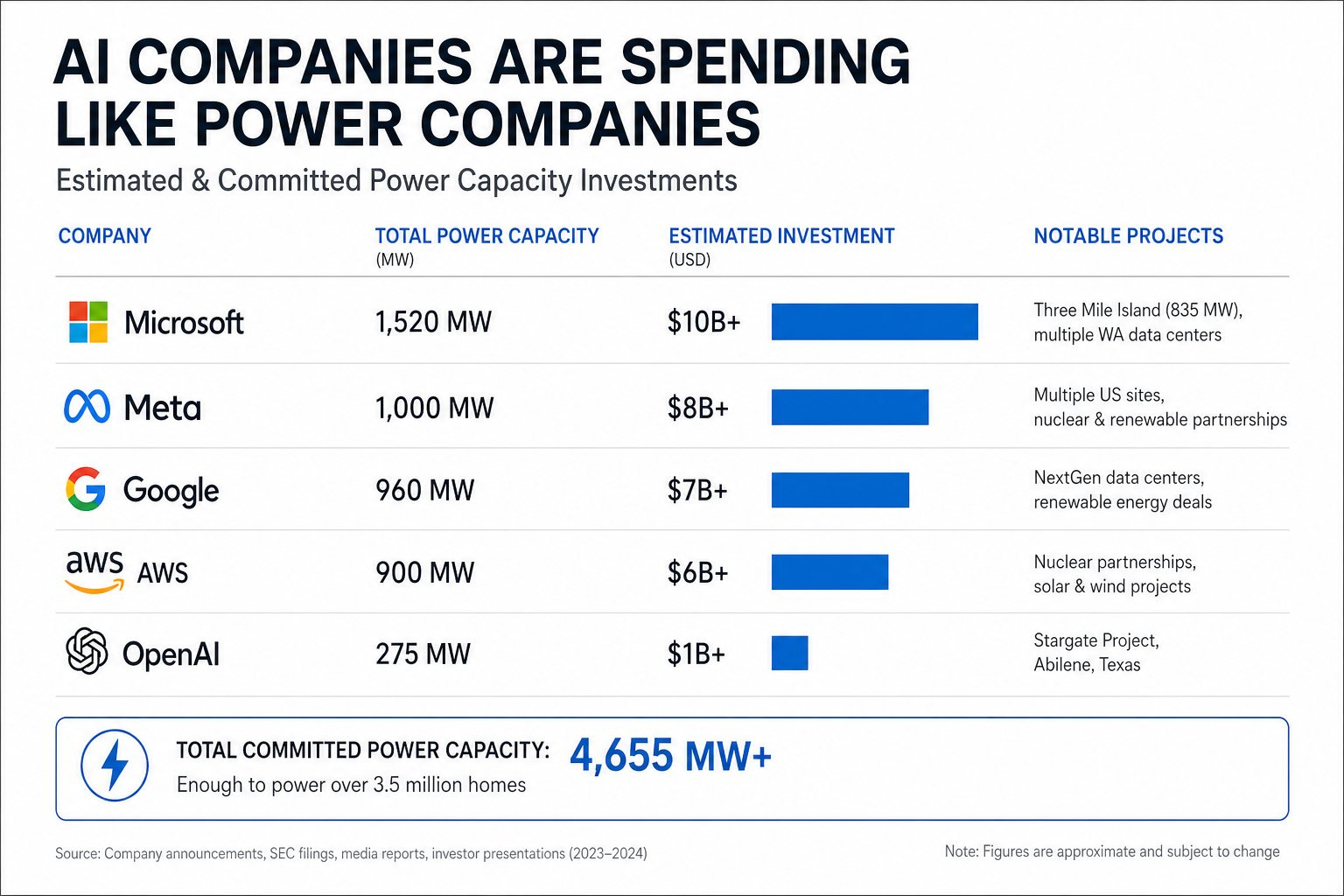
Here’s something no one talks about at TechCrunch but everyone in energy and infrastructure whispers about in private: the company winning the AI optimizing for megawatts deployed per quarter.
Not for DAU or unit economics.
And once you see it, you can’t unsee it.
The Metric Nobody’s Tracking
Go back 18 months. Every AI startup was measuring success the same way: API calls per month, cost per token, user growth curves. Very SaaS. Very startup. Very wrong.
Then Meta started spending like they were building a nuclear plant.
We’re talking $60 billion in capex in 2024. Their CEO started talking about power infrastructure like he was running Tennessee Valley Authority. Suddenly, the CFO deck wasn’t about LLM performance or benchmark scores, it was about how many new data centers came online, how much compute they secured for the next three years, and whether they could negotiate better power rates than their competitors.
OpenAI started the same move. Microsoft followed. Google’s playing the same game.
The narrative got flipped, and nobody noticed.
Still talking about “innovation” and “better models.”? The actual game? Whoever deploys the most compute most efficiently wins. Full stop.
Why Energy Becomes the Constraint
Think about it logically.
Models don’t really differentiate anymore. Seriously. The top 5 AI companies have access to the same papers, the same talent pools, the same training methodologies. The gap between Claude and GPT-5 and Gemini isn’t some secret sauce, it’s just compute. Bigger model. More training data. More iterations.
But here’s the thing: everyone knows that. So the competitive moat shifts.
It shifts to: Can I afford to train and run the biggest models?
And that is a hardware + energy problem, not a software problem.
Training a state-of-the-art LLM costs roughly $100-300 million. But that’s just one training run. You want to stay competitive? You need to train multiple versions, constantly iterate, handle inference at scale. We’re talking billions in annual compute spend.
Where does that come from? Capital. And what’s capital bought by? Access to electricity at scale.
The company that can negotiate the cheapest power rate wins. The company that builds its data centers closest to hydroelectric power wins. The company that secures long-term energy contracts first wins.
This is not software competition. This is infrastructure competition.
The Math
Let’s ground this in numbers, because abstractions feel nice but reality is sharper.
A modern GPU-intensive data center running an LLM inference at scale consumes roughly 5-10 MW of power continuously. If you want to run competitive inference for millions of users simultaneously, you’re looking at hundreds of megawatts. Thousands if you want true global scale.
A single 100 MW data center costs $500 million to $1 billion to build. Add power procurement, cooling, networking, and you’re easily at $1.5 billion.
Do that five times over, because you need geographic redundancy, you need to handle growth, you need to experiment with different architectures, and you’re at $7-10 billion in infrastructure capex. Per year.
For OpenAI, Anthropic, Google, Meta, that number is real. It’s now. It’s not speculative future infrastructure. It’s today’s cost of staying in the game.
Now ask yourself: what startup has $10 billion to spend annually on infrastructure?
None. Not one.
This is why the AI game consolidated so fast. This is why every new AI startup that raised $500 million got bought by a hyperscaler within three years. They couldn’t compete on infrastructure. They couldn’t out-bid the incumbents on power rates. They couldn’t secure the compute resources to train competitive models.
Margins Live in Megawatts, Not UX
Here’s where the economics get weird for traditional software founders.
In SaaS, your margin story is usually: build better UX, charge premium pricing, high gross margin.
In AI infrastructure, your margin story is: use less power than your competitor to deliver the same output.
This is why Meta is dumping tens of billions into custom silicon. They’re not doing it for fun. They’re doing it because a Meta-designed chip might run 10-20% more efficiently than buying GPUs off the shelf. That 10-20% efficiency gain, at billion-scale inference operations, translates to hundreds of millions of dollars in annual power savings.
That’s where you make money.
And once you’re optimizing for power efficiency, everything changes. Your algorithm design changes, you pick algorithms that are less compute-intensive, not necessarily most accurate. Your infrastructure changes, you move to regions with cheaper power, not regions with the best talent. Your go-to-market changes, you sell compute access, bundled with LLMs, not AI software.
You start to look like a power company.
Because you are a power company.
Why This Matters for Who Wins
The winner in AI will be the company that can:
Deploy the most megawatts most cheaply
Negotiate the best long-term power contracts
Build the most efficient compute-per-watt infrastructure
Own or control energy generation (solar, geothermal, nuclear, doesn’t matter)
Scale inference globally without hitting power supply bottlenecks
This is why Microsoft, Google, Meta, and Amazon are winning. Not because they’re better at AI. But because they’re better at power procurement, data center engineering, and energy negotiations.
It’s also why OpenAI will eventually be absorbed into a hyperscaler, or build its own megawatt capacity, or die. It has no moat on energy. It has no leverage on power rates. It can be undercut by anyone who can source electricity cheaper.
Anthropic faces the same problem. So does any independent AI company.
The only defense is to:
Build something so uniquely valuable that customers pay 50%+ premium to run it instead of a competitor (unlikely long-term)
Own energy sources directly (you become a utility yourself)
Get acquired by someone with energy leverage (probable)
What Does the Winner Look Like?
The dominant AI company of 2030 will look nothing like a startup.
It’ll look like this:
Massive balance sheet to fund $10+ billion annual capex
Direct power generation partnerships (solar farms, nuclear plants, geothermal contracts)
Vertically integrated chip design to squeeze out efficiency gains
Global data center footprint optimized for power costs, not latency
Subscription/utility pricing model for LLM access (not per-token, but per-compute-hour or monthly allocation)
Gross margins that compress over time because competition drives down the cost of compute
Sound familiar?
That’s not a tech company. That’s a utility. That’s what FDR would recognize. That’s infrastructure.
And meta-point: utilities are boring, stable, regulatory-heavy, and profitable if you have scale. They’re not 10x return ventures. They’re 2-3x return infrastructure plays for patient capital.
This is what venture capitalists won’t tell you: the winner in AI will be boring. It’ll look like a power company, because that’s what it is.
The Crazy Part
Everyone’s still betting like this is a software race.
VCs are funding “AI companies” as if product differentiation or superior UX creates durable competitive advantage. It doesn’t. Not when the actual constraint is infrastructure and energy.
Founders are writing pitches about their model architecture or their product innovation. But they should be writing pitches about their power procurement strategy.
Meta sees it. That’s why their energy spend accelerated. That’s why their CEO talks like he’s building a power grid.
Microsoft sees it. That’s why they’re locking in deals with nuclear operators.
Google sees it. That’s why they’re buying up hydroelectric power rights.
The one-liner version: In AI, the company that wins the energy game wins the AI game.
Everything else is just marketing.