
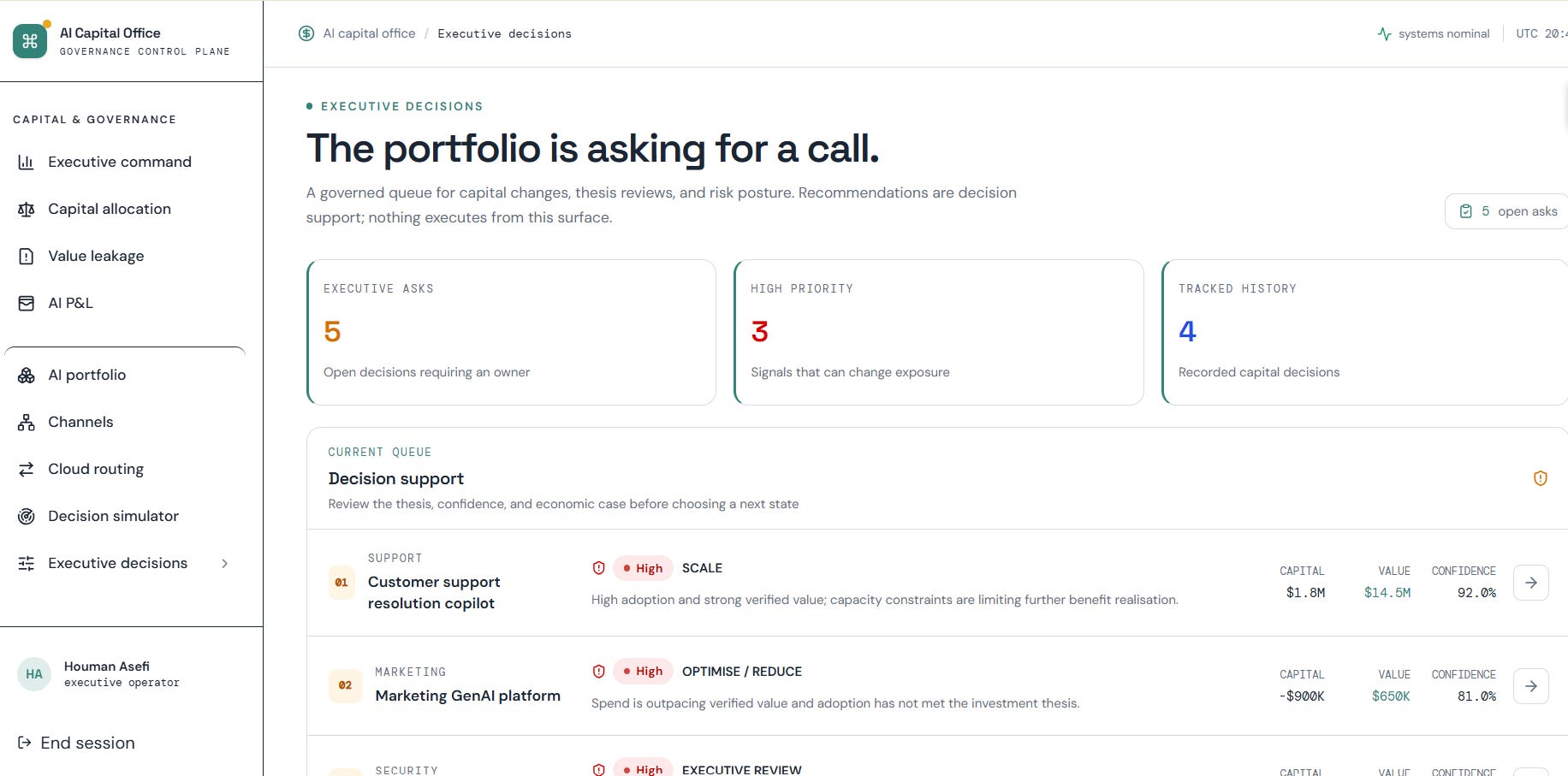
I recently demonstrated my AI capital allocation and governance prototype to the leadership team at a very large company.
The feedback was positive. But the question that stayed with me was about where the information would come from.
It was the right question.
I had built a way to look across an enterprise’s AI investments: where money was going, what value each initiative was producing, which investments deserved more funding, and which needed a harder review.
The demonstration used synthetic data. That made it possible to show how the decisions would work without pretending I had connected the company’s financial and operational systems.
But their question took us straight to the work that would make the system useful in a real organisation.
Someone has to find the spending. Someone has to establish what performance looked like before the AI initiative. Someone has to determine whether the claimed improvement actually happened, and whether it was worth what the business paid.
That is a full-time job.
It is a substantial part of the Director of AI role as I see it: making the organisation’s AI economics legible enough for management to act on.
The number on the screen is the end of a long process
A dashboard can display “verified value” in a clean box.
Getting to a defensible number is considerably messier.
Consider a customer service initiative. The team reports that its AI agent has reduced handling time. That sounds useful, and it may be. But before I would use that claim to justify additional capital, I would want to understand the baseline.
Was handling time already improving? Has the mix of customer enquiries changed? Are agents resolving cases faster, or passing more difficult cases to another team? Has the customer experience improved?
Then there is the question of what the saved time became.
Perhaps the business handled more volume without adding staff. Perhaps overtime fell. Perhaps employees had more capacity, but there was no corresponding change in output or cost.
Those are different outcomes. They should not all enter the investment review as the same dollar benefit.
The cost side needs the same care. A model invoice tells us something, but it does not tell us the full cost of operating the workflow. Integration, internal engineering, oversight and exception handling can all matter.
This is why the question from the leadership team was so useful. It exposed how much organisational work sits underneath a seemingly straightforward portfolio view.
The Director of AI has to connect the pieces
In the operating model I have in mind, the Director of AI coordinates that work.
Finance needs to help establish the costs and agree how benefits will be valued. Business owners need to explain what changed in the workflow. Technology teams need to account for the systems and infrastructure involved.
The Director of AI has to bring those views together and resolve the gaps between them.
A business unit may describe an initiative as a success because employees like it. Finance may see another recurring expense. The technology team may see a system that works well but requires more support than expected.
Each view can be accurate.
The difficult part is producing an account of the initiative that is complete enough to support a funding decision.
I would not expect one person to independently verify every benefit across a large enterprise. The role needs named owners in the business, access to financial information and a review process that people take seriously. Without that authority, the Director of AI risks becoming the person who chases updates and assembles slides.
That is a very different job from helping management allocate capital.
Every initiative needs a reason to remain funded
This is the thinking behind the investment thesis in my prototype.
At approval, an AI initiative should have a clear statement of the business problem, the expected outcome, the cost and the assumptions that make the investment worthwhile. There should also be a point at which management agrees to reconsider it.
Otherwise, the original pitch can survive long after the conditions behind it have changed.
An initiative might depend on employees using the system several times a day. Three months later, adoption is low. Another might rely on a particular level of accuracy, only to discover that human review consumes much of the expected saving.
Neither finding automatically means the initiative should be shut down. It does mean the original investment case needs attention.
The control plane is intended to make that review easier. It should connect the original expectation to the evidence now available, show what remains uncertain and put a decision in front of the right person.
Sometimes the answer will be to invest more. Sometimes it will be to fix the workflow. Sometimes the honest answer will be that there is not enough evidence yet.
And sometimes the capital should go elsewhere.
Better software can make weak evidence look convincing
One thing I am conscious of in building this is how easily precision can be mistaken for certainty.
A return multiple with two decimal places looks authoritative. So does a confidence score. Neither deserves trust merely because the interface presents it neatly.
I want the system to let an executive inspect what supports a number.
Which part is measured? Which part comes from an estimate by the business owner? What baseline was used? When was the evidence last reviewed?
A projected benefit should remain visibly different from a realised one. A simulation should remain a simulation.
That matters particularly when the software recommends reallocating capital. It can help management explore a decision, but responsibility for that decision still belongs to management.
The prototype makes those distinctions possible. A real deployment would have to earn them through the quality of its data and the discipline of its review process.
This is the part of enterprise AI I want to make visible
The demo gave me a useful way to explain the product. The leadership team’s question clarified what it would take to operate it.
Building the interface is one part of the work. Establishing a credible account of spending and outcomes requires cooperation across the enterprise, and it has to continue after the first report is produced.
That is where I see the connection to the broader question I write about in Full Stack Capitalist: who captures value when technology changes?
Inside an enterprise, that question becomes very practical. The company funds the tools and absorbs the implementation costs. Whether it captures the benefit depends on what changes in the business, and whether anyone can establish that the change occurred.
I want to build systems that help leadership follow that process all the way through.
The most useful screen in an AI investment review may be the one that lets someone challenge the number, find its source and decide whether it is strong enough to fund the next dollar.