
Here’s the question people keep asking: whose model is going to win?
Wrong question.
It’s the question a normal tech reporter asks, and it’s the question that keeps you staring at leaderboards instead of at the thing that actually matters.
The model layer is not where this gets decided. Models converge. Every few months the gap between the top labs on any given benchmark shrinks to a rounding error, and the moment one lab ships something clever, the other three copy it within a quarter.
That’s a commodity racing to its natural price, which is close to zero.
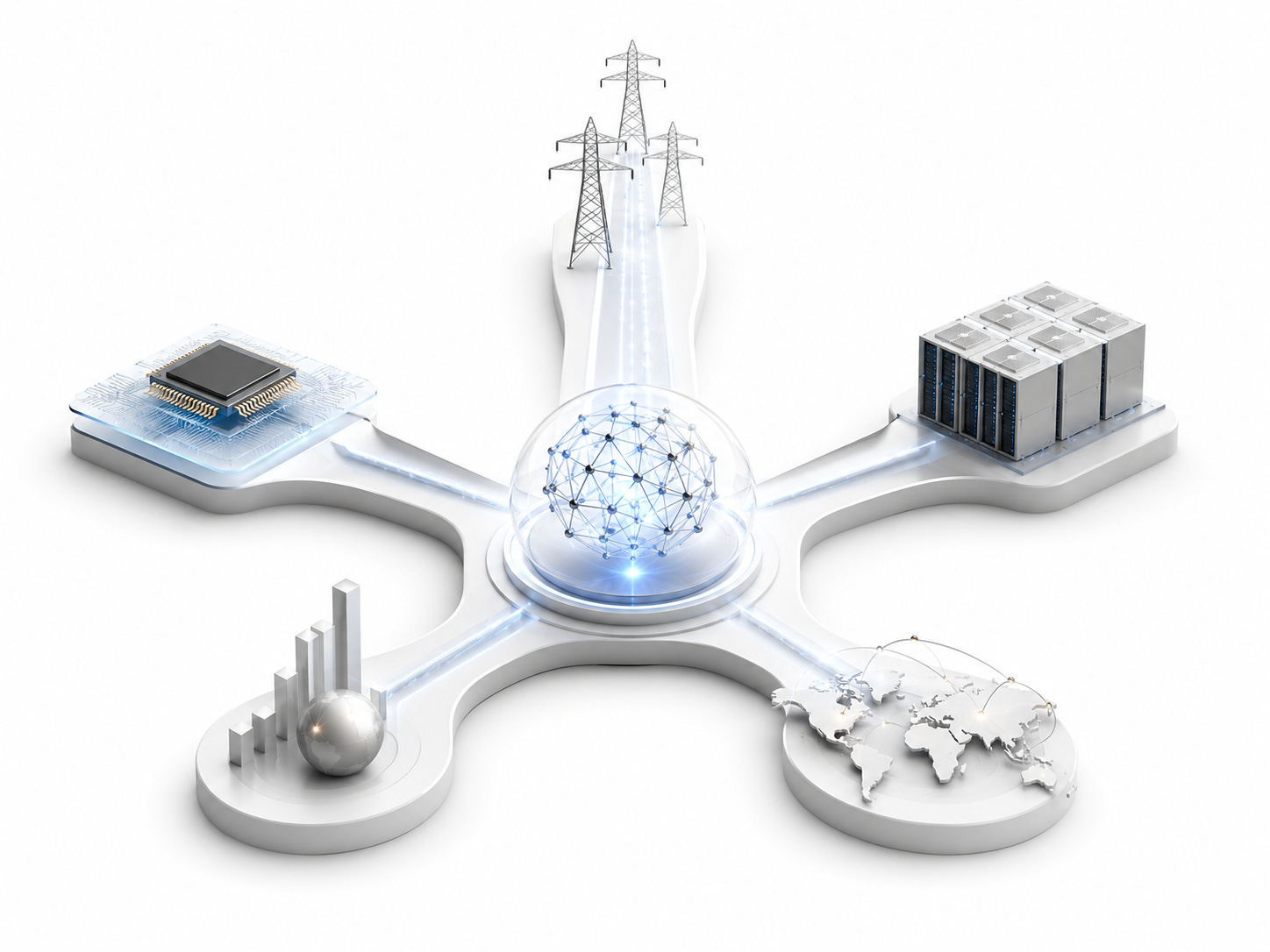
The AI race is being decided one layer down, in the physical and financial infrastructure that has to exist before any model can be trained or served to a single user.
And that infrastructure runs through five chokepoints: power, chips, data centers, capital, and distribution.
Whoever sits at each chokepoint gets to charge on everyone downstream. That’s the whole game. Not who’s smartest. Who’s scarce.
Let me walk you through each one the way I’d explain it over a beer (or coffee!), because once you see the pattern you can’t unsee it, and it changes how you read every AI headline from here on out.
Chokepoint one: power
Two years ago the constraint on AI was GPUs. You couldn’t get them.
Now you can, or close to it, and the constraint has moved to something much more boring and much harder to fix: electricity.
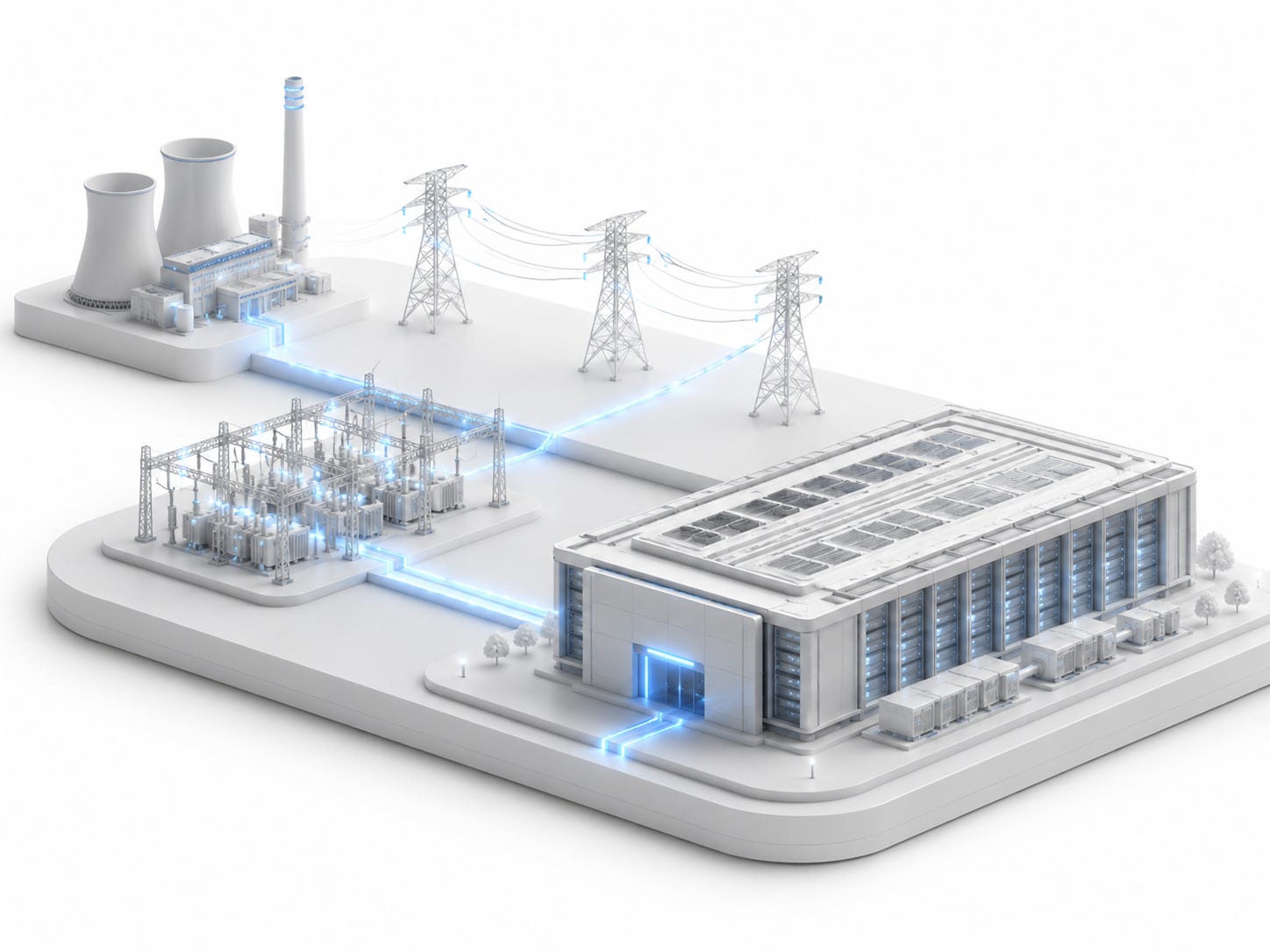
A single AI data center site is now asking regional grids for 100 to 750 megawatts of power, and those grids were never built for loads like that. Gartner is projecting that 40 percent of AI data centers will be power-constrained within the next year. Global data center electricity use is on pace to roughly double by 2030, and some projections have data centers alone consuming as much power in 2026 as the entire country of Japan.
This is why Jensen Huang stood on stage at GTC 2026 and reframed Nvidia’s whole business with a formula: revenue equals tokens per watt times available gigawatts.
Read that twice. He’s telling you, in public, that the ceiling on AI revenue isn’t chip supply anymore.
It’s megawatts.
That’s a stunning admission from the guy who runs the chip company. And it’s why you’re now watching Microsoft commit $15 billion to a UAE buildout, Meta drop $10 billion on a Louisiana campus, and every hyperscaler sign direct power purchase agreements instead of waiting in line for the grid like everybody else.
Whoever can conjure electricity out of the ground faster than their competitor gets to build faster, train faster, and serve more customers. Everyone else waits in an interconnection queue that can run three years long.
Chokepoint two: chips
You already knew this one, but it’s shifted shape. Nvidia still owns somewhere between 75 and 90 percent of the AI accelerator market depending on whose number you trust, and it’s still the default answer to “who wins AI hardware.”
But the real chokepoint underneath Nvidia isn’t Nvidia.
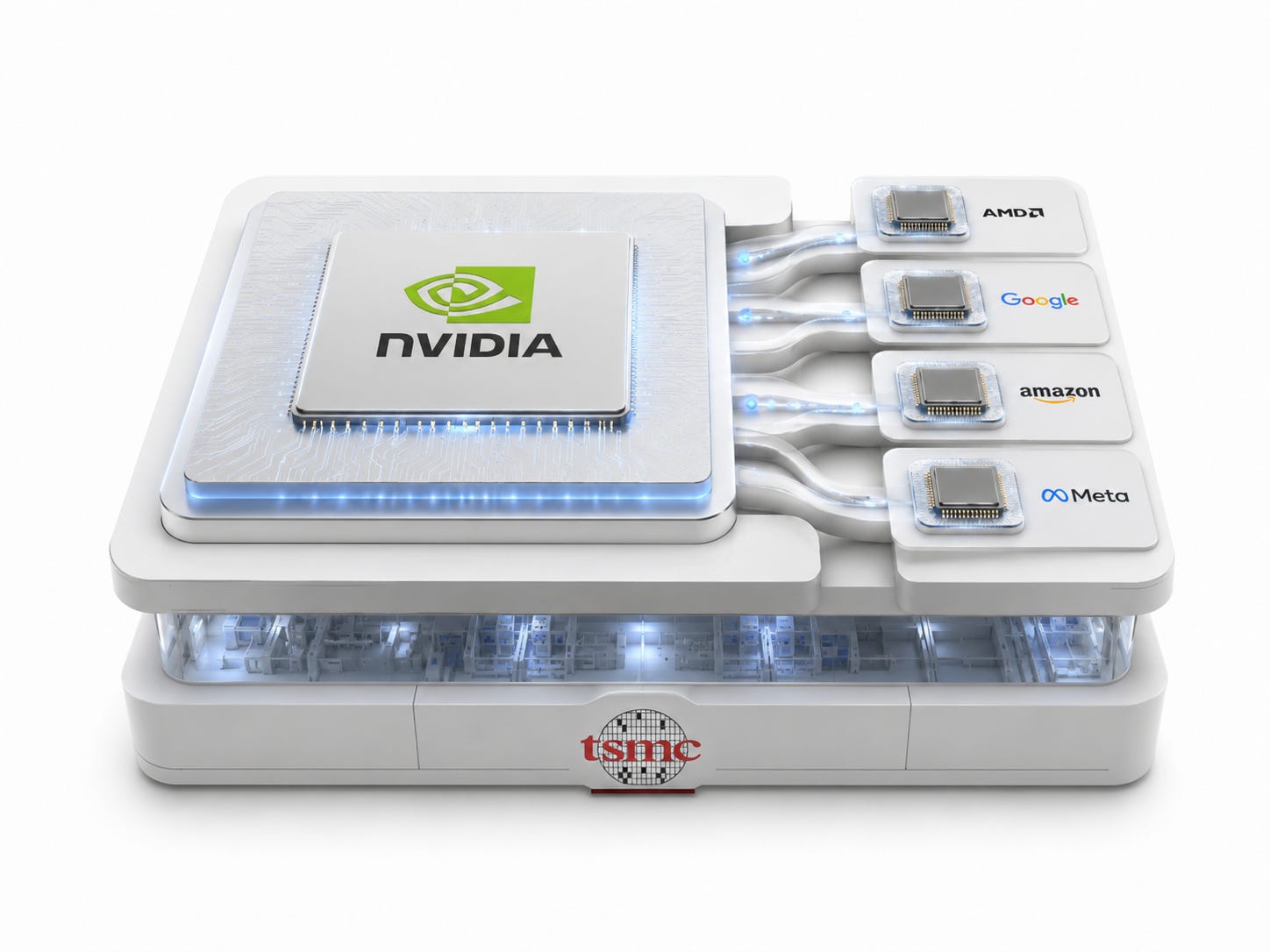
It’s TSMC, because TSMC is the only company on earth that can manufacture the advanced packaging, called CoWoS, that every serious AI chip needs.
Nvidia alone is expected to consume something like 595,000 CoWoS wafers in 2026, more than the entire industry used in 2024.
That’s a company that has locked up the scarce input the entire market depends on.
So the hierarchy looks like this: TSMC sits underneath everyone, Nvidia sits on top of TSMC’s packaging capacity, and everyone else, AMD, the custom silicon teams at Google and Amazon and Meta, is fighting over what’s left.
This is also where geopolitics stops being background noise. TSMC is in Taiwan.
Export controls already cut a $4.6 billion quarterly China revenue line out of Nvidia almost overnight. Whoever controls Taiwan’s fabs, or builds a credible alternative to them, controls the entire AI hardware stack.
Chokepoint three: data centers
This is where a new class of company has muscled into a game the hyperscalers used to have to themselves.
They’re called neoclouds, CoreWeave, Nebius, Lambda, Crusoe, and their entire pitch is: we can get you GPU capacity faster than Amazon, Microsoft, or Google can build it themselves.
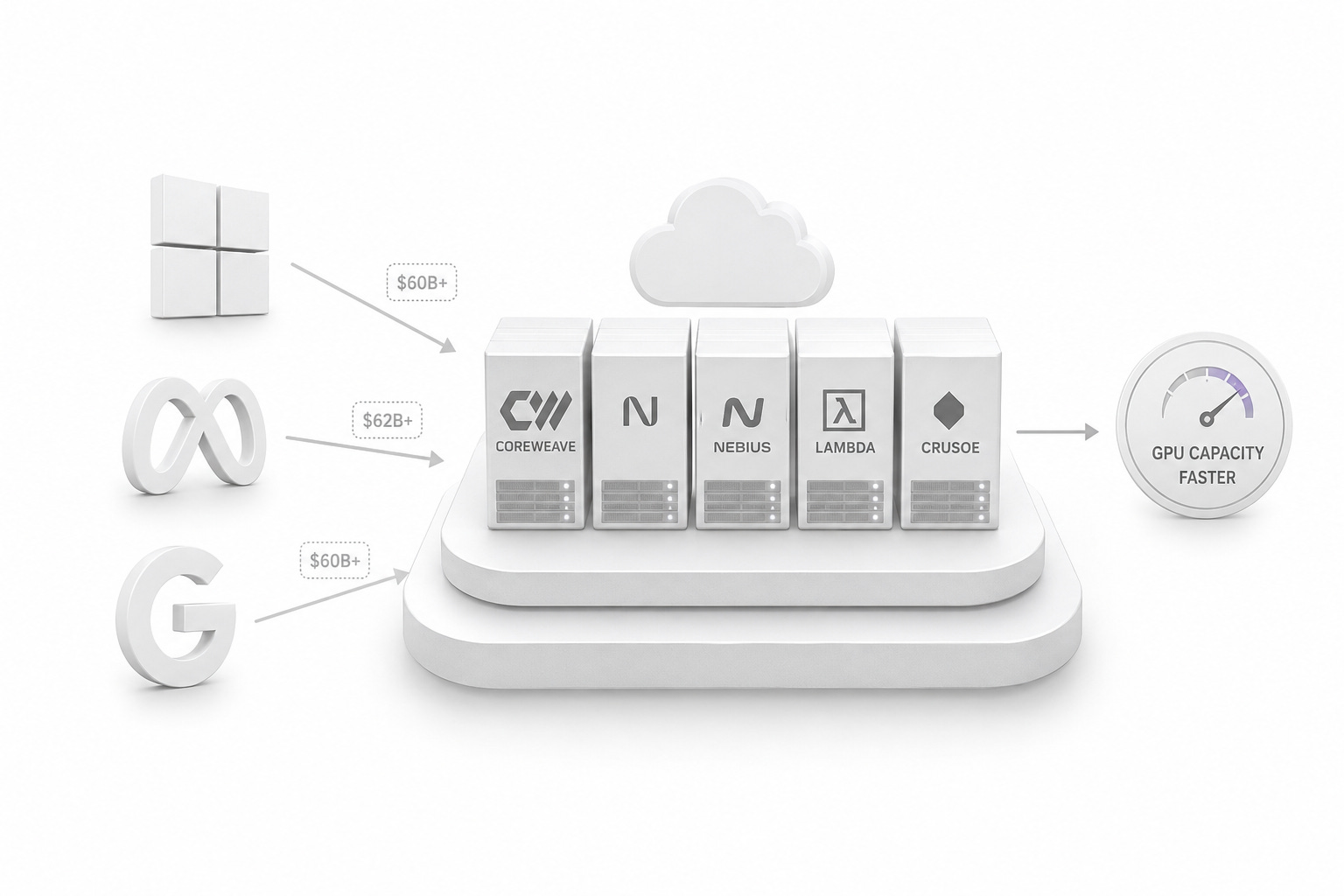
It’s worked. Microsoft has struck roughly $60 billion in commitments with CoreWeave, Nebius, and Nscale combined. Meta signed $35 billion with CoreWeave and up to $27 billion with Nebius.
The funny part is the hyperscalers are simultaneously the neoclouds’ biggest customers and their biggest long-term threat, because those contracts let hyperscalers book AI spend as an operating expense instead of piling more capex onto their own balance sheets.
But watch what just happened. When Meta signaled it might resell its own excess compute through something called Meta Compute, Nebius and CoreWeave stock dropped 15 percent in a single morning.
That’s the whole fragility of this layer in one data point. Neoclouds don’t own a chokepoint of their own. They’re renting scarce power and scarce chips and repackaging them faster than the giants can. That’s a real business, but it’s a business built on somebody else’s scarcity, which means it’s the most exposed layer of the five.
Chokepoint four: capital
Here’s the number that should stop you: the five biggest hyperscalers are on pace to spend over $600 billion on infrastructure in 2026 alone, roughly three quarters of it aimed straight at AI.
Multiply that out and Goldman Sachs is now talking about $5 trillion in hyperscaler AI and data center spending by 2030.
No company generates that kind of cash from operations. So they’re borrowing it.
Hyperscalers issued a record $428 billion in bonds in 2025, and estimates for total AI-related debt issuance over the next few years run as high as $1.5 trillion.
A lot of that debt isn’t even sitting on the hyperscaler’s own balance sheet. It’s structured through special purpose vehicles and leases, serviced by private credit funds and insurers, in arrangements the Bank for International Settlements is now openly calling “shadow borrowing.”
Translation: the AI buildout is being financed less like a tech company expanding and more like a utility building a power plant, except the debt is scattered across a web of private credit vehicles instead of sitting in one regulated place where anyone can see it clearly.
Whoever controls that capital, the infrastructure funds, the private credit shops, the sovereign wealth funds writing nine figure checks, has leverage over the entire buildout regardless of who’s got the best model.
Money is the chokepoint that makes the other four chokepoints possible.
Chokepoint five: distribution
This is the one people get most wrong, because they assume the best model wins the user.
It doesn’t.
Distribution wins the user. ChatGPT still leads on raw traffic, but its share of AI chatbot web visits has fallen from around 87 percent to roughly 53 percent in about eighteen months, not because the product got worse, but because Google started placing Gemini directly inside Search, Android, Chrome, and Workspace, tools billions of people already had open.
Gemini’s referral traffic grew 388 percent year over year. Google didn’t win users by being smarter. It won them by being everywhere already.
That’s the whole distribution chokepoint in one example.
Whoever owns the pipe the user is already standing in, the operating system, the search bar, the messaging app, gets AI usage for free. Everyone else has to buy it, one download at a time. It’s the same reason Grok is climbing off the back of X Premium bundling instead of model quality.
So who actually holds the leverage right now
Walking chokepoint by chokepoint, here’s how I’d rank who’s sitting pretty, who’s exposed, and who could flip the board.
On power, the utilities and grid operators in power-rich regions, think Texas, parts of the Gulf South, the UAE, hold real pricing power for the first time in decades, because they’re now the thing everyone is begging for access to.
Their vulnerability is regulatory and political, since ratepayer backlash over AI-driven price hikes is already showing up in state utility fights. The challengers here are the hyperscalers building their own dedicated generation, nuclear partnerships and on-site gas turbines, specifically to route around the utilities altogether.
On chips, TSMC has the strongest structural position of any company in this entire essay, full stop, because it is the sole supplier of the packaging every serious AI chip needs.
Its vulnerability is almost entirely geopolitical, sitting ninety miles from a country that claims it.
Nvidia sits just below TSMC, extraordinary pricing power, 80-plus percent margins on its top chips, but its vulnerability is customer concentration risk running the other direction, since Amazon, Google, Meta, and Microsoft are all racing to build custom silicon specifically to reduce their Nvidia dependence. AMD and Broadcom are the clearest challengers, AMD by building a real merchant alternative, Broadcom by co-designing the custom ASICs the hyperscalers are building to escape Nvidia in the first place.
On data centers, the hyperscalers, Amazon, Microsoft, Google, Meta, own the strongest position because they control both the balance sheet and the customer relationship. Oracle has carved out a genuinely strong niche as the value option for bare-metal AI clusters. The neoclouds, CoreWeave and Nebius foremost, have real revenue and real backlog, but the Meta Compute scare showed exactly how thin their moat is the moment a hyperscaler customer decides to become a hyperscaler competitor.
On capital, the infrastructure funds and private credit shops, the ones that have quietly grown into a $1.7 trillion asset class, hold more leverage than most people realize, because they’re now writing the checks that let hyperscalers keep spending without blowing up their own credit ratings.
Their vulnerability is that they’re underwriting demand assumptions nobody has stress tested against a slowdown. Sovereign capital, Gulf state funds especially, are the emerging challengers, trading capital for guaranteed access to compute their own economies don’t yet produce.
On distribution, Google holds the strongest hand of anyone in this whole list, not because Gemini is necessarily the best model, but because it’s about to be the default AI experience on both Android and, through the Apple deal, iPhone, covering north of 90 percent of the global smartphone market.
OpenAI’s vulnerability is the mirror image of Google’s strength, extraordinary product but no owned distribution layer underneath it, which is exactly why it keeps cutting platform deals instead of just growing organically. Anthropic’s position is the interesting anomaly, weak on consumer distribution but dominant on enterprise API spend, which tells you distribution isn’t one chokepoint, it’s actually two, consumer and enterprise, and right now different companies own each half.
The binding constraint, stated plainly
None of these five chokepoints is fixed. They rotate. Two years ago it was chips. Right now it’s power. Next year it might be capital, if debt markets start pricing AI infrastructure risk the way they’re starting to price everything else with concentrated counterparty exposure.
The skill that matters, whether you’re a founder, an operator, or an investor, isn’t picking the best model. It’s identifying which chokepoint is binding right now and positioning yourself as close to it as you can get.
For founders, that means asking a different question than “what can I build with AI.” Ask instead: which of these five layers am I renting from, and what happens to my margins if that layer gets more expensive next year.
For operators, it means treating your AI vendor contracts as infrastructure exposure, not software procurement, because you’re now several layers deep in someone else’s power and capital risk whether you priced it in or not.
For investors, it means the boring picks-and-shovels companies, the ones nobody’s writing hype pieces about, the transformer manufacturers, the grid interconnection specialists, the advanced packaging suppliers, are frequently the ones with the actual pricing power, because they get paid regardless of which model or which chatbot wins the popularity contest upstream.
And for anyone thinking about this at the policy level, the lesson is that national AI competitiveness is now an energy and manufacturing policy question wearing a technology costume. The countries that win aren’t the ones with the best AI labs. They’re the ones that can permit a gigawatt of new power generation in eighteen months instead of five years.
Full Stack Capitalist is not another newsletter about which AI model won this week.
I write about the infrastructure beneath AI: chips, energy, data centres, capital and geopolitical power.
Free subscribers receive the major essays.
Paid subscribers receive the deeper research: company rankings, infrastructure maps, investment implications and the systems determining who wins the AI economy.
The next paid report will rank the companies controlling the five critical chokepoints of AI and examine where their power is strongest, and where it could break.
Become a paid subscriber to receive the full report.