
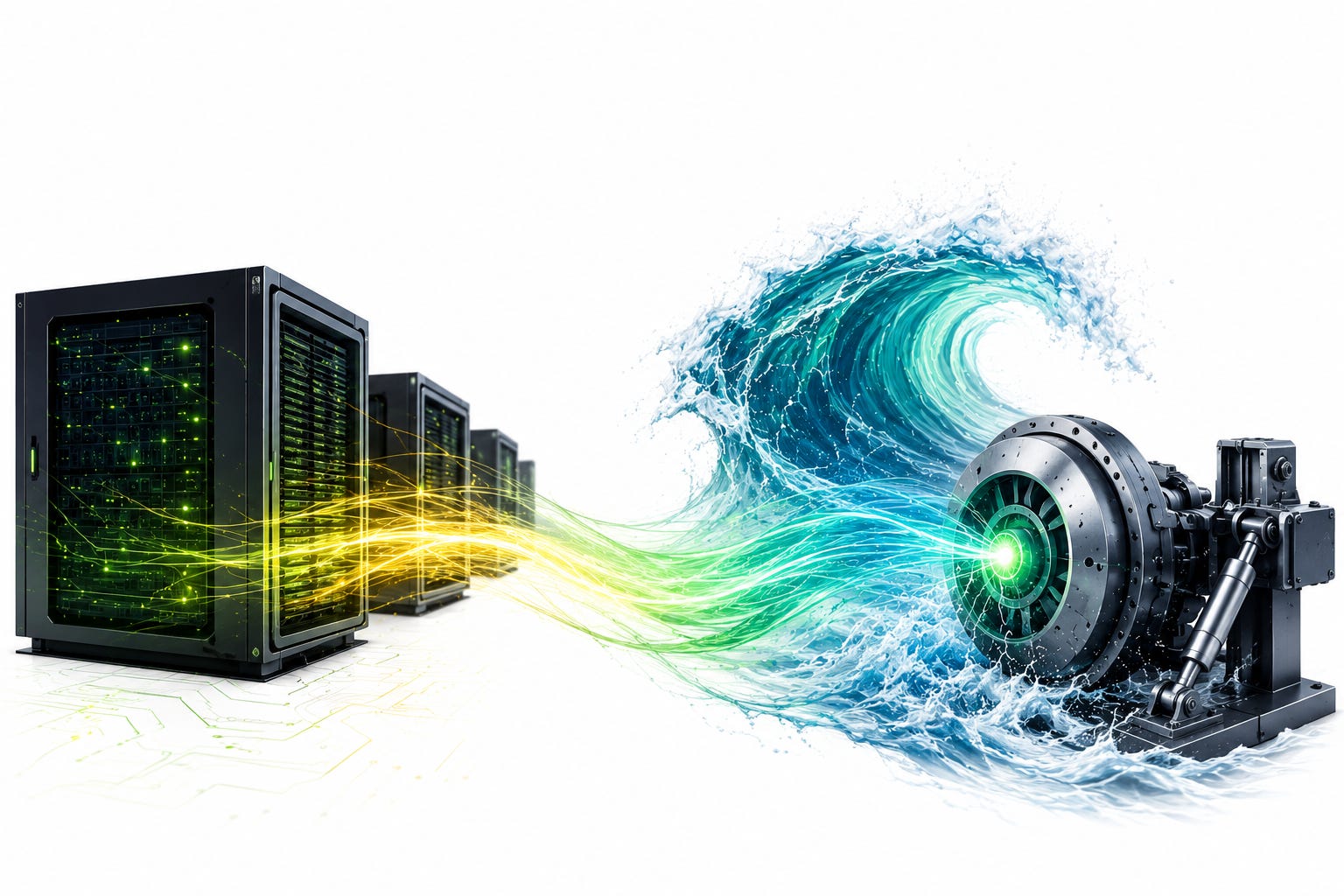
There’s a sentence buried in NVIDIA’s corporate blog that nobody in mainstream tech coverage is treating seriously enough. It reads: “The next era of AI will not be defined by compute alone. Its growth will be determined by energy.”
That’s Jensen Huang’s company announcing, in plain language, that the constraint has shifted. NVIDIA, a company whose entire identity is selling the world’s most powerful compute is telling you that compute is no longer the scarce variable. Energy is.
The occasion for that statement was a blog post about Eco Wave Power, a Tel Aviv-based startup that converts ocean wave motion into electricity. On the surface it reads like a feel-good climate story: scrappy renewable energy company partners with the world’s most powerful tech corporation, AI helps optimize wave floaters, oceans save the planet. That’s the narrative mainstream coverage reached for. It’s wrong, or at least it’s looking at the wrong thing.
What’s actually happening here is a structural signal about where rent gets captured in the AI economy. And once you see it, you can’t unsee it.
The Numbers Don’t Lie, and They’re Alarming
Let’s start with the constraint itself, because the scale of it is still not fully internalized by most operators and investors.
U.S. data centers consumed 183 terawatt-hours of electricity in 2024, more than 4% of the country’s total electricity consumption, roughly equivalent to Pakistan’s entire annual demand. By 2030, that figure is projected to grow by 133% to 426 TWh. Globally, data center electricity consumption reached 415 TWh in 2024 and the IEA projects it climbs to 945 TWh by 2030, roughly Japan’s entire annual consumption today. Brookings estimates it could approach 1,050 TWh by 2026 alone, which would make data centers, as a category, the fifth largest energy consumer in the world.
Anthropic has estimated that training a single frontier AI model will require five gigawatts of power by 2027. Former Google CEO Eric Schmidt testified before Congress that data centers will need 29 GW of additional power by 2027 and 67 GW more by 2030. The IEA’s data shows electricity consumption from AI-focused data centers climbed well ahead of overall data center growth in 2025, powered by a year where five large technology companies spent more than $400 billion in capital expenditure combined, a figure set to increase by a further 75% in 2026.
Here is the number that should stop you cold: by 2028, U.S. data centers’ total combined electricity demand is projected to nearly double, from 80 to 150 gigawatts. That’s like adding Spain’s entire energy infrastructure in three years. Spain. In three years.
Current permitting processes for new power plants and high-voltage transmission lines can take over a decade. The gap between what AI needs and what the grid can deliver is not a rounding error. It is the defining constraint of the next phase of the AI economy.
What Eco Wave Power Is Actually About
Against that backdrop, revisit what NVIDIA actually published about Eco Wave Power.
The company attaches floaters to existing coastal structures, breakwaters, seawalls, to capture wave energy. It keeps its hydraulic conversion equipment onshore, away from storm damage. Wave energy is less intermittent than solar: no night, no cloud coverage, no seasonal production collapse. The density of seawater is roughly 800 times the density of air, which means you can generate substantially more energy from a much smaller device than a wind turbine.
NVIDIA’s Omniverse platform builds digital twins of the wave infrastructure, simulating wave conditions and deployment scenarios before any physical construction begins. At the operational layer, NVIDIA’s accelerated computing enables predictive maintenance, anomaly detection, and environmental forecasting in real time. AI models analyze ocean conditions continuously and optimize energy generation patterns.
The critical detail is the pilot at the Port of Los Angeles, operating in collaboration with AltaSea and Shell. The goal is to run a data center entirely on wave power, without drawing from the existing grid. AI software schedules compute tasks based on forecasted wave strength, when stronger wave patterns are predicted, more intensive compute workloads are queued. The ocean becomes the power source; AI becomes the grid management layer.
This is an attempt to route around the most expensive bottleneck in AI infrastructure: grid connection wait times, transmission upgrade costs, permitting timelines, and the land acquisition required to expand conventional generation.
The Chokepoint Economics
To understand why this matters structurally, you have to trace where the rent is flowing.
The traditional model for large-scale computing is straightforward: hyperscalers buy land, negotiate utility contracts, build data centers, and pay whatever the regional electricity rate demands. They are price-takers in the energy market. Their capital expenditure on compute is enormous, but their energy costs are operationally variable and negotiated through existing utility infrastructure. The constraint was always on the silicon side.
That model breaks when energy supply becomes genuinely scarce. And scarcity in energy is different from scarcity in chips. NVIDIA can accelerate its production cadence. You cannot accelerate a decade-long transmission line permitting process.
The companies that recognized this earliest are now making moves that look bizarre from a conventional tech-sector lens but are perfectly rational once you accept the constraint. Microsoft, Alphabet, and Amazon have all announced nuclear power purchasing agreements. The pipeline of conditional offtake agreements between data center operators and small modular reactor projects grew from 25 gigawatts at the end of 2024 to 45 gigawatts by mid-2026. NTT Global Data Centers announced plans to double its global capacity to 4 GW in March 2026. The combined capital expenditure from five large tech companies in a single year now exceeds what the entire U.S. electric utility industry invests in generation, transmission, and distribution combined, by a factor of two.
What these companies are doing is vertically integrating backward into energy production. They are becoming energy companies that happen to run AI infrastructure. The rent capture logic is elementary: if the binding input is energy, and you control your energy supply, you own a structural cost advantage that compounds with every gigawatt of additional demand the market generates.
Eco Wave Power fits into this logic as a novel source structure. It uses existing coastal infrastructure, no land acquisition for generation equipment. It bypasses grid connection for direct-to-data-center delivery. The AI-driven scheduling layer means the computing workload adapts to energy availability rather than the other way around, which eliminates the reliability problem that has historically made intermittent renewables unattractive for always-on computing.
NVIDIA’s endorsement isn’t altruism. NVIDIA sells the AI infrastructure that energy-intensive data centers run. Solving the energy constraint is directly accretive to NVIDIA’s total addressable market. The Inception program gives NVIDIA early visibility into the companies building the next generation of energy-adjacent infrastructure. The digital twin technology deepens NVIDIA Omniverse’s penetration into physical infrastructure applications. This is a strategically coherent investment of platform capital.
The Geopolitics
Eco Wave Power is headquartered in Tel Aviv. Its projects include Jaffa Port in Israel, the Port of Los Angeles, Portugal’s Port of Leixões, Suao Port in Taiwan, and Mumbai with Bharat Petroleum. That geographic footprint is not random. It is coastal-adjacent to some of the highest-growth AI infrastructure markets in the world.
Taiwan is the center of gravity for global semiconductor production and increasingly for AI infrastructure investment. India is building out data center capacity at a rate that is straining regional grids in Mumbai, Chennai, and Hyderabad. Portugal sits on the Atlantic with access to European energy markets where grid capacity constraints and renewable energy mandates are reshaping capital flows.
The countries that will win the AI race aren’t necessarily those with the most compute. They’re the ones that solve the energy equation fastest. Singapore is constrained by geography. Northern Virginia is running out of grid capacity and residents are starting to organize politically against data center expansion, a January 2026 survey found nearly three-quarters of Virginia voters blame data centers for rising electricity costs. Areas with high concentrations of data centers have seen electricity prices jump 267% over five years in some markets. The political economy of grid-dependent AI infrastructure is becoming hostile.
Coastal nations with wave energy potential and permitting flexibility are sitting on underpriced strategic assets. That’s the geopolitical read hiding behind the clean energy press release.
What This Changes for Each of You
For founders and operators: the AI cost structure you’re planning around is going to shift faster than most models assume. If you’re building AI-native products that depend on inference at scale, your operational costs are increasingly a function of your infrastructure provider’s energy position, not just their chip generation. The hyperscalers are not all equal here. The ones with the most aggressive energy vertical integration will have structurally lower marginal inference costs in three to five years. That difference will show up in pricing power and margin compression for the competitors who remain grid-dependent.
For investors: the energy-AI convergence thesis is real but the obvious plays are already crowded. Nuclear SMR companies, grid infrastructure stocks, and the hyperscalers themselves have all seen the trade. The underpriced segment is the stack one layer below: the companies building AI-optimized energy systems — demand forecasting, workload scheduling, digital twin infrastructure for physical energy assets — that let data centers operate like intelligent grid participants rather than passive consumers. Eco Wave Power is small and pre-scale, but the category it represents is not.
For enterprise operators: the energy constraint is already showing up in your vendor relationships whether you’ve noticed it or not. Data center capacity in high-demand regions is getting harder to secure. Regional electricity rates in Northern Virginia are rising and will continue to rise as the political backlash to data center expansion matures. If your AI infrastructure is concentrated in a single grid region, that’s a risk you haven’t priced. Geographic diversification of compute, toward regions with surplus energy or emerging direct-generation capacity, is an operational hedge that most enterprise planning processes haven’t reached yet.
For governments and policymakers: the nations most likely to build durable AI competitiveness are not necessarily those throwing the most money at model development or chip production. They’re the ones that solve the energy authorization bottleneck. The U.S. currently faces a 49 GW generation shortfall by 2028. The countries that can compress permitting timelines, build coastal renewable infrastructure, and create policy frameworks that let AI companies source power directly rather than through decades-old utility structures will attract the capital and the talent. This is industrial policy, not climate policy, and it needs to be treated as such.
The Uncomfortable Conclusion
NVIDIA publishing a blog post about a wave energy startup is not a curiosity. It’s an announcement. The company that defined the compute era of AI is publicly investing its platform visibility in energy solutions, because the people running NVIDIA understand better than most that their next constraint is not silicon.
The AI economy has a power problem. Not in the metaphorical sense. In the literal sense of electrons, gigawatts, grid capacity, and transmission infrastructure. The companies that treat energy as a strategic asset, securing their own supply, integrating AI into energy management, building direct generation adjacent to compute, are going to have a structural advantage that is durable in a way that model capability is not. Models commoditize. Electrons don’t.
The tide, in the most literal sense, is turning. The question is who owns the shoreline.