
Nvidia designs the most sophisticated chips on Earth. Apple pays whatever it takes to skip the line. Qualcomm waits. Intel hoped. Samsung invested billions.
The entire tech industry obsesses over design; architecture, instruction sets, clock speeds. Investors value Nvidia at over $3 trillion. Stock analysts debate whether AMD or Nvidia will win.
Nobody talks about TSMC.
But if you care about who actually controls the AI economy, you’re looking at the wrong company.
The Visible Story Is a Distraction
The tech press tells you: Nvidia won because it’s the best designer.
The actual story is: TSMC won because it’s the only manufacturer.
Nvidia’s dominance is narrative dominance. TSMC’s dominance is structural.
There’s a difference.
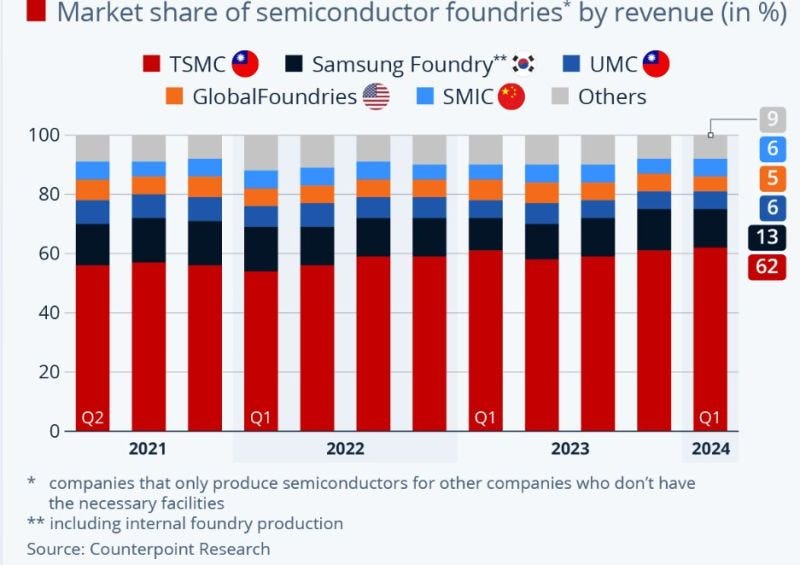
Nvidia can design all the incredible chips it wants. But Nvidia cannot manufacture them. It outsourced that decades ago. So Nvidia designs, then begs TSMC for capacity. It negotiates yield rates. It submits to TSMC’s process roadmap. It competes for wafer allocation with Apple, AMD, and every other fabless company on Earth.
TSMC, by contrast, owns the machine that turns all designs into reality.
When demand for AI chips exploded in 2023-2024, what happened?
Nvidia couldn’t deliver. Not because the design was wrong. Because TSMC couldn’t produce them fast enough.
Apple paid a premium to skip the queue.
Qualcomm got pushed back.
Intel, which does have its own fabs, failed to produce competitive chips anyway—proving that even owning your own manufacturing doesn’t help if you don’t own the best manufacturing.
If you understood the supply chain, you predicted this. If you only read about Nvidia’s design wins, you were confused.
Scarcity Creates Leverage. Leverage Creates Dominance.
Economics lesson: In any supply chain, whoever controls the bottleneck controls the market.
The AI chip industry has one bottleneck: advanced semiconductor fabrication. Specifically, cutting-edge process nodes (3nm, 5nm, 7nm).
TSMC controls ~92% of the market for advanced chips. Samsung has a small slice. Everyone else produces at older nodes or doesn’t produce at all.
This isn’t because TSMC’s designs are better; TSMC doesn’t design consumer chips. It’s because:
TSMC has the most advanced fabs. The machines that make 3nm chips cost $20 billion per factory. You need ASML’s EUV lithography tools (only ASML makes them, only Japan and Netherlands let you buy them). You need decades of process expertise. You need a supply chain of specialized vendors who also only work with TSMC.
Demand vastly exceeds supply. Every data center company, every smartphone maker, every AI accelerator designer wants chips made at TSMC. But TSMC’s capacity is fixed. You can’t just build a fab in six months. It takes 3-5 years and $15-20 billion.
TSMC can choose who gets what. When supply is scarce, the producer has pricing power. TSMC raises prices, and customers pay. TSMC allocates capacity, and customers wait or move up the queue if they pay premiums. Apple gets priority because Apple is Apple. Nvidia gets allocated portions. Qualcomm gets the leftovers. This is not decided by who designed the best chip. It’s decided by TSMC’s supply and demand math.
Long-term contracts lock in advantages. Companies with exclusive supply agreements (Apple’s Q-series chips, for example) reduce risk for both parties; but they also mean everyone else is fighting for scraps.
Nvidia’s $3 trillion valuation assumes it controls the AI chip market. But structurally, Nvidia controls design, not supply. TSMC controls supply. Supply is what constrains the market.
If TSMC decided to cut Nvidia’s allocation in half, Nvidia couldn’t do a thing. It would have to accept lower volumes, longer lead times, or watch competitors get priority. Nvidia would lose revenue. But TSMC wouldn’t; TSMC would fill that capacity with someone else’s chip.
That’s the definition of real power.
What This Means: The Distribution Layer Owns The Chain
Design is becoming commoditized. Manufacturing is the power.
Every major chip company; Nvidia, AMD, Intel, Qualcomm, Google (TPU), Amazon (Trainium), Meta (Artemis)…is now trying to design world-class chips. And they mostly succeed. The design problem is solved. You can hire brilliant chip architects. You can iterate on architecture. You can build better tensor cores.
But you still need TSMC to make your chips real.
This is why:
Intel is losing despite owning its own fabs. Intel designs decent chips but manufactures them in-house at Intel fabs. Those fabs are not as advanced as TSMC’s, so Intel chips are slower, more expensive, and less power-efficient. Intel could outsource to TSMC, but then it depends on TSMC’s generosity. Either way, Intel loses.
Apple is winning despite not owning fabs. Apple designs the most efficient consumer chips on Earth (M-series, A-series). Apple also pays TSMC premium prices to get priority access. Apple accepts dependency on TSMC because TSMC’s capacity is so much better than anyone else’s. The premium cost is worth it because Apple’s software-hardware co-optimization justifies the investment. Net result: Apple owns the smartphone market, not despite using TSMC but because TSMC lets Apple realize its designs at scale.
Nvidia is slowing despite best-in-class design. Nvidia can’t make chips faster than TSMC can produce them. So Nvidia throttles revenue on TSMC’s supply clock, not Nvidia’s design cycle. Nvidia can double engineering spend and release faster designs. Doesn’t matter. TSMC is the constraint.
Chinese chip companies are stuck. China has banned access to TSMC’s most advanced nodes (via US export controls). So Chinese companies must use older processes or build their own fabs. This is why China is investing $150+ billion in domestic semiconductor manufacturing—not because it’s efficient, but because it has no choice. Control of the manufacturing bottleneck is so important that China is willing to overspend massively to build alternative capacity.
The distribution layer; the physical, capital-intensive manufacturing infrastructure—owns the entire AI economy. Not the designers.
The Mechanism: Why Capacity Scarcity Translates to Market Control
Let’s make this concrete.
Imagine you’re running Qualcomm. You design a world-class AI inference chip. Better performance per watt than Nvidia’s. Better for smartphones.
You go to TSMC: “We need 500,000 wafers of 3nm in Q2.”
TSMC says: “We have 800,000 wafers of 3nm total allocation. Apple reserved 400,000. Nvidia gets 250,000. AMD gets 100,000. You get 50,000.”
Your design is better. Your use case is important. Doesn’t matter. TSMC’s wafer allocation is fixed. You get the scraps.
You have three choices:
Pay higher prices. TSMC quotes you $50,000 per wafer instead of $30,000. You accept because you have no choice.
Wait. TSMC says capacity opens up in Q4. You wait six months, lose first-mover advantage, and Apple already owns the market with its own inference chips.
Outsource to Samsung. Samsung can make your chips, but at an older process node, which means they’re slower and more power-hungry. Your competitive advantage evaporates.
In every scenario, TSMC wins. You lose.
This is not about fair competition or the best design. This is about scarcity. TSMC controls a scarce resource (advanced manufacturing capacity). You need that resource. You accept TSMC’s terms.
This is how real markets work.
The Implication: Control of Execution Beats Control of Intellectual Property
The traditional tech playbook was: Whoever designs best wins. IP > everything.
The new AI economy playbook is: Whoever controls execution wins. Supply > IP.
Consider:
Nvidia’s chip designs are now public knowledge (via reverse engineering, academic papers, leaks). Qualcomm, AMD, Intel can see exactly what Nvidia did. They can copy the architecture. But they still can’t beat Nvidia—because they can’t get TSMC wafers as fast.
Open-source AI models (LLaMA, Mistral, etc.) have architecture intelligence that’s basically free. But closed-source models (OpenAI’s GPT, Google’s Gemini) still win because they have access to compute. OpenAI doesn’t own the best algorithms. It owns capital, which translates to TSMC wafer access, which translates to training compute, which translates to model advantage.
China can design chips as well as anyone. But US export controls cut China off from TSMC’s advanced processes. Result: China is architecturally competitive but capacity-constrained. That constraint turns into economic and military disadvantage.
The distribution layer—not the design layer—shapes the market.
Who Should Be Scared (And Who Isn’t)
If you’re TSMC, you own the future. Your competitive moat gets deeper as AI demand accelerates. You’re becoming more essential, not less. You can raise prices. You can pick winners and losers. Your government (Taiwan) will do anything to protect you because TSMC is now a national security asset.
If you’re Nvidia, you should be nervous—even though you don’t want to admit it. Nvidia’s dominance depends on continued TSMC scarcity. The moment TSMC capacity loosens, or Samsung/Intel/others become competitive manufacturers, Nvidia’s moat erodes. Nvidia is a fabless company betting on a bottleneck staying tight. But bottlenecks eventually get solved.
If you’re Apple, you’re hedging. You have long-term contracts with TSMC. But you’re also investing in your own chip design to reduce dependency. You’re also quietly exploring manufacturing optionality (though you’ll never go fully in-house). Apple understands that controlling your supply chain is as important as controlling your design.
If you’re a startup trying to compete with Nvidia in chips, you’re already dead. You can’t get TSMC capacity. Your only play is to design a better chip and hope Nvidia stumbles, or hope TSMC allocates you more capacity. Neither is likely.
The Uncomfortable Truth
Nvidia’s $3 trillion valuation assumes it controls the AI chip market forever.
It doesn’t. TSMC does.
Nvidia’s success is real, but it’s derivative. Nvidia wins because TSMC lets it. Nvidia’s competitive advantage—fast iteration, architectural innovation, software-hardware integration—matters only if TSMC gives it wafers. The moment TSMC’s capacity constraints ease, competitors with better designs will catch up. The moment geopolitics cuts TSMC off from advanced equipment, everyone who depends on TSMC becomes vulnerable.
The smartest investors aren’t picking between Nvidia and AMD. They’re asking: Who controls the bottleneck?
The answer is TSMC.
Everything else is commentary.
What This Means for AI Strategy
If you’re building an AI company:
Understand your supply chain. Don’t just ask: “What’s the best chip for my use case?” Ask: “Who has TSMC wafer allocation, and how locked in are they?” If your best chip choice has 6-month lead times because of TSMC scarcity, pick the next-best chip that’s in stock.
Vertical integration might make sense. Apple proved that if you control both design and volume, you can move faster than the market. But only if you have massive scale and captive demand (smartphones). If you’re a mid-market company, vertical integration bankrupts you.
Don’t confuse design wins with market dominance. A startup could design the perfect inference chip and still never ship at scale because it can’t get manufacturing. The designing company is not the winning company. The company that can manufacture at volume is.
Geopolitics is infrastructure policy. Taiwan is now the most important strategic asset on Earth—because TSMC is. If you’re operating globally, you’re now subject to US-China-Taiwan dynamics. This will get worse, not better.
The Real Moat in AI Hardware
Everyone talks about Nvidia’s architectural innovation. But the real moat in AI hardware is boring, unglamorous, and completely understood by economists:
Control of a scarce resource that everyone needs.
TSMC has it. Everyone else doesn’t.
That’s why TSMC wins. Not because it designs better than Nvidia, but because Nvidia has to beg TSMC for capacity.
When you understand that, you understand the real AI economy.