
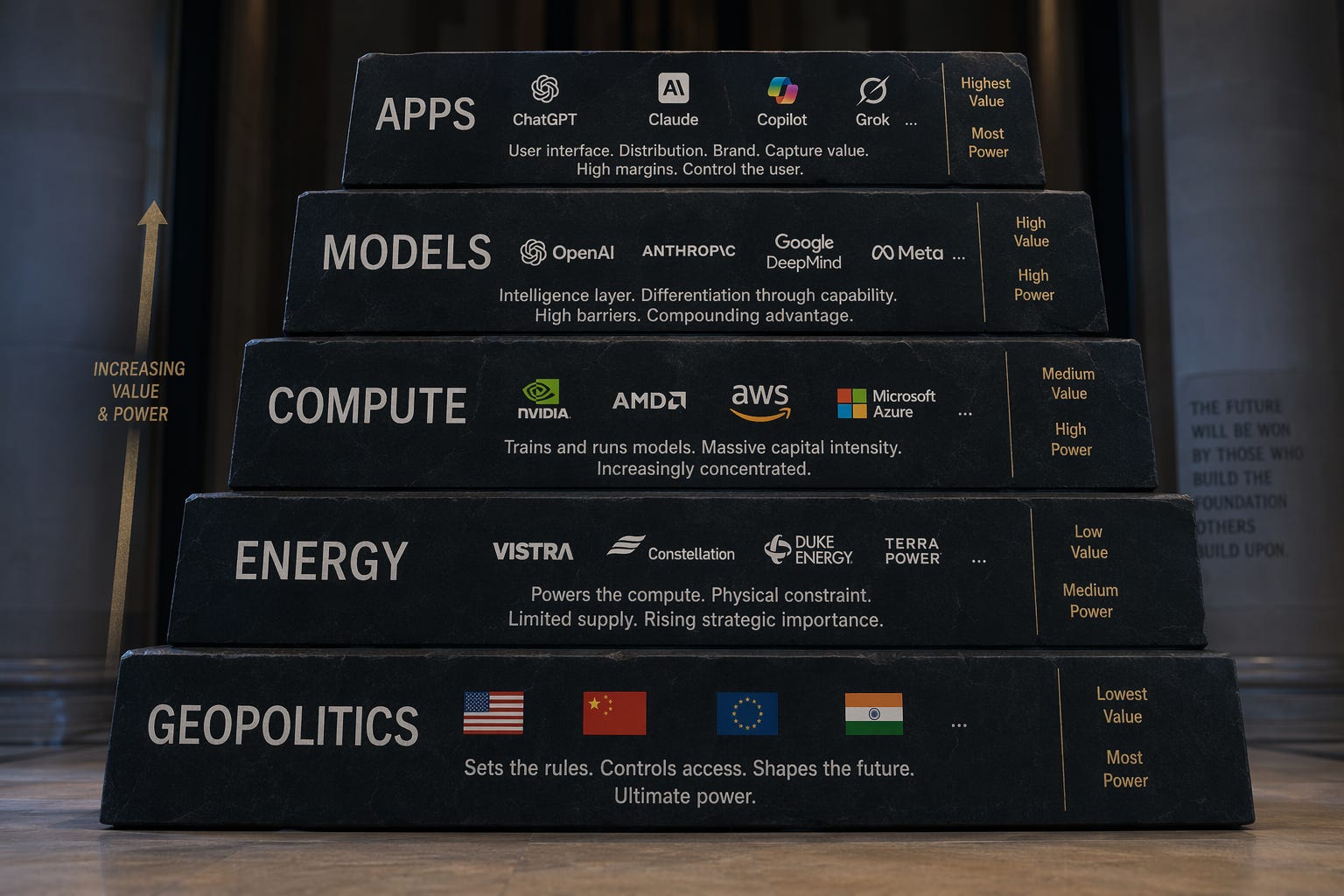
Everyone is now building AI apps.
Almost nobody is building at the power layer.
That’s why most of them will fail.
The Illusion
Walk into any VC pitch meeting right now. The dominant narrative is unshakeable:
“Better models = winning AI.”
This is wrong.
It’s so wrong that it’s become the organizing principle of a capital misallocation cascade. Thousands of teams are raising millions to build on top of Claude, GPT-5, or Gemini. They’re optimizing prompt engineering. They’re chasing RAG. They’re wrapping APIs in interfaces.
They’re playing the wrong game.
The appeal is obvious: models are the thing you can point to. Models are demarcated. Models have leaderboards. You can benchmark them. You can measure their latency. You can feel the difference when you use them.
So the entire industry has organized around a fiction: that ownership of model capability is ownership of AI value.
It isn’t.
The model is the commodity. The system that surrounds it is the power.
The Actual System
AI is not a product category.
It’s a power stack.
And if you’re not controlling one of the layers, you’re working for someone who is.
The stack looks like this:
Energy → Compute → Chips → Capital → Institutions
Each layer sits on top of the previous one. Each layer captures the majority of margin and control from the layer below it.
Energy is the foundation. No energy, no compute. No compute running, no data processing, no models. You can’t outsmart this. Electricity is the ultimate constraint on AI scaling.
This is why Nvidia is lobbying for new power plants. This is why OpenAI is making deals with power providers. This is why DeepSeek’s cost advantage is fundamentally a power-density problem, not an algorithmic one.
Control the energy supply, and you control the ceiling for everyone else.
Compute sits on energy. Compute is the infrastructure; the data centers, the runtime environment, the orchestration layer. The providers here (AWS, Azure, OCI, but increasingly the vertically integrated giants like OpenAI and Google) control where models run and how they scale. They own utilization. They own pricing power. They own the demand curve.
The model company doesn’t own this layer. OpenAI doesn’t run the compute where most of their models run. They’re dependent on cloud partners. That’s a power lever they don’t hold.
Chips is the layer that manufactures the constraints. NVIDIA’s H100 and H200 are the only viable production chips for large-scale training right now. That’s why NVIDIA has pricing power that defies logic. That’s why AMD and Intel have been playing catch-up for three years. That’s why every AI power player is trying to build in-house chips (OpenAI, Google, Meta, Apple, Amazon).
The chip company doesn’t care about your model. They care that you need their silicon to run it.
Capital is the layer that allocates resources across the whole stack. This is where the big winners are. Venture capital and mega-fund allocations have determined what gets built, where chips get manufactured, where compute gets deployed, what models get funded. Capital doesn’t care which model wins. Capital cares about optionality; it backs whoever can control the next layer.
Institutions are the layer at the top. They’re the users, the governments, the enterprises that actually deploy and pay for AI. They set the value anchor. They determine ROI. They determine whether AI is actually useful or just expensive software theater.
Most of the industry is focused on layers 3 and below. Building products. Optimizing models. Trying to own utility.
The winners are already fighting over layers 4 and 5.
Where Things Break
I’ve been inside large-scale AI implementation programs. $10M+. Enterprise-grade. With boards and stakeholders and outcome requirements.
Here’s what actually breaks them:
Data isn’t usable. Not because the data is bad. Because data ownership is unclear. Because the model can’t be trained on it. Because moving it across the system is technically infeasible or legally blocked. The model is ready. The infrastructure is ready. The data is stuck behind organizational friction.
No ownership of outcomes. The AI works. The model outputs something. But who’s responsible for whether it actually solves the business problem? That’s where the system collapses. Models output. Systems have to own outcomes. No one owns outcomes, so the program becomes an expensive pilot.
Capital is misallocated. You’ll spend 3M on a “best of breed” model and 50K on the infrastructure to actually deploy it. The margin ratio is backwards. The real cost is operationalizing AI, not buying it.
Infrastructure is fragmented. Different teams use different cloud providers. Different models. Different APIs. Different security models. The organization has seven different ways to run a prompt and no unified way to track what’s running where or what it’s costing.
AI doesn’t fail because of models. Models are rarely the constraint. AI fails because the power layers aren’t aligned. Because control is distributed. Because nobody owns the economics of the full stack.
When you’re inside a system trying to build on top of models, you’re building on top of someone else’s power layer. Your margin depends on someone else’s architecture.
Who Actually Wins
The winners in this phase are not the app builders. Not the prompt engineers. Not the consultants wrapping UI around APIs.
The winners are:
Compute owners. AWS. Azure. Collectively worth trillions. They own utilization. They own pricing. Every AI service that runs on their cloud has to negotiate with them.
Energy providers. And the entities that can secure reliable, cheap power. Every hyperscaler that can guarantee 24/7 electricity for a data center has leverage. Enough leverage to name their terms.
Capital allocators. The VCs and mega-funds that can move billions into infrastructure, not products. They’ll own a piece of every layer.
Infrastructure operators. The teams that build the middle; the orchestration, the monitoring, the multi-cloud management, the security layer. They’ll capture defensibility because complexity is the moat.
Chip manufacturers. The only hard constraint. NVIDIA isn’t worried about competition from better models because models don’t matter without their silicon. They set price, and everyone pays it.
The losers are:
App builders who think their user interface is defensible when the model is generic.
Prompt engineers who think they’ve learned a durable skill.
Anyone building a “ChatGPT for X” without control of the underlying compute or capital allocation.
What This Means for You
If you’re building anything in AI; product, infrastructure, distribution, policy; you have to ask yourself:
“What layer am I actually controlling?”
If you’re building an app on top of someone’s API, you control the user experience. That’s real. But you don’t control the layer that matters. The layer that matters is the layer that generates the margin. You’re paying API costs that the layer owner sets. You’re dependent on uptime that the layer owner guarantees.
You have a business. You don’t have power.
If you’re building infrastructure; say, a multi-cloud orchestration layer, or a unified security model for AI deployments…you’re one layer closer. You’re not generating the margin directly, but you’re controlling the system that the margin flows through. That’s a different kind of power.
If you’re allocating capital, you’re picking winners across multiple layers. That’s the safest bet.
If you’re securing energy or manufacturing chips, you’ve eliminated optionality. You’ll win regardless of which model wins.
Builders are not playing for power. They’re playing for margin. And margin flows upward, to whoever controls the stack.
The Next Wave
I’m tracking where capital is actually moving; not what VCs say they’re doing, but where the money is landing. I’m watching which teams are securing control of infrastructure layers. Which governments are trying to nationalize compute. Which energy deals are the real bottleneck.
The AI story is power consolidating around whoever controls the layers that models depend on.
If you want to understand the system not just the surface you need to see the power map.
Subscribe to stay ahead of it.