
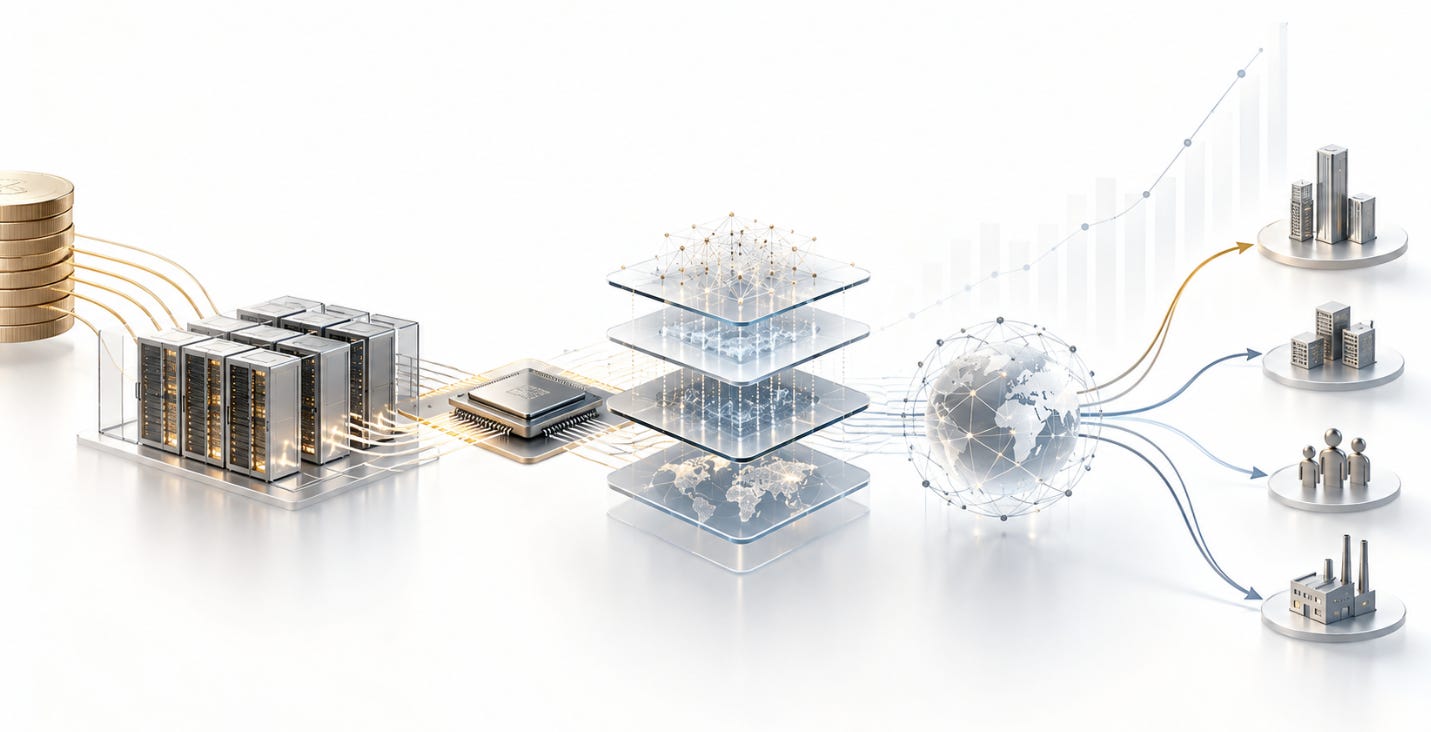
We are spending something close to three-quarters of a trillion dollars building the physical infrastructure of AI.
And I think we are asking the wrong question about it.
Does spending is sustainable?
Whether there is an AI bubble?
Whether the hyperscalers are overbuilding?
Whether there will be enough demand for all these GPUs?
Those are reasonable questions.
But there is a much more important one.
Who actually earns the return on all this capital?
Because the company writing the cheque is not necessarily the company capturing the value.
And the company capturing the value today may not be the one holding the power ten years from now.
That distinction matters enormously.
I have spent enough of my career around infrastructure to be suspicious whenever people treat a capital cycle as a technology story.
I worked at Huawei.
Then Cisco.
I have designed infrastructure.
Worked around data centres.
Built racks.
Managed large technology programs.
Sat between vendors, customers, engineering teams and executives trying to make the economics work.
Later, working around enterprise data, analytics, cloud and industrial software, I saw the same pattern from the other side.
Technology changes.
The economics underneath it are strangely repetitive.
There is always a supplier.
There is always an infrastructure owner.
There is always somebody financing the infrastructure.
There is always someone operating it.
There is always somebody using it.
And eventually there is somebody who actually makes money because the infrastructure exists.
Those are rarely the same company.
AI is no different.
Except the numbers are much bigger.
Start with the money
The four largest American hyperscalers are now committing extraordinary amounts of capital to infrastructure.
Alphabet originally guided towards $175–185 billion of 2026 capex.
Meta subsequently lifted its expected range to $125–145 billion.
Microsoft spent $37.5 billion in one quarter alone, with roughly two-thirds going into relatively short-lived assets such as GPUs and CPUs.
Amazon has been operating around the $200 billion capex level.
Not every dollar is AI.
But AI is increasingly determining the architecture of the spending.
And the spending is accelerating.
Nvidia gives us another way of looking at the same phenomenon.
Its latest quarterly data-centre revenue reached $89 billion.
For one quarter.
Gross margin: roughly 75%.
Think about that for a moment.
While everyone debates whether AI applications have found sustainable business models, one layer of the stack is already collecting extraordinary economics.
The shovel manufacturer is doing very well.
But this is where the story gets interesting.
Because infrastructure booms do not distribute returns evenly.
The AI value chain
I think about the AI economy as a stack.
Not a software stack.
An economic stack.
It looks something like this:
Energy
↓
Grid access
↓
Land
↓
Data centres
↓
Power and cooling equipment
↓
Semiconductors
↓
Networking
↓
Cloud infrastructure
↓
Foundation models
↓
Applications
↓
Enterprise workflows
↓
Labour and business process transformation
↓
Final economic output
Money moves downward into the stack.
Value is supposed to move upward.
Those are not the same thing.
This is the mistake I think a lot of investors make.
They follow the expenditure.
But expenditure tells you where money is being spent.
It does not tell you where economic surplus ultimately accumulates.
Layer 1: Nvidia is capturing the first return
The first obvious winner is semiconductors.
More specifically, accelerated compute.
Today, Nvidia occupies probably the most attractive point in the entire AI value chain.
Demand exceeds supply.
Switching costs are high.
Its software ecosystem reinforces the hardware.
Customers are competing against one another for capacity.
And those customers are enormously well capitalised.
That is a beautiful business.
Nvidia doesn’t need to prove that AI increases global productivity.
It needs customers to believe enough in AI to keep buying infrastructure.
There is a huge difference.
The hyperscalers carry the utilisation risk.
Nvidia largely gets paid when the equipment ships.
This is first-order AI economics.
Someone announces another data centre.
Nvidia sells another rack.
A cloud company raises capex.
Semiconductor revenue increases.
Very straightforward.
But first-order economics rarely tell you where an industrial revolution finishes.
Layer 2: the infrastructure companies
When I used to work around physical infrastructure, racks, networks and data centres, one thing became obvious very quickly.
Servers don’t float in the air.
You need switchgear.
Transformers.
UPS systems.
Cooling.
Cables.
Generators.
Networking.
Fire suppression.
Land.
Water.
Construction.
Operations teams.
Maintenance.
And, above everything else, electricity.
This layer isn’t as glamorous.
It is also becoming extremely important.
The IEA expects global data-centre electricity consumption to roughly double by 2030.
More importantly, these loads are geographically concentrated.
Transmission infrastructure can take four to eight years to build.
Transformer and cable lead times have already stretched.
The IEA estimates that roughly 20% of planned data-centre projects could face delays unless grid bottlenecks are addressed.
That changes the economics.
When compute was scarce, Nvidia had power.
When electricity becomes scarce, electricity starts gaining power.
When grid connections become scarce, the grid connection itself becomes an economic asset.
This is already happening.
Texas has been forced to confront hundreds of gigawatts of proposed data-centre load requests, much of it speculative, and regulators have begun tightening access because the grid cannot treat every proposed project as real demand.
That tells you something.
The AI bottleneck is moving.
And economic power normally moves toward the bottleneck.
The first big power shift
For the last three years, the AI hierarchy looked roughly like this:
Models > GPUs > Cloud > Electricity
I don’t think it stays that way.
I think we are moving towards:
Energy + grid access > compute availability > models
Models are becoming more numerous.
Compute architectures will diversify.
Chips will improve.
Inference will get cheaper.
But you cannot prompt your way around a missing 500 megawatts.
Physics eventually gets a vote.
This is something software people occasionally forget.
Then comes the hyperscaler problem
Now we reach Amazon, Microsoft, Google and Meta.
These companies are spending the money.
So naturally people assume they will capture the return.
Maybe.
But the economics are less obvious than they appear.
Suppose Microsoft spends $100 billion building AI infrastructure.
Some of that immediately becomes Nvidia revenue.
Some becomes networking revenue.
Some becomes power equipment revenue.
Some becomes construction revenue.
Some becomes utility revenue.
Some becomes depreciation.
Then Microsoft has to turn what remains into customer revenue.
That requires utilisation.
And utilisation requires applications.
And applications require customers willing to pay enough to cover the infrastructure underneath them.
Suddenly this becomes a much more difficult equation.
The hyperscaler doesn’t merely need AI adoption.
It needs:
AI revenue > depreciation + electricity + cooling + networking + financing + labour + model development + operating costs.
And it needs that equation to remain attractive while the underlying hardware improves so rapidly that today’s state-of-the-art accelerator becomes tomorrow’s legacy asset.
Microsoft disclosed that roughly two-thirds of its $37.5 billion quarterly capex was going into short-lived assets, primarily GPUs and CPUs.
That phrase matters.
Short-lived assets.
We are building some of the most expensive infrastructure in human history using components with technology-like obsolescence curves.
That is unusual.
A railway can operate for generations.
A transmission line can operate for decades.
A GPU may be economically old surprisingly quickly.
I wrote recently that data centres are increasingly behaving like technology stocks.
This is why.
The hyperscalers may still win
There is another side to this.
Amazon, Microsoft and Google aren’t simply renting GPUs.
They control distribution.
That matters enormously.
AWS already sits inside enterprise infrastructure.
Azure sits inside enterprise identity, data, security and productivity.
Google controls Search, Workspace, advertising and enormous consumer distribution.
Meta controls billions of daily human interactions.
That means their return on AI capex does not have to appear as a neat line item called “AI revenue.”
Google can spend $1 billion on AI infrastructure and earn the return because Search gets slightly better.
Meta can make its advertising system slightly more efficient.
Amazon can improve AWS economics.
Microsoft can defend Office.
This is a critical point.
AI capex can generate defensive ROI.
The return may be revenue preserved rather than revenue created.
That makes the economics considerably harder for outsiders to measure.
Then we reach the model companies
OpenAI.
Anthropic.
Google DeepMind.
xAI.
And dozens of others.
This layer gets most of the attention.
I’m less convinced it captures most of the long-term economic surplus.
Foundation models face an uncomfortable structural problem.
The models are extremely expensive to create.
But the marginal differentiation between models can shrink very quickly.
One company spends billions training a breakthrough capability.
Six months later, competitors replicate much of it.
Open-source models close part of the gap.
Inference becomes cheaper.
Customers route workloads between providers.
The intelligence becomes increasingly interchangeable.
That doesn’t mean foundation-model companies disappear.
It means their bargaining power may decline relative to the infrastructure underneath them and the distribution above them.
This is classic commoditisation.
The middle gets squeezed.
The application layer has the opposite problem
Thousands of AI startups are now being built on top of these models.
They have tiny infrastructure requirements compared with Nvidia or Microsoft.
Wonderful.
But many have almost no structural moat.
A model API.
A workflow.
A nice interface.
Some prompts.
Maybe proprietary context.
I’ve written before that many “AI-native” companies may eventually discover that they own little more than a prompt library.
That doesn’t mean they cannot make money.
They absolutely can.
But revenue and economic power are different things.
If your gross margin depends on somebody else’s model…
running on somebody else’s cloud…
using somebody else’s GPUs…
inside somebody else’s distribution channel…
then you don’t own much of the stack.
And businesses that don’t own scarce parts of the stack rarely control the economics forever.
Which brings us to the enterprise
This is where my view changed the most.
At Cisco, I spent years working around data, analytics, migrations and enterprise transformation.
The biggest economic return from AI may not accrue to “AI companies” at all.
It may accrue to ordinary businesses.
A mining company.
A manufacturer.
A bank.
A logistics company.
An insurer.
A retailer.
A marketing agency.
Imagine an industrial company spends $20 million adopting AI.
It eliminates $60 million of recurring operating cost.
Who captured the AI value?
Nvidia captured revenue.
Microsoft captured cloud revenue.
The model provider captured API revenue.
The integrator captured implementation revenue.
But the industrial company captured $40 million of economic surplus.
And it may capture that surplus every year.
That is fundamentally different.
The infrastructure companies get paid for providing intelligence.
The enterprise gets paid for turning intelligence into economics.
That could ultimately be the largest pool of value.
First-order economics
The first-order effects are easy.
More AI demand means:
More GPUs.
More servers.
More data centres.
More electricity.
More networking.
More cooling.
More cloud revenue.
This is where most equity-market excitement currently sits.
And understandably so.
The numbers are enormous.
Second-order economics
This is where things become much more interesting.
AI infrastructure demand creates scarcity somewhere else.
Electricity becomes scarcer.
Grid interconnections become more valuable.
Transformers become harder to acquire.
Gas turbines get longer lead times.
Land beside substations appreciates.
Nuclear projects become economically plausible again.
Utilities gain negotiating power.
Governments start asking whether AI infrastructure should pay for grid upgrades.
Local communities start asking why residential electricity customers should subsidise transmission infrastructure built for trillion-dollar technology companies.
Capital starts moving into energy systems.
The bottleneck leaves Silicon Valley.
It moves into substations.
I’ve said this before:
AI infrastructure is becoming energy policy.
And once that happens, AI stops being purely a technology industry.
It becomes an industrial system.
Third-order economics
This is the part I find most important.
Once countries recognise compute as strategic infrastructure, governments enter the market.
Now we get:
Sovereign compute.
Energy subsidies.
GPU export controls.
AI industrial policy.
National data-centre strategies.
Nuclear investment.
Grid reform.
Strategic semiconductor manufacturing.
Government-backed AI champions.
Compute trade agreements.
Potential AI infrastructure taxes.
Suddenly the $750 billion isn’t merely corporate capex.
It starts reshaping geopolitics.
Countries with abundant reliable electricity gain leverage.
Countries with constrained grids lose competitiveness.
Natural gas becomes an AI input.
Nuclear becomes technology infrastructure.
Copper becomes technology infrastructure.
Transformers become technology infrastructure.
Land becomes technology infrastructure.
Industrial policy and technology policy merge.
That is third-order AI economics.
The consequences spread far beyond software.
So who captures the value?
My current ranking looks something like this.
Today
1. Nvidia and semiconductor infrastructure
Scarcity plus enormous demand plus exceptional pricing power.
2. Power, cooling and electrical equipment
Less visible.
Increasingly important.
3. Hyperscalers
Enormous strategic upside, but carrying enormous capital and utilisation risk.
4. Model companies
Huge strategic influence today.
Questionable long-term margin durability.
5. Applications
Potentially enormous businesses, but highly uneven outcomes.
6. Enterprises using AI
Still early.
Potentially the largest long-term economic beneficiary.
But who captures the power?
This is a different ranking.
And I think investors confuse the two.
Revenue does not equal power.
Profit does not equal power.
Market capitalisation does not equal power.
Control over a scarce dependency creates power.
Right now Nvidia controls an important dependency.
That gives Nvidia power.
The hyperscalers control compute infrastructure and distribution.
That gives them power.
But over the next decade, I suspect power migrates further down the physical stack.
Towards:
Electricity.
Generation.
Transmission.
Grid access.
Semiconductor manufacturing capacity.
Critical minerals.
And ultimately governments.
Because governments control many of the things nobody else can manufacture with software.
Land use.
Energy markets.
Transmission approvals.
Nuclear licensing.
Trade restrictions.
Export controls.
Industrial subsidies.
National security regulation.
The deeper AI penetrates the economy, the more political the infrastructure beneath it becomes.
The strange thing about the next ten years
I think AI will simultaneously become more powerful and less special.
Intelligence will become cheaper.
Models will proliferate.
Agents will become normal.
Inference costs will collapse.
AI will disappear into software.
And precisely because intelligence becomes abundant, the scarce complements around intelligence become more valuable.
This is a basic economic principle.
When one input becomes abundant, value migrates towards whatever remains scarce.
AI makes cognition cheaper.
It does not make electricity cheaper.
It does not create transmission lines overnight.
It doesn’t manufacture transformers instantly.
It doesn’t produce land.
It doesn’t shorten nuclear permitting to six weeks.
It doesn’t magically create semiconductor fabs.
So the economic centre of gravity changes.
My ten-year view of the value chain
If I had to draw the AI value chain today:
Capital → chips → compute → models → applications → enterprises
Ten years from now, I think it looks more like:
Energy → compute → intelligence → automation → economic output
And the biggest winners may be companies that sit at the edges.
At one end:
Those controlling scarce physical infrastructure.
At the other:
Those converting abundant intelligence into real economic productivity.
The middle may be brutal.
And that brings me back to the $750 billion
Whenever I see these capex numbers, I think back to standing around actual infrastructure.
Racks.
Cables.
Equipment.
Physical systems.
You quickly learn that PowerPoint architecture and physical architecture are very different things.
Every box needs electricity.
Every machine generates heat.
Everything eventually fails.
Everything needs financing.
And somebody somewhere must earn enough money to justify building it again.
AI has spent the last few years feeling almost magical.
But $750 billion of capex has a wonderful ability to remove the magic.
Eventually somebody needs a return.
Nvidia is already getting one.
Electrical-equipment suppliers are getting one.
Utilities increasingly will.
Cloud providers probably will.
Some model companies will.
Many won’t.
Thousands of AI applications won’t.
And perhaps the biggest return of all will appear somewhere almost nobody on Wall Street currently labels an “AI company.”
A manufacturer producing 15% more with the same factory.
A bank processing twice the work with the same headcount.
A logistics company removing kilometres from every delivery route.
A pharmaceutical company compressing years of research.
A mining operation avoiding one day of downtime.
That is where technology becomes productivity.
And productivity is where infrastructure investment finally becomes economic value.
So I don’t think the $750 billion question is:
“Will AI generate enough revenue?”
The better question is:
Who owns the bottleneck between $750 billion of infrastructure and the trillions of dollars of economic value it is supposed to create?
Find that bottleneck.
And you will probably find the next decade’s real winners.