
I used to be technical.
I was an engineer. I wrote code for a living, the kind of code where if you got it wrong, something broke and you found out immediately.
Then my career did what most careers do. It moved up and away from the keyboard.
Programs. Transformation. Strategy. Leadership. All the things you get promoted into once you’re good enough at the thing you stop doing.
I haven’t written a meaningful piece of code in about fifteen years.
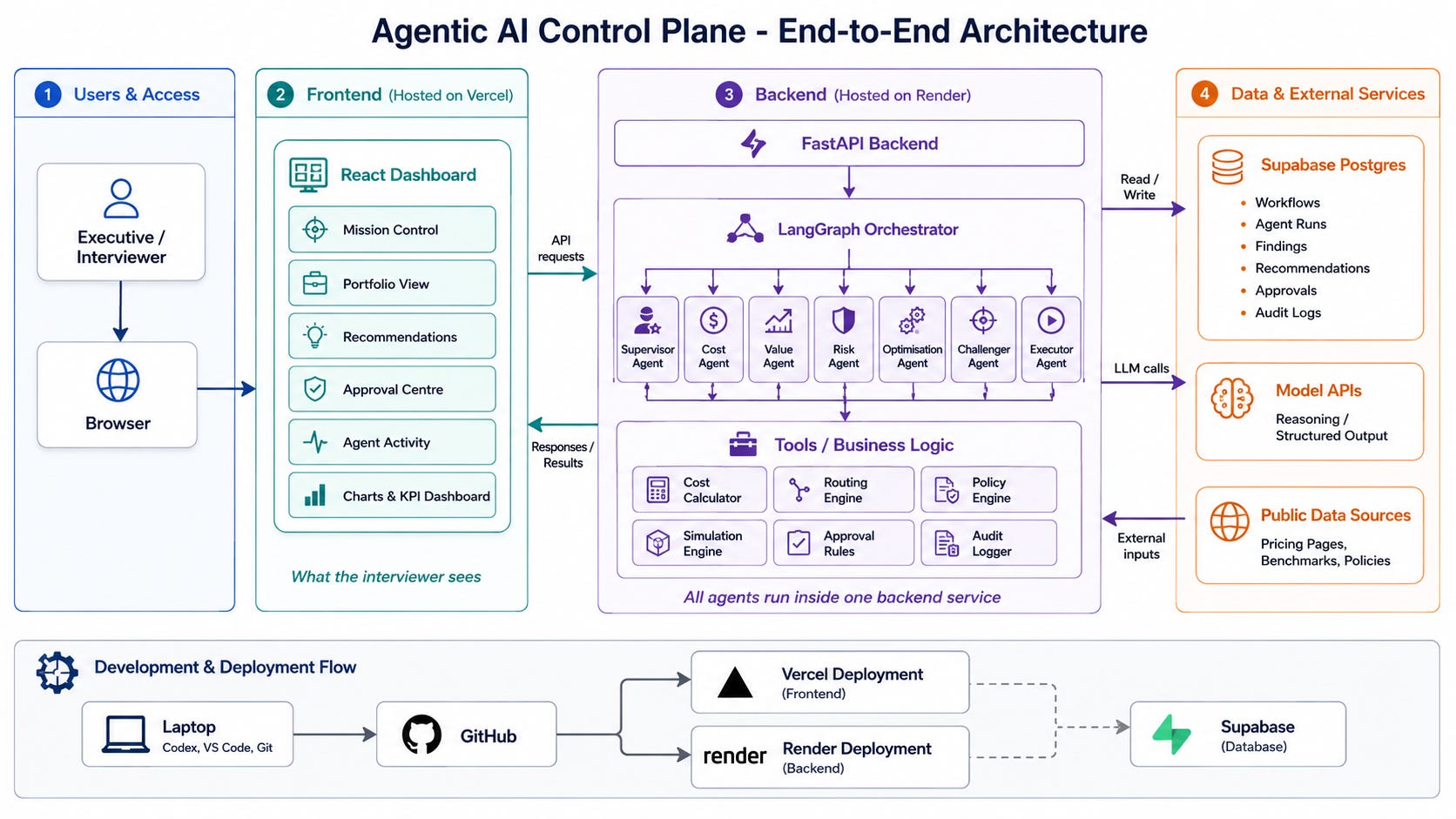
Right now I’m building a full agentic AI control plane. Frontend. Backend. Database. Agent orchestration. Cost agents, risk agents, value agents, challenger agents, human approvals, audit trails. The whole stack, end to end, by myself.
Am I confident I can pull it off? Not completely. I have real doubts, the kind that show up at 11pm when something isn’t working and I don’t have the muscle memory to know why.
But I believe something more strongly than I doubt myself: AI can make you radically better at almost anything, provided you have enough agency to keep moving when you don’t fully understand the path in front of you.
That’s the part nobody wants to say out loud, because it sounds like it’s letting people off the hook. It isn’t. It’s actually a harder standard than the old one.
For thirty years, the operating assumption was simple. Technical work required technical people. You either had the years in, the syntax memorized, the mental model of the compiler, or you didn’t build the thing. Competence was gated by accumulated, hard-won, narrow expertise. That gate is what made engineers valuable and made everyone else defer to them.
AI doesn’t remove that gate so much as it moves it.
The binding constraint isn’t syntax anymore. Syntax is now the cheapest part of the entire process, something the model produces on demand, correctly, faster than I could type it even in my sharpest engineering years. What’s expensive now, what actually determines whether the control plane gets built or dies in a half-finished repo, is something else entirely.
It’s knowing what to build. It’s being able to break an ambiguous goal into a sequence of concrete, checkable steps. It’s asking the model the right question instead of a vague one, and knowing enough to smell it when the answer it gives you is confidently wrong. It’s testing, re-testing, and having the stomach to keep moving when the first three approaches don’t work and you can’t fully explain why.
None of that is coding. All of it used to require coding to develop.
That’s the uncomfortable part.
AI hasn’t just closed my fifteen-year gap. It’s exposed the fact that the gap was never purely technical to begin with. A huge share of what made “technical people” valuable was never the syntax. It was the judgment that came from years of hitting walls and learning to diagnose them.
AI can now hand you the wall-hitting experience on demand, compressed, without the fifteen years. What it cannot hand you is the willingness to keep hitting walls until something works. That part is still yours. That part was always yours.
So I’m not pretending AI has made me a software engineer overnight.
It hasn’t, and anyone who tells you a tool alone rebuilt fifteen years of missing reps is selling something. What I’m actually testing is narrower and, I think, more honest: whether judgment, curiosity, systems thinking, and high agency can bridge a technical gap that used to be uncrossable without putting in the years.
If the answer is yes, and I think it’s trending yes, then the real scarce resource in the AI era was never technical skill. It was always agency. Technical skill was just the expensive proxy we used to measure it, because for decades it was the only proxy available.
That proxy is gone now. What’s left is the real thing, standing there with nowhere to hide.
Let’s see.