
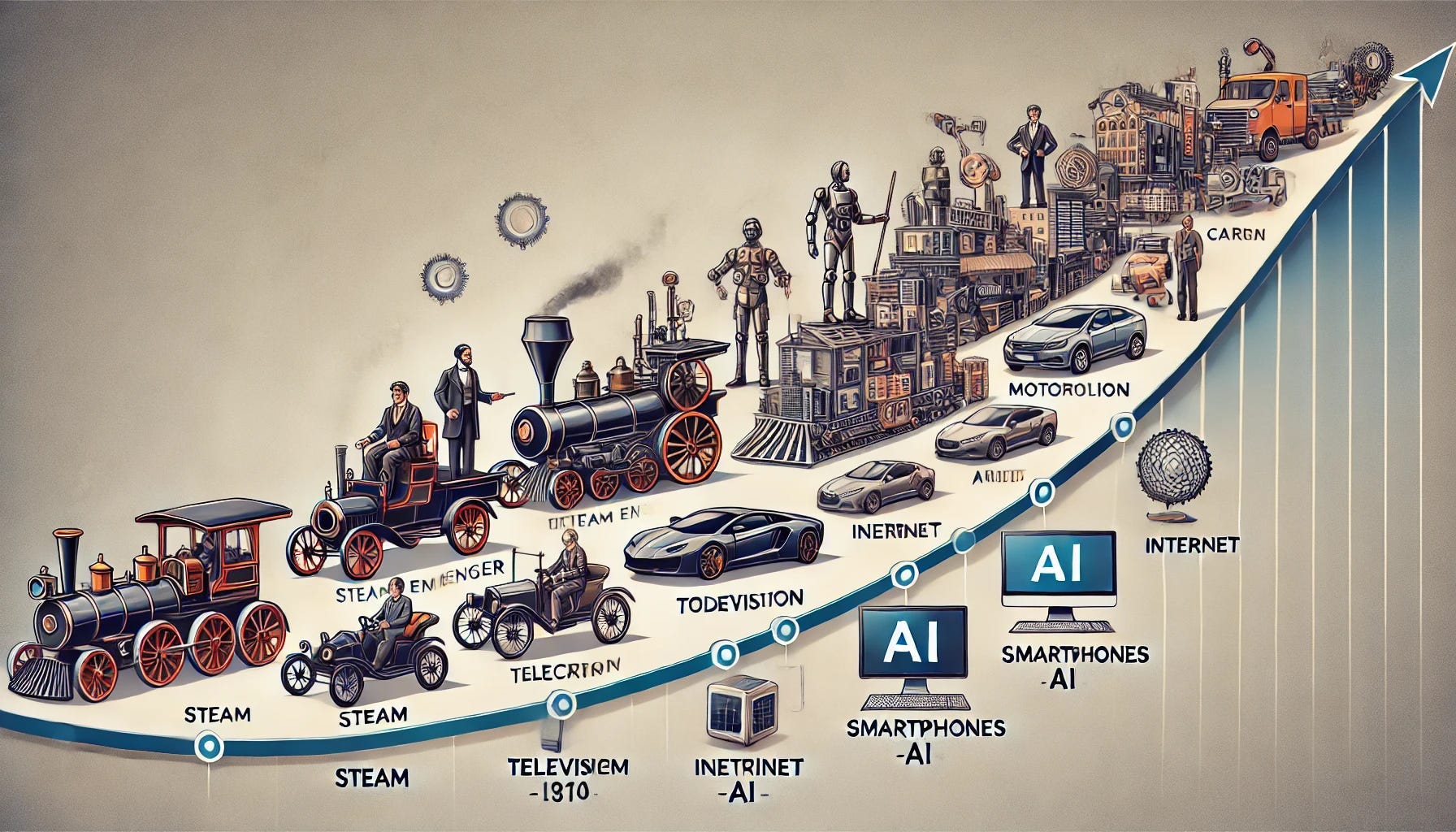
People think AGI will be a productivity revolution.
They’re half right.
It will be a productivity revolution and a property revolution and a power revolution.
The question is: Who captures the value? Who owns the bottlenecks? And who gets left holding the bag?
John Stuart Mill figured out industrial capitalism in 1848. His insights on rent, distribution, and institutional design map directly onto the AGI era; if you know how to translate them.
Here are the 15 operating rules that matter. Not abstract theory. Not moral hand-wringing. Just the cold economic logic of what happens when intelligence becomes abundant and everything else doesn’t.
RULE 1: Separate Production from Distribution
Mill’s insight: Production follows technical constraints. Distribution follows institutional rules.
AGI translation: AI will explode what humans can produce. It will not automatically distribute the value.
Everyone sees the productivity gains. Almost no one is redesigning ownership structures to match.
What this means for you:
If you own compute infrastructure, you win.
If you work for wages, you lose.
If you don’t redesign equity participation before AGI hits full scale, you’re fighting over scraps while rent collectors compound.
The productivity is coming. The question is: Are you positioned to capture it, or just create it for someone else?
RULE 2: Identify the Bottleneck Factor
Mill watched wealth flow from land (agrarian) → capital (industrial) → management (late-stage capitalism).
The pattern: Wealth accumulates wherever scarcity lives.
In the AGI era, these are your bottlenecks:
Compute (NVIDIA isn’t a chip company; it’s a bottleneck monopoly)
Energy (AI scales linearly with power; ask yourself where the next 10GW comes from)
Data rights (who owns the training corpus?)
Distribution platforms (OpenAI isn’t a model company; it’s a distribution machine)
Regulatory permission (EU AI Act creates compliance moats)
Trust/legitimacy (who do people allow to deploy agents?)
If you’re not actively building or buying a bottleneck, you’re being bottlenecked.
RULE 3: Rents Migrate, They Don’t Disappear
AGI doesn’t eliminate rent extraction. It relocates it.
Land rents dominated agricultural economies.
Capital rents dominated industrial capitalism.
Coordination rents dominated late-stage corporate bureaucracy.
AGI creates:
Platform rents (whoever controls the agent ecosystem)
Compute rents (cloud providers, chip makers)
Attention rents (AI-SEO winners, LLM-native distribution)
Regulatory rents (compliance = barrier to entry)
Most founders fight yesterday’s monopoly while today’s rent collectors are already entrenched.
Your move: Stop fighting old battles. Figure out where the new rent lives and own it first.
RULE 4: Coordination is Scarce Even If Intelligence Is Abundant
Mill understood that managerial ability behaves like a monopoly.
AGI automates cognition. It does not automate:
Authority
Responsibility
Political legitimacy
Trust
Post-AGI, coordination rent becomes governance rent.
Translation:
The person who decides what the AI does and who it serves extracts more value than the person who builds it.
This is why IAOA-type institutions matter. Control over AI deployment standards = rent extraction at civilizational scale.
RULE 5: Wages Stop Being the Primary Distribution Mechanism
When labor isn’t scarce, wages structurally collapse.
This isn’t a glitch. It’s the natural outcome of an intelligence-abundant economy.
The problem: Most people’s only claim on economic output is their labor. If labor has no bargaining power, distribution breaks.
The alternatives:
Asset ownership
Equity participation
Compute dividends (like oil dividends in Norway/Alaska)
Data royalties (you contributed to the training corpus)
Sovereign AI wealth funds
Universal capital participation
If you don’t redesign distribution mechanisms before wage collapse, you get instability. Not “inequality discourse” instability. Actual political fracture.
RULE 6: Property Legitimacy Must Be Rewritten
Mill’s property logic: You own what you produced through fair exchange.
AGI breaks this.
GPT-4 was trained on humanity’s collective output. Who “produced” it?
The engineers at OpenAI?
The millions of people whose writing trained the model?
The platform companies who hosted the data?
The taxpayers who funded DARPA research?
Humanity as a species?
This isn’t a philosophy question. It’s a legal fracture line.
If people don’t believe AI ownership is legitimate, property rights destabilize. If property rights destabilize, governance collapses.
Your move: Stake your claim early. Define the legitimacy narrative. Control the property frame before someone else does.
RULE 7: Credit Becomes Nuclear in an AGI World
Mill understood credit amplifies both booms and crises.
AGI massively increases perceived future productivity.
Translation: Speculative leverage explodes.
Expect:
AGI-backed financial bubbles (already starting)
AI derivatives (model performance swaps)
Model-weight securitization (yes, really)
Compute-backed sovereign debt
Without credit governance, boom-bust cycles get violent.
If you’re levering up on AI productivity assumptions, you’re playing with dynamite. If you’re a government regulating credit markets, you’re already behind.
RULE 8: International AI Trade Follows Reciprocal Demand
Mill’s trade theory: Terms of trade depend on reciprocal demand — who needs whom more?
AGI geopolitics:
Country A exports compute
Country B exports energy
Country C exports models
Country D exports regulation/standards
Power flows to whoever is less dependent.
The US has compute. The Middle East has energy. China has manufacturing + data. Europe has regulatory frameworks.
The game: Lock in dependencies where you have leverage. Break dependencies where you don’t.
Geopolitics becomes intelligence supply-chain bargaining.
RULE 9: Small Ownership Prevents Political Instability
Mill favored distributed land ownership because it diffuses rent capture.
AGI equivalent:
Broad equity access to AI companies
National AI wealth funds (every citizen gets compute dividends)
Distributed ownership of inference infrastructure
Public model access (open weights as public good)
Concentrated AI ownership → computational aristocracy.
Distributed AI ownership → political stability.
This isn’t altruism. It’s systems design for durability.
If 0.1% of the population owns 99% of AGI capital, you don’t get a utopia. You get a revolution.
RULE 10: Institutional Design > Moral Signaling
Mill didn’t moralize markets. He redesigned the rules.
The AGI era mistake: Endless ethics debates while ignoring structural levers.
Real levers:
Ownership law (who can own model weights?)
Inheritance tax design (preventing computational dynasties)
Data property rules (GDPR was the warm-up act)
Platform interoperability mandates (break the walled gardens)
Antitrust for compute clusters
Want different outcomes? Change the structure.
Ethics panels don’t shift power. Institutional redesign does.
RULE 11: Inheritance Becomes More Dangerous Than Production
Mill was skeptical of unlimited inheritance even in 1848.
In the AGI era: If AI capital compounds autonomously, dynasties become algorithmic.
Your AI hedge fund runs itself. Your model empire scales without human intervention. Your compute cluster self-optimizes.
Without inheritance constraints, you get permanent computational nobility.
This isn’t about fairness. It’s about system stability.
RULE 12: Bottleneck Capture = Political Capture
Whoever controls:
AI infrastructure
Model access
Cloud platforms
Agent ecosystems
Can influence:
Information flow
Elections
Economic access
Narrative formation
This isn’t “Big Tech bad.”
This is civilizational leverage.
The company that controls the AI layer controls more than a market. It controls the decision-making substrate of society.
RULE 13: Management Rent Evolves into Legitimacy Rent
Mill: Managers extract surplus because coordination is scarce.
AGI: Coordination is automated, but legitimacy isn’t.
Power shifts to:
Institutions trusted to deploy AGI
Entities authorized to set AI goals
Agencies controlling risk thresholds
This is where your AI standards organizations live.
Control over what counts as “safe AI” or “aligned AI” or “certified AI” = rent extraction.
Not through force. Through legitimacy monopoly.
RULE 14: If You Don’t Redesign Distribution, You Get Revolt
Mill feared social fracture from concentrated land rents.
AGI concentration creates:
Mass labor displacement
Meaning crisis (if work = identity, what happens when work disappears?)
Economic redundancy
Wealth inequality spikes
Distribution redesign is not optional. It is a stability requirement.
You can have AGI abundance or you can have wage-based distribution.
You cannot have both.
Pick wrong, and the system collapses.
RULE 15: The Binding Constraint Always Moves
Mill’s deepest insight: Progress doesn’t eliminate scarcity. It relocates it.
AGI won’t end constraints. It will shift them.
From:
Labor scarcity
To:
Legitimacy scarcity
Energy scarcity
Compute scarcity
Attention scarcity
Governance capacity scarcity
If you misidentify the new constraint, your entire economic model collapses.
The people building AGI think they’re solving intelligence.
They’re actually relocating the bottleneck to everything else.
What This Means for Operators
If you’re a founder, investor, or policy architect, here’s your checklist:
1. Map bottlenecks.
Where is the new scarcity? Who controls it? Can you own it?
2. Map surplus flows.
AGI creates massive productivity gains. Where does the surplus go? Are you positioned to capture it?
3. Map legitimacy anchors.
Who do people trust to deploy AI? Can you build or buy that trust?
4. Redesign distribution early.
Wages won’t work. What replaces them? Equity? Dividends? Sovereign funds?
5. Control credit risk.
Leverage explodes in high-growth environments. Don’t get caught in the bust.
6. Internationalize bargaining power.
AI is global. Your dependencies define your weakness.
The Bottom Line
AGI does not eliminate political economy.
It intensifies it.
The same forces Mill identified in 1848 — rent extraction, bottleneck control, institutional design, distribution failure — don’t disappear.
They accelerate.
The difference between winning and losing in the AGI era isn’t technical capability.
It’s economic positioning.
Are you capturing rents or paying them?
Are you owning bottlenecks or getting bottlenecked?
Are you redesigning institutions or getting crushed by them?
Most people are building features.
Smart operators are building structural leverage.
The AGI revolution is here.
The question is: Which side of the value extraction are you on?
If you found this useful, you’re thinking about economics correctly. If this made you uncomfortable, you’re probably sitting on the wrong side of the coming redistribution. Either way, the rules don’t care about your feelings. They care about structure.
Welcome to the AGI economy.