
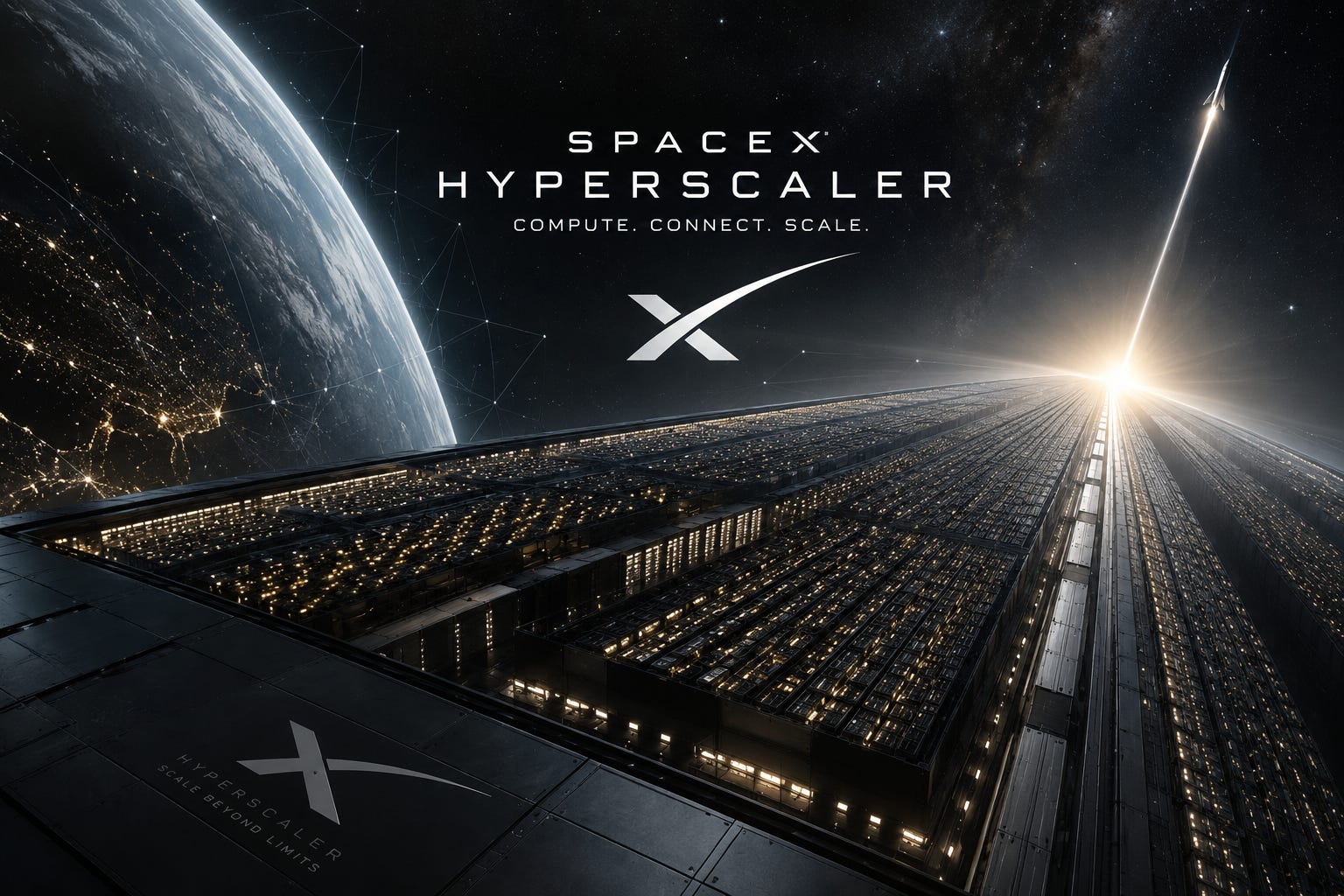
The narrative everyone tells: “SpaceX makes rockets cheaper. Revolutionary. They’re going to Mars.”
The truth is darker and more interesting.
Elon didn’t build a rocket company. He built an infrastructure business that happens to use rockets as the delivery mechanism. And by accident - or perhaps by design - he’s created the only hyperscaler with orbital optionality.
This matters because AI is now the engine of all capital allocation. And the next frontier of AI economics isn’t GPUs in Virginia. It’s compute distributed across a substrate that nobody else can build.
The Hyperscaler Trap
Let’s start with why this matters.
Every major AI player - OpenAI, Google, Meta, Anthropic - is caught in the same constraint: they need to train larger models, which requires exponentially more compute, which requires exponentially more power, which requires being geographically anchored to where power is cheap and abundant.
This is why you see the same pattern everywhere: massive data centers in Texas, Virginia, and the Pacific Northwest. Data centers that cost billions. Data centers that require 500+ megawatts of power. Data centers that take 2-3 years to build and are immediately constrained by local grid capacity.
The hyperscaler model works because:
Centralized compute is cheaper (density = efficiency)
Low latency between GPUs is critical for training
Power is the binding constraint
You’re stuck negotiating with state governments for grid allocation
It’s a defensible moat, but it’s also a fixed asset moat. Once you build the data center, you’ve committed capital for a decade. You can’t move it. You can’t redistribute it. You’re geographically locked.
This is why OpenAI needs $100 billion in capital. This is why Microsoft is signing decade-long power contracts. This is why Nvidia is effectively the central bank of AI.
Now watch what Elon is doing.
Colossus Principles Applied to Orbit
Colossus is Tesla’s training supercomputer, and it’s the design philosophy that matters here, not the name.
The idea: instead of one massive centralized cluster, build a distributed system where:
Training happens in many smaller pools
Each pool can operate independently
They coordinate through efficient networking
You can add capacity by adding more nodes, not building a new data center
The system scales horizontally, not vertically
This is the opposite of hyperscaler centralization. It’s optionality. It’s modularity.
Now apply that to space.
Starlink isn’t a broadband network. Starlink is a distributed compute substrate that Elon owns.
Here’s what people miss:
A Starlink satellite in orbit is a node. It has:
Computing capacity (small but growing)
Power from solar panels
The ability to communicate with other satellites at light speed
Zero dependence on terrestrial grid infrastructure
Add enough of these nodes, and you’ve created something a hyperscaler can’t: a compute network that scales without grid constraint.
Training a trillion-parameter model on terrestrial GPUs? You need 500+ megawatts and state approval and grid negotiation.
Training it across a distributed orbital network? You need launch costs and thermal management.
Those are solvable problems. Grid politics are not.
The Economics of Orbital Compute
Let me be blunt about the constraints, because this is where economic reality crashes into hype.
Power density. A Starlink satellite runs on maybe 5-10 kW of power. A modern GPU cluster runs on 5-10 megawatts. You cannot get power density in orbit that matches terrestrial data centers. Not yet.
So orbital compute won’t replace GPU clusters for training. It’ll compete in a different market: inference at the edge.
This is actually more valuable.
Here’s why: inference is the profit pool. Training is the capital expenditure. You train once, you infer millions of times.
If you own an inference layer distributed globally - at light-speed latency, redundant across satellites, accessible anywhere on Earth - you’ve solved the last-mile compute problem that terrestrial cloud can never touch.
Think about this:
A user in Lagos queries a model
Today: latency to Virginia is 150+ milliseconds
Via orbital: latency is 25 milliseconds
The difference is whether real-time applications are possible
Add distributed inference, and suddenly:
Real-time translation works
Autonomous vehicle coordination works
Sub-10ms AI responses become the baseline
Terrestrial cloud becomes “batch processing in the sky”
This isn’t theoretical. Elon’s already signaling it. He’s talking about Starlink terminals with onboard compute. He’s talked about using satellites for AI inference.
The economics are clear: whoever owns the lowest-latency global inference layer owns a $100+ billion business.
Starlink as Distribution Layer
Here’s where the distribution insight kicks in.
Starlink doesn’t compete with AWS on compute. It competes on accessibility.
Right now, cloud compute is sold through:
AWS, Azure, GCP (3 companies)
Regional offices and sales teams
Complex contracts and commitments
Geographic concentration
Starlink is available everywhere. To everyone. Via satellite.
Now imagine: you own a manufacturing plant in Paraguay. You need real-time AI-powered quality control. You need sub-50ms latency. AWS can’t reach you at that latency. Neither can Azure.
But Starlink can.
The distribution advantage isn’t that Starlink is faster (it’s not, for training). It’s that Starlink is ubiquitously accessible.
This is how you kill a moat. You don’t build a better hyperscaler. You make hyperscaler economics irrelevant by distributing compute to the edge.
Think about the incentive structure:
OpenAI, Google, Meta: locked into centralized data center capital expenditure
SpaceX: building satellites for other reasons (broadband, mobility, Starshield), and using those satellites to monetize inference
Who wins? The player with lower marginal cost to add compute capacity.
For hyperscalers, that marginal cost is new data center construction: $1-2 billion per facility.
For Starlink, that marginal cost is launching another satellite: maybe $50-100 million worth of launch cost amortized across a fleet.
The math breaks the hyperscaler model.
The Thermal Management Reality Check
I need to be honest about the technical constraint that most people ignore: heat.
A GPU running inference generates heat. In a data center, you pump liquid cooling through it. Easy.
A satellite in orbit? You’re radiating heat into the void. There’s a ceiling to how much compute you can dissipate per square meter of radiator panel.
This is why orbital compute will never be a 1:1 replacement for terrestrial data centers. The thermal envelope is real.
But here’s the thing: you don’t need 1:1 replacement. You need enough inference capacity at the edge to:
Serve real-time requests globally
Reduce latency for time-sensitive applications
Create a pricing pressure point on hyperscalers
Elon doesn’t need to replace AWS. He just needs to eat the margin on low-latency, globally-distributed inference.
That’s a $50+ billion market, and hyperscalers can’t protect it.
Why This Changes the AI Capital Equation
Zoom out to the macro incentive problem.
Every AI company right now is fighting for:
Access to compute (controlled by Nvidia and hyperscalers)
Access to power (controlled by grid operators and energy companies)
Capital to build data centers (most expensive step)
These are the binding constraints on AI progress.
Elon’s creating a fourth option: access to distributed orbital compute that doesn’t depend on terrestrial power or hyperscaler gatekeeping.
Is it perfect? No. Is it cheaper than AWS for training? No.
But for inference - the monetized layer - it’s a different equation.
Now consider the incentive structure:
OpenAI needs to raise $100 billion because it’s betting all capital on hyperscaler infrastructure
Google needs to keep throwing capital at data centers because that’s its competitive moat
Anthropic is trapped in the same hyperscaler incentive structure because that’s where compute comes from
SpaceX is adding a new vector that doesn’t require betting the company on centralized infrastructure.
This is asymmetric. Elon has options. The hyperscalers are locked in.
The Distribution Angle
Elon controls the distribution layer.
Distribution has always been the hidden moat:
Coca-Cola owns distribution, not the formula
Amazon owns distribution, not the products
Nvidia owns distribution (data center relationships, drivers, ecosystem), not just GPUs
Elon is building distribution by building infrastructure.
Once you have a satellite constellation:
Every device on Earth can access compute
You set the pricing
You don’t have to negotiate with AWS or Google
You’re not dependent on any terrestrial entity’s infrastructure
This is why Starlink margins will eventually be incredible. It’s not because broadband is high-margin. It’s because once the satellite is in orbit, the marginal cost of adding a user is nearly zero.
Apply that to compute inference:
Launch costs amortize across thousands of use cases
Marginal cost to add a new customer: almost nothing
You capture the spread between your cost and cloud pricing
A 60% gross margin on $50 billion in inference revenue is $30 billion annually. That’s hyperscaler profit pools.
And SpaceX owns the distribution layer.
What Actually Matters: The Optionality
Elon built optionality that nobody else has.
Optionality is worth money. It’s worth the extra cost of a Starlink terminal. It’s worth the price premium for distributed compute.
Because once you have two suppliers of compute infrastructure - one centralized, one distributed - prices come down. Terms improve. The negotiating power shifts.
Hyperscalers have 10-15 years of pricing power because building new data centers takes time.
Starlink can add inference capacity through satellite launches in months.
That’s not a threat today. But in 3-5 years, when Starlink has 100,000+ satellites and has built an inference layer on top? It becomes a real competitive dynamic.
And the hyperscalers can’t replicate it because they don’t have:
A satellite constellation
Launch capabilities
The infrastructure already in the sky
They could build it. But that costs $50+ billion and takes a decade.
By then, Elon’s already won.
The Full-Stack Capitalist Take
SpaceX is the most underpriced option on AI infrastructure because:
It’s not marketed as AI infrastructure. It’s “broadband and national security.” The market hasn’t repriced it.
The margin structure is hidden. Starlink today is a broadband play. Tomorrow it’s an inference layer. Same satellites. Different revenue model.
It creates asymmetric incentives. OpenAI, Google, and Anthropic are capital-locked into hyperscalers. SpaceX has the option to be a hyperscaler without being capital-locked in the same way.
Distribution always wins. Not technology. Not capability. Distribution. And Elon owns a distribution layer that nobody else can build.
The binding constraint will shift. We think power is the constraint. But in 5 years, it’ll be latency. And latency is Starlink’s game.
Here’s what this means for founders and investors:
If you’re building AI infrastructure, you’re not competing with AWS. You’re competing with eventual Starlink margins.
If you’re building an AI application that needs real-time, globally distributed inference, you should price Starlink compute as a constraint.
If you’re an enterprise evaluating “edge AI,” the economics just changed. Terrestrial edge is expensive. Orbital edge has different unit economics.
If you’re a hyperscaler, you just learned that your capital-intensive moat has an expiration date.
That’s not a business. That’s a choke point.
Subscribe to The Full-Stack Capitalist for weekly breakdowns of how incentive structures reshape markets. This week: how Elon quietly became your cloud provider.