
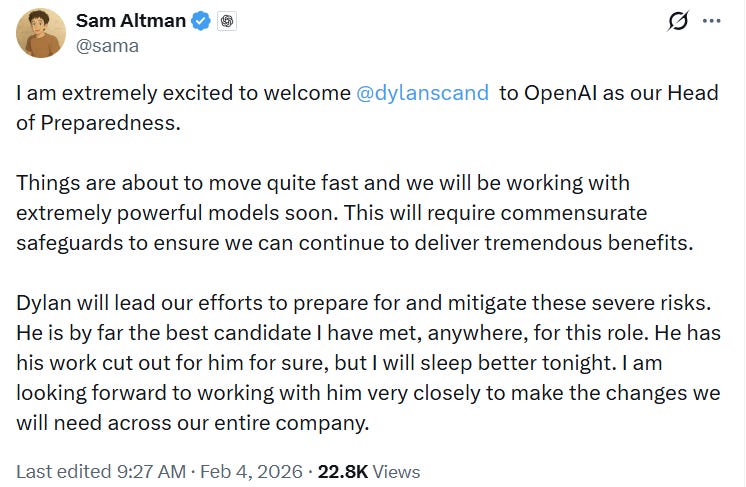
OpenAI hired Dylan Scandinaro from Anthropic as Head of Preparedness.
Not Head of Safety. Not VP of Ethics. Not Chief Responsibility Officer.
Preparedness.
That’s a military term. A national security term. A term you use when:
The threat is existential
The timeline is compressed
Reversibility is not an option
This isn’t virtue signaling. This is OpenAI building a command structure for a world where AI might actually change everything.
And here’s what matters: Google, Anthropic, and the frontier labs are all doing the same thing at the same time.
Why This Matters More Than Model Benchmarks
The Signal vs The Noise
Noise:
GPT-5 rumors
Pricing wars
Benchmark leaderboards
“Who has the best chatbot”
Signal:
Org chart convergence across competitors
Creation of entirely new C-suite roles
Hiring from each other for existential risk positions
Militarization of safety language
When rival companies start building identical organizational structures around the same risk hypothesis, that’s revealed preference.
They’re not building these roles because regulators asked for them. They’re building them because their internal models scare them.
The Birth of a New Executive Class
Meet the AGI Risk Executive
This is a new species of corporate power:
Not a researcher. (They advise, but don’t decide.)
Not a policy person. (They react to external pressure.)
Not a safety engineer. (They build guardrails within existing systems.)
The AGI Risk Executive sits at the strategic apex and asks:
What if we’re right about AGI timelines?
How do we structure the company for a 3-5 year window to navigate this?What if we’re early?
How do we avoid looking insane while still being prepared?What if we’re wrong but a competitor isn’t?
How do we avoid being steamrolled by someone who gets there first?
This role only exists if you believe AGI is:
Plausible (not science fiction)
Near (measured in years, not decades)
Non-reversible (you don’t get a do-over)
Why “Preparedness” Is Economic, Not Ethical
Here’s where most analysis goes wrong:
People think this is about doing the right thing.
It’s not. It’s about not dying.
The Real Incentive Structure
Let’s game this out from OpenAI’s perspective:
Scenario 1: AGI doesn’t happen
You wasted $5-10M/year on a preparedness team
You look a bit paranoid in hindsight
Cost: Negligible
Scenario 2: AGI happens and you’re unprepared
You lose control of the most powerful technology in history
Governments seize your assets
Your competitors who were prepared become permanent winners
You might literally cause human extinction
Cost: Infinite
This is the asymmetric bet that explains everything.
The expected value of preparedness is infinite because the downside of unpreparedness is existential.
What This Reveals About Value Capture
The Coming Concentration
Here’s the dark economics underneath:
If AGI is real and near, then:
Moats become permanent
First mover advantage doesn’t erode; it compounds exponentially.Regulation becomes capture
Whoever shapes the preparedness frameworks controls the market structure forever.Talent becomes non-fungible
There are maybe 50 people on Earth who can credibly run “AGI Preparedness.” They’ll be worth billions.Distribution becomes everything
When the product is superintelligence, the only differentiator is who controls the pipes.
OpenAI hiring for post-AGI competitive position.
The preparedness role is about ensuring that when AGI arrives, OpenAI:
Isn’t shut down
Isn’t nationalized
Isn’t replaced
Controls the narrative
Sets the standards
This is statecraft dressed as corporate governance.
Why Google Is Hunting for a “Chief AGI Officer”
Let’s decode what Google’s move reveals:
The Admission
Google doesn’t create C-suite roles lightly. They’re a 25-year-old company with ossified org structures.
Creating a “Chief AGI Officer” is Google admitting:
AGI is a distinct category
Not just “better AI” but a phase transition requiring new governance.Current structures are inadequate
Their existing AI Ethics teams, DeepMind safety research, and product orgs can’t handle what’s coming.This is a board-level concern
AGI risk sits at the same altitude as CFO/CTO; it’s about existential corporate outcomes.
The Question
Why would Google, the most bureaucratic of the frontier labs, suddenly move this fast?
Because they’re losing.
Google has:
More compute than OpenAI
More data than OpenAI
More researchers than OpenAI
More distribution than OpenAI
And they’re still behind.
The AGI Officer role is Google’s admission that technical capability isn’t the bottleneck anymore.
The bottleneck is decision-making speed in the face of existential uncertainty.
That’s what preparedness is really about.
The Convergence Pattern (And What It Means)
Why Everyone Is Building the Same Org Chart
When competitors independently arrive at identical organizational structures, you’re watching:
Not: Copying each other
Not: Regulatory compliance theater
Not: PR management
But: Convergent evolution under identical selection pressure.
The selection pressure is: How do you run a company that might build God?
The answer, apparently, is:
Create a role outside the normal chain of command
Give them veto power over deployment
Make them report directly to the CEO
Staff them with people who’ve thought about this longer than anyone else
Use military/national security language
Why This Is Pre-AGI Statecraft
The Historical Parallel
We’ve seen this movie before:
1940s: Nuclear preparedness
New government agencies (AEC, later DOE)
New executive roles (National Security Advisor)
New language (”deterrence,” “fallout,” “first strike”)
New decision-making frameworks (MAD)
2020s: AGI preparedness
New corporate roles (Head of Preparedness, Chief AGI Officer)
New language (”alignment,” “capability overhang,” “deployment decisions”)
New frameworks (staged release, red teaming, model cards)
The parallel is exact.
Both are:
Dual-use technologies with massive destructive potential
Developed by small teams with enormous leverage
Subject to winner-take-all dynamics
Impossible to un-invent once created
Requiring decisions made under radical uncertainty
The difference: Nuclear weapons were built by governments. AGI is being built by corporations.
So corporations are building governmental functions inside themselves.
That’s what “preparedness” is. It’s the privatization of statecraft.
What This Means for Value Creation
The New Moat: Existential Risk Management
Here’s the economic insight everyone is missing:
In the AGI era, the most valuable companies won’t be the ones with the best models.
They’ll be the ones that can:
Deploy safely enough to avoid shutdown
Move fast enough to stay ahead
Navigate regulation without being captured
Survive their own success
Preparedness isn’t overhead. It’s the meta-capability that determines who survives selection.
Think about it:
OpenAI with great models + no preparedness = Shut down by governments
OpenAI with okay models + great preparedness = Shapes regulation, survives, compounds
The Talent War You’re Not Watching
Why Scandinaro’s Hire Matters
Dylan Scandinaro came from Anthropic. That’s not random.
Anthropic is the company that:
Invented “Constitutional AI”
Pioneered staged deployment
Built safety into their pitch deck
Made preparedness a competitive advantage
OpenAI poaching Anthropic’s preparedness people is like:
Apple poaching Nvidia’s chip designers
Google poaching AWS’s infrastructure leads
It’s a signal about where the strategic value is.
The Emerging Talent Market
There are maybe 100 people globally who have:
Deep technical AI knowledge
Experience in safety/alignment
Ability to operate at board level
Credibility with both researchers and regulators
Willingness to make hard calls under uncertainty
These people are about to become the most valuable executives on Earth.
Because they’re the only ones who can answer: “Should we deploy this?”
That question will be worth trillions.
Why “Preparedness” Beats “Safety”
The Framing Shift
Notice the language evolution:
2018-2021: “AI Ethics”
Implication: This is about values and principles
2021-2023: “AI Safety”
Implication: This is about preventing bad outcomes
2023-2026: “AI Preparedness”
Implication: This is about being ready for what’s coming
The shift from safety → preparedness is crucial.
“Safety” assumes you can make the system safe.
“Preparedness” assumes you need to be ready for when you can’t.
It’s the difference between:
Installing seatbelts (safety)
Building a bunker (preparedness)
Preparedness acknowledges: We might not control this. But we can control our response.
The Questions These Executives Are Actually Asking
Behind Closed Doors
The AGI Preparedness role exists to force the organization to confront:
“What’s our deployment threshold?”
At what capability level do we stop releasing publicly?“What’s our government engagement strategy?”
Do we invite regulation? Resist it? Write it ourselves?“What’s our competitive intelligence on other labs?”
Who’s ahead? Who’s being reckless? Who do we need to watch?“What’s our communications strategy if we achieve AGI?”
How do we tell the world without causing panic or inviting takeover?“What’s our worst-case planning?”
If this goes wrong, how do we preserve maximum option value?
These aren’t research questions. They’re strategic decisions with billion-dollar (or civilization-level) stakes.
You need a specific executive to own them because no one else will.
What This Means for Founders and Operators
The Takeaway for People Who Build Things
If you’re watching this and thinking “this doesn’t apply to me,” you’re wrong.
Here’s why:
1. Preparedness is the new competitive advantage
In any market where:
Technology is advancing faster than governance
Downside risks are existential
First-mover advantage is extreme
Regulatory capture is possible
The winners will be those who build preparedness into their operating system.
This applies to:
Biotech (CRISPR, synthetic biology)
Crypto (regulatory navigation)
Defense tech (dual-use AI)
Even SaaS (data privacy, AI deployment)
2. Org charts reveal strategy better than pitch decks
When you’re evaluating competitors, partners, or investments:
Ignore: What they say in press releases
Watch: What roles they create and who they hire for them
The org chart is the revealed preference.
3. The decision-making bottleneck is shifting
For the last 20 years, startup success was about:
Technical execution
Product-market fit
Distribution
In the next 20, it’s about:
Strategic decision-making under radical uncertainty
Navigating dual-use technology risks
Building companies that can survive their own success
The preparedness mindset is the meta-skill.
Why Most People Are Still Arguing About Prompts
The Perception Lag
Right now, the AI discourse is dominated by:
“Which model is best?”
“How to write better prompts”
“Will this replace my job?”
“ChatGPT vs Claude vs Gemini”
Meanwhile, the frontier labs are:
Building command structures for AGI
Hiring executives to manage existential risk
Converging on preparedness frameworks
Treating this like pre-war mobilization
The gap between public conversation and private reality has never been wider.
This is the alpha.
The Bottom Line
What the Org Chart Is Telling You
This is a confession.
A confession that:
They think AGI is real
They think it’s soon
They think it’s dangerous
They think survival isn’t guaranteed
They think organizational structure matters as much as technical capability
And when Google, Anthropic, and OpenAI all confess the same thing at the same time?
That’s the market telling you something.
History will make this obvious.
Right now, you have a choice:
Keep arguing about prompts.
Or start thinking about preparedness.
The Full Stack Capitalist framework:
When cognition becomes cheap, survival becomes strategic.
When models become commoditized, governance becomes the moat.
When everyone can build AGI, the winners are whoever doesn’t die from it.
That’s what this hire is really about.
Welcome to the economics of existential risk.
It’s the only game that matters now.