
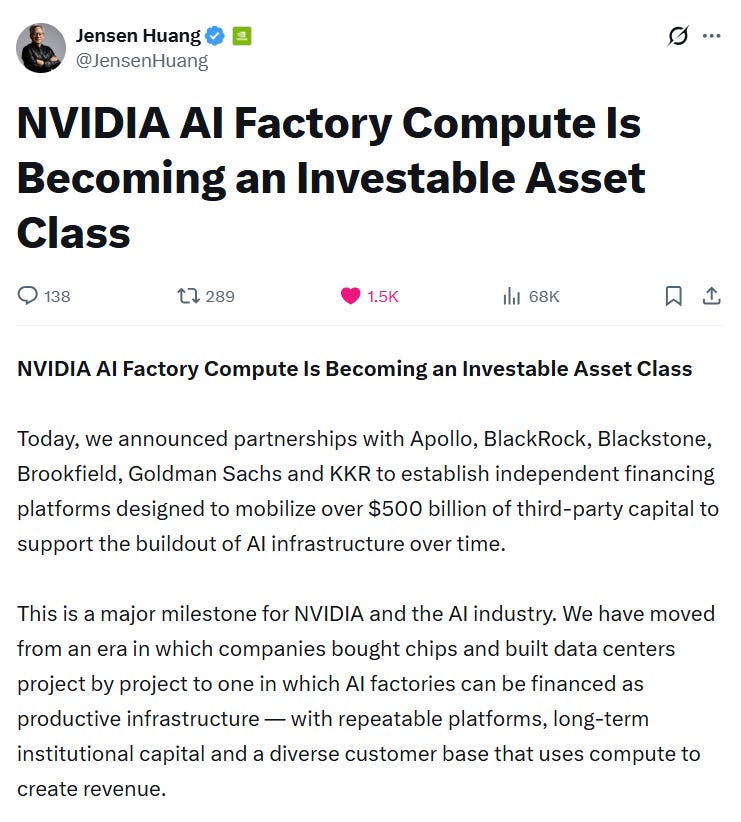
NVIDIA is partnering with Apollo, BlackRock, Blackstone, Brookfield, Goldman Sachs, and KKR to mobilize more than 500 billion dollars in third party capital for AI infrastructure.
The framing is clean and confident. Compute is becoming an investable asset class, like toll roads or commercial real estate. NVIDIA provides the platform, the financial institutions provide the capital and the underwriting discipline, and everybody wins.
Read it again, slower. What actually happened is that NVIDIA found a new balance sheet to stand on. And the balance sheet it found belongs, eventually, to your 401k.
That is not a metaphor. It is the literal mechanical path the money takes. To understand why this deal matters, you have to walk through three layers of economics, because each layer solves the exact problem created by the layer before it, and each solution pushes the same underlying risk one step further from anyone who chose to take it.
First order: the circular loop everyone already knows about
Start with the thing people have been complaining about for over a year.
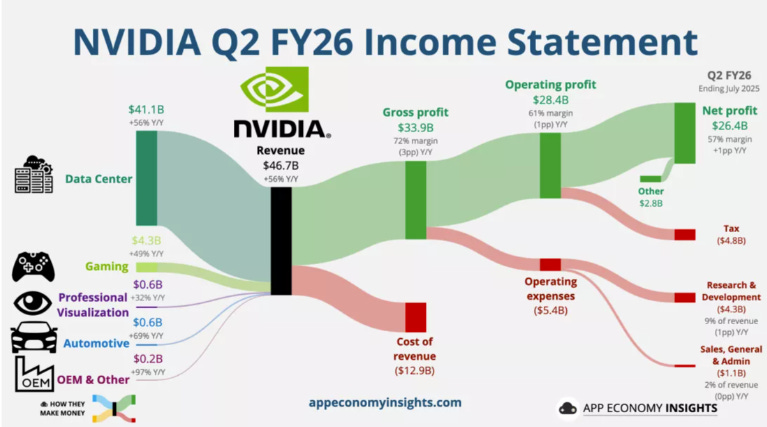
NVIDIA invests in its own customers, those customers use the money to buy NVIDIA chips, and NVIDIA books the sale as revenue. Between 2020 and 2025, NVIDIA made roughly 170 investments worth about 53 billion dollars across the AI ecosystem, including stakes in OpenAI, CoreWeave, and Nebius, companies that turn around and spend heavily on NVIDIA hardware.
In 2025 alone the pace accelerated to 59 deals worth 23.7 billion dollars. NVIDIA holds a 91 percent stake in CoreWeave. It committed up to 100 billion dollars to OpenAI. It just put up to 10 billion into Anthropic alongside a 5 billion dollar Microsoft investment, with Anthropic agreeing to buy 30 billion dollars of Azure compute in return.
Jensen calls the circularity accusation ridiculous, and he has a point in the narrow sense that his equity checks are small relative to what these companies raise elsewhere.
But the deeper issue was never the size of any single check. It was that the whole ecosystem’s reported demand was being partially financed by the same company selling the product, which makes it structurally hard to tell how much of the AI buildout reflects end user willingness to pay versus vendor financed order backfilling.
That is first order circularity, and it’s the version of this story that’s been in the financial press for a year.
Second order: the banks said no, so the debt went private
First order circularity created a second, less visible problem: concentration risk on bank balance sheets.
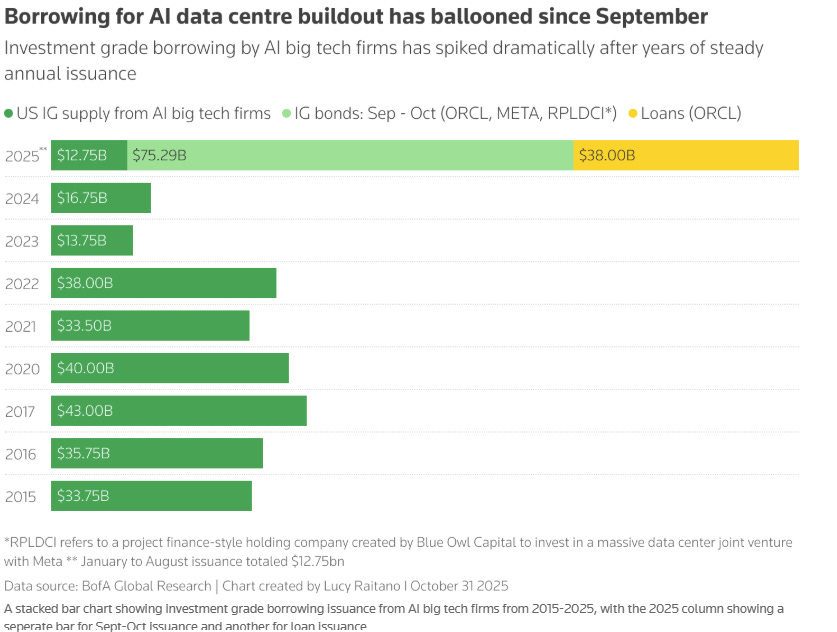
Oracle’s roughly 300 billion dollar buildout commitment tied to OpenAI pushed major banks toward their single counterparty concentration limits.
Data center construction loans are unusually large relative to typical infrastructure lending, so a handful of delayed or canceled projects can blow out a bank’s exposure to the entire sector. Once banks hit those limits, they stopped being willing or able to originate new data center debt at the pace the buildout needed.
So the financing moved somewhere banks don’t have to answer to regulators about single name concentration: private credit.
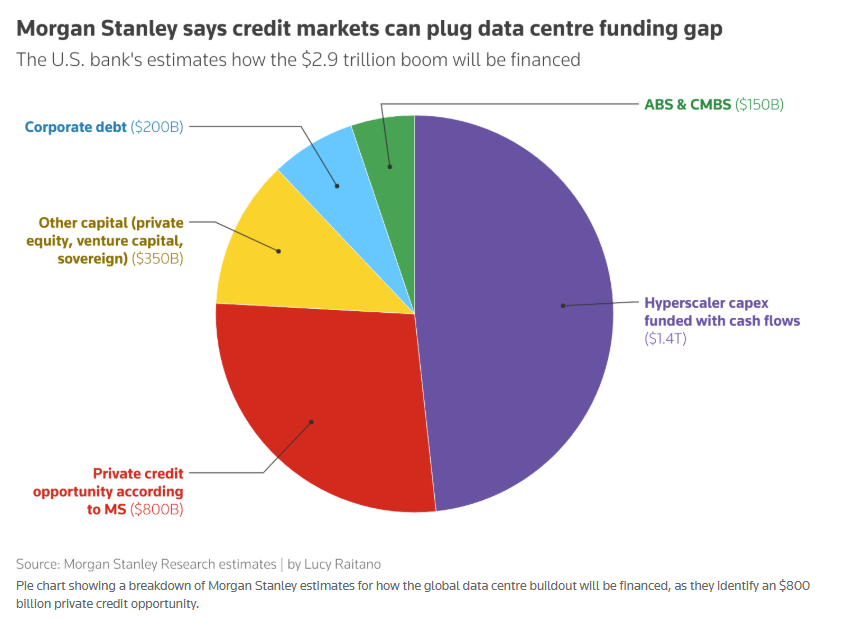
Loans from private credit funds to AI related companies went from near zero to over 200 billion dollars in a few years, and Morgan Stanley projects another 800 billion in private data center financing on top of that.
CoreWeave’s 7.5 billion dollar debt facility, arranged through Blackstone’s tactical opportunities group, is secured by the company’s GPUs and customer contracts, carries a variable rate around 11 percent, and started requiring repayment just as the value of that GPU collateral was already softening. CoreWeave’s interest payments now eat about 26 percent of revenue and 46 percent of adjusted EBITDA.
This is the second order move. Risk that used to sit on regulated bank balance sheets, subject to stress tests and capital requirements, got repackaged as private credit and moved to firms that don’t face the same oversight.
Third order: private credit needs duration capital, and duration capital means your retirement
Private credit funds don’t hold this debt forever on their own money.
They raise it from limited partners who want long duration, stable yield assets to match long duration, stable liabilities.
Who has liabilities like that? Pension funds and insurance companies.
That’s not incidental, it’s the entire point of the structure. Larry Fink said this part back in May, describing the roughly 10 trillion dollars of infrastructure investment the US needs over the next decade as money that has to come from savings accounts, pension accounts, and insurance companies, because the private sector is where the scale actually lives.
The channel is already well established.
New York and Pennsylvania state pension plans have money in Blue Owl’s 7 billion dollar digital infrastructure fund, the same fund behind Meta’s data center financing vehicles and multiple Oracle deals.
Major life insurers now hold nearly a trillion dollars in private credit overall. When hyperscaler backed data center bonds have come to market, insurance companies and pension funds have been the primary buyers, and demand has run multiples over what was offered, in one case more than three times oversubscribed for what were otherwise speculative grade bonds.
The Bank for International Settlements flagged this pattern in July, noting that when project failure risk lands on institutional investors rather than banks, there’s no equivalent resolution mechanism to absorb the shock in an orderly way.
Now look at what NVIDIA just announced. Apollo, BlackRock, Blackstone, Brookfield, Goldman, and KKR are not just asset managers.
They are the exact firms that specialize in taking illiquid, long duration credit exposure and repackaging it for pension plans and insurers who need yield to meet actuarial obligations decades out.
A 500 billion dollar financing platform built with these six firms isn’t NVIDIA discovering a new customer base. It’s NVIDIA institutionalizing the pipeline from GPU demand directly into retirement capital, at a scale and with a repeatability that ad hoc private credit deals never had.
The binding constraint was never capital. It’s who eats the loss.
Every version of this story from Jensen’s team makes the same argument.
NVIDIA compute is fungible, software upgradeable through CUDA, and backed by a deep pool of potential buyers if any single customer fails, so it behaves like durable infrastructure rather than a depreciating asset.
The A100 example gets rolled out constantly: introduced in 2020, still in active commercial use six years later. That’s true, and it’s also not the relevant question. The relevant question is what a GPU is worth relative to the newest generation, not whether it still runs.
One year H100 rental pricing went from about 1.70 dollars per GPU hour in October 2025 to 2.35 dollars in March 2026, while Blackwell capacity already commands 5.30 to 7.05 dollars per hour. Older silicon doesn’t stop working, it just stops earning what it used to, and every financing model built on residual value assumes someone will keep paying a premium for compute that’s no longer the frontier.
NVIDIA’s own announcement quietly acknowledges this. It’s offering a residual value support mechanism covering up to 25 percent of a given financing opportunity. That’s NVIDIA underwriting a slice of the downside on the assets it’s selling into these platforms.
Fair enough as far as it goes, but it means 75 percent of the residual value risk, plus all of the demand and utilization risk, sits with capital that has no equity upside if the trade works and full exposure if it doesn’t.
That’s the actual second and third order economics here.
First order, the ecosystem financed its own demand. Second order, that financing moved from regulated banks to unregulated private credit because banks hit real limits.
Third order, private credit funded itself with pension and insurance money that needs the yield but has no real way to independently verify utilization, demand durability, or GPU obsolescence risk fifteen layers removed from the actual data center.
None of this makes the AI buildout fake.
Enterprises are shipping real products with this compute, and usage is genuinely growing.
But real usage growth and a well underwritten financing structure are two different claims, and the entire architecture of this 500 billion dollar deal exists because the first three years of AI infrastructure financing already ran into limits that regulated capital wouldn’t cross.
Pension funds and insurers are not being brought in because they have superior judgment about GPU depreciation curves. They’re being brought in because they’re one of the last remaining pools large enough to absorb the scale this buildout requires, and because their liabilities are long dated enough that any reckoning is somebody else’s problem for a decade.
If the revenue shows up on schedule, this looks brilliant in hindsight, a natural infrastructure asset class finding its natural capital base.
If it doesn’t, and there are already senators writing formal letters about opaque debt markets and Moody’s publishing notes questioning whether AI data center leases will hold up as advertised, the loss doesn’t land on NVIDIA’s equity holders, who’ve had a decade long run to build a cushion.
It lands on whoever’s retirement plan bought the bond, years after the fact, with no idea the exposure was ever there.
What this means if you’re building, operating, investing, or governing
If you’re a founder building on top of AI infrastructure, the message is that compute pricing has a floor set by financing economics, not just supply and demand, which means the “AI is getting cheaper” trend line is less guaranteed than it looks once older GPU generations need to keep earning their financing costs.
If you’re an operator running AI transformation inside a company, pay attention to which vendors are structurally exposed to this financing chain, because a private credit stress event in the neocloud layer would hit availability and pricing for everyone downstream, not just the company that defaulted.
If you’re an investor, the tell to watch is not NVIDIA’s revenue growth, it’s the spread and coverage ratios on hyperscaler and neocloud bonds. Forbes already flagged softening demand and declining coverage ratios on that paper earlier this summer. That’s the canary, well before anything shows up in NVIDIA’s own numbers.
If you’re in government or policy, the four senators who wrote that letter in January were asking the right question before it was fashionable.
The exposure here isn’t concentrated in a few AI companies anymore. It’s distributed across pension funds and insurers whose beneficiaries never consented to a GPU depreciation bet, and there is currently no equivalent of a bank resolution regime for what happens when that bet goes wrong at scale.
NVIDIA found a new place to put the risk that the first two rounds of financing couldn’t hold anymore. That’s worth understanding clearly, because retirement money doesn’t get to renegotiate the way a hyperscaler balance sheet can.