
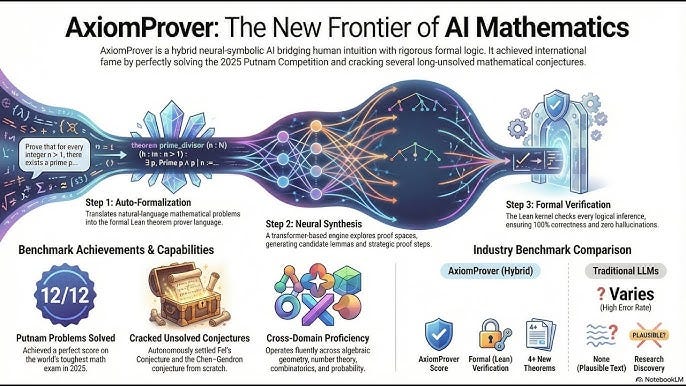
People frame Math AGI as a productivity upgrade for math researchers.
That’s the wrong mental model; and it’s costing decision-makers the most important strategic window of the decade.
Here’s the frame: Math AGI is not about doing math faster. It’s about who controls the reasoning layer underneath every future economy.
The Mental Model
Think of economic infrastructure in layers:
Layer 1 — Physical: Roads, ports, energy grids. Nations own this or die.
Layer 2 — Digital: Internet, cloud, telecommunications. America won this round.
Layer 3 — Cognitive: The reasoning and optimization infrastructure that allocates resources, prices risk, and coordinates complexity at civilizational scale.
Layer 3 is being built right now. By fewer than 10 actors who understand what they’re actually constructing.
Everyone else is watching and calling it “AI for math.”
The Power Map (Real Version)
Forget the public narrative about benchmark scores and theorem-proving competitions. Map the actual power concentrations:
Camp 1 —> Formal Proof Engines (Axiom, DeepMind Alpha systems, Lean-adjacent AI)
The public story: automated theorem proving. Academic curiosity.
The behind the scene story: these are flawless reasoning architectures being trained on domains where ground truth is verifiable. Mathematics is just the training ground. The output is a system that can reason without hallucination in high-stakes environments; financial contracts, regulatory compliance, supply chain failure modes, legal arbitration.
When reasoning becomes verifiable and cheap, every institution that currently employs armies of analysts to reduce uncertainty becomes a restructuring candidate.
Camp 2 —> Quantitative Optimization AGI (Renaissance, Two Sigma, Palantir, Nvidia’s compute stack)
This is the most secretive and most consequential camp. The least discussed publicly. That silence is the signal.
Quant funds have been running proto-versions of Math AGI for 30 years. Renaissance Technologies didn’t build a hedge fund. They built a closed-loop mathematical intelligence system that modeled market microstructure better than any human team could; then extracted systematic alpha from a market that had no idea what it was playing against.
The next iteration doesn’t just trade markets. It is the market; simulating order flow, modeling second-order participant behavior, optimizing execution across jurisdictions in real time.
Palantir is the B2B face of this same thesis: sell the optimization layer to governments and enterprises who cannot build it themselves. The product isn’t software. It’s the cognitive infrastructure that replaces the judgment layer inside institutions.
Camp 3 —> Engineering-Reality AGI (Tesla, Nvidia Omniverse, DARPA-adjacent defense AI)
This is Math AGI meeting physical reality. Autonomous vehicle fleets aren’t a transportation play; they’re a continuous-optimization problem running in the real world at scale, generating feedback loops that improve the underlying model. Same structure applies to grid management, materials discovery, defense logistics.
Nvidia understood this before anyone else. They didn’t sell you a GPU. They sold you the only compute substrate capable of running these systems; and then built Omniverse as the simulation layer where Math AGI can be trained against reality before touching it.
The military implications are not subtle. The nation that can run faster, higher-fidelity simulations of conflict, resource allocation, and economic interdependency will make better decisions faster than the one that cannot. War gaming becomes real-time strategic optimization.
Where the Capital Actually Lands
Three markets. Radically different timelines. Same underlying infrastructure play:
Finance is the immediate market. The Bloomberg Terminal was the information layer. Math AGI is the reasoning layer. Whoever builds the reasoning termina; the system that doesn’t just surface data but tells you the optimal decision across a defined objective function; owns the most valuable seat in capital markets for the next 30 years.
Energy and Resource Extraction is the medium-term market that nobody is pitching yet. Mining optimization, grid balancing, extraction sequencing; these are pure mathematical optimization problems running on physical constraints. The companies that plug Math AGI into resource operations will structurally outcompete on margin before competitors understand what changed. Expect the first wave to be invisible: efficiency gains that look like operational excellence until the spread becomes impossible to close.
Government is the sleeper. This is the insight that separates strategic thinkers from everyone else in the room.
Governments run the largest, most complex resource allocation problems on earth. Tax policy, infrastructure prioritization, healthcare distribution, defense posture, monetary supply; these are optimization problems currently solved by committees of humans using intuition, ideology, and incomplete data.
The government that deploys Math AGI against its own resource allocation decisions will operate with a structural advantage over every government that doesn’t. The government that rents this capability from a private company will have optimized its decision-making while creating a dependency that transfers sovereignty at the margin.
That’s the knife edge. And most governments don’t know they’re standing on it.
The Insight Hidden in Plain Sight
Renaissance Technologies proved the entire thesis three decades early.
Jim Simons built a closed mathematical system that modeled human market behavior better than the humans creating it; and ran that advantage systematically, at scale, in near-silence, for 30 years. The Medallion Fund isn’t an investment vehicle. It’s proof of concept for what happens when mathematical reasoning infrastructure meets a complex adaptive system that can be modeled and exploited.
The next version of this operates at civilizational scale.
It doesn’t trade stocks. It simulates economies; running thousands of policy scenarios against real constraint sets to find the decisions that optimize for defined national objectives. It models climate risk not as a ESG checkbox but as a resource and infrastructure optimization problem with 50-year decision horizons. It runs national resource allocation across competing priorities in real time.
This is not speculative. The architecture exists. The question is only who builds it first, who controls it, and who is left renting cognition from someone else’s infrastructure.
The Sovereignty Frame (The One That Matters)
Here is the power map distilled to its essential logic:
Nations that own the reasoning layer: make autonomous decisions across economic, military, and resource domains. Operate with full strategic agency.
Nations that access the reasoning layer through allied partners: gain capability but accept dependency. Strategic agency is real but bounded by the relationship.
Nations that rent the reasoning layer from private companies: outsource judgment to entities whose incentives are not aligned with national interest. The optimization function is running; but it’s running for shareholders, not citizens.
Nations that don’t engage: make decisions using 20th century tools against adversaries using 21st century infrastructure. The gap compounds.
The Window
Fewer than 10 serious actors are in this race at the level that matters. The gap between the front-runners and the field is already significant and accelerating.
The window for governments, sovereigns, and institutions to engage as principals; rather than customers; is closing. Not in decades. In years.
The decision that looks optional today becomes non-negotiable when the infrastructure is mature and the pricing power is established.
History doesn’t remember who studied the map. It remembers who moved first.
The Full Stack Capitalist thesis: AI doesn’t just change what’s possible. It rewrites who controls the decision-making layer of economies, institutions, and nations. The operators who understand this before the market prices it in are playing a different game entirely.