

Well, this is awkward.
I spent months building an AI startup, got it to a proposed A$1 million valuation, rejected a A$500K investment offer, and then decided to leave.
My co-founder is keeping the business. We’re on good terms.
Nobody stole the code. Nobody ran away with the money. There’s no lawsuit coming.
Pretty disappointing by startup drama standards.
But I learned more about business economics in those few months than I expected.
And since this is Full Stack Capitalist, I figured I’d share the numbers, the mistakes and the stuff most founders conveniently leave out of their LinkedIn success stories.
Today:
How we built SearchFit from zero to 1,000+ users.
Why 600 credit cards turned into just 17 paying customers.
How we discovered that our $100 product might actually be a $5,000 product.
Why we rejected A$500K at a proposed A$1M valuation.
Why my co-founder and I decided to go our separate ways.
The seven things I’d do differently.
Let’s get into it.
1. We had an idea. AI made building it stupidly easy.
The original idea was pretty straightforward.
For 20 years, Google decided which businesses got discovered online.
Then ChatGPT happened.
Suddenly people started asking AI assistants questions like:
What’s the best accounting software for my company?
Which cybersecurity provider should I use?
What’s the best CRM for a small business?
Which agency should I hire?
And AI started answering.
Sometimes it recommended brands. Sometimes it completely ignored them.
That created an interesting question.
If AI is becoming a new discovery channel, who’s helping businesses understand whether they’re being recommended?
That’s where SearchFit came from.
We built a platform to help brands understand and improve their visibility across AI-powered search and recommendation systems.
And here’s what surprised me.
Building the software wasn’t particularly difficult. Building a business around it was a different story.
AI-assisted development meant we could move quickly without a massive engineering team.
Features that might previously have required weeks could be prototyped much faster.
We built.
We launched.
We started getting users.
At one point, we had more than 1,000 registered accounts.
Beautiful.
For about five minutes, I thought we were onto something enormous.
Then I looked at the revenue.
2. We had 600 credit cards and almost no money.
Here are the numbers.
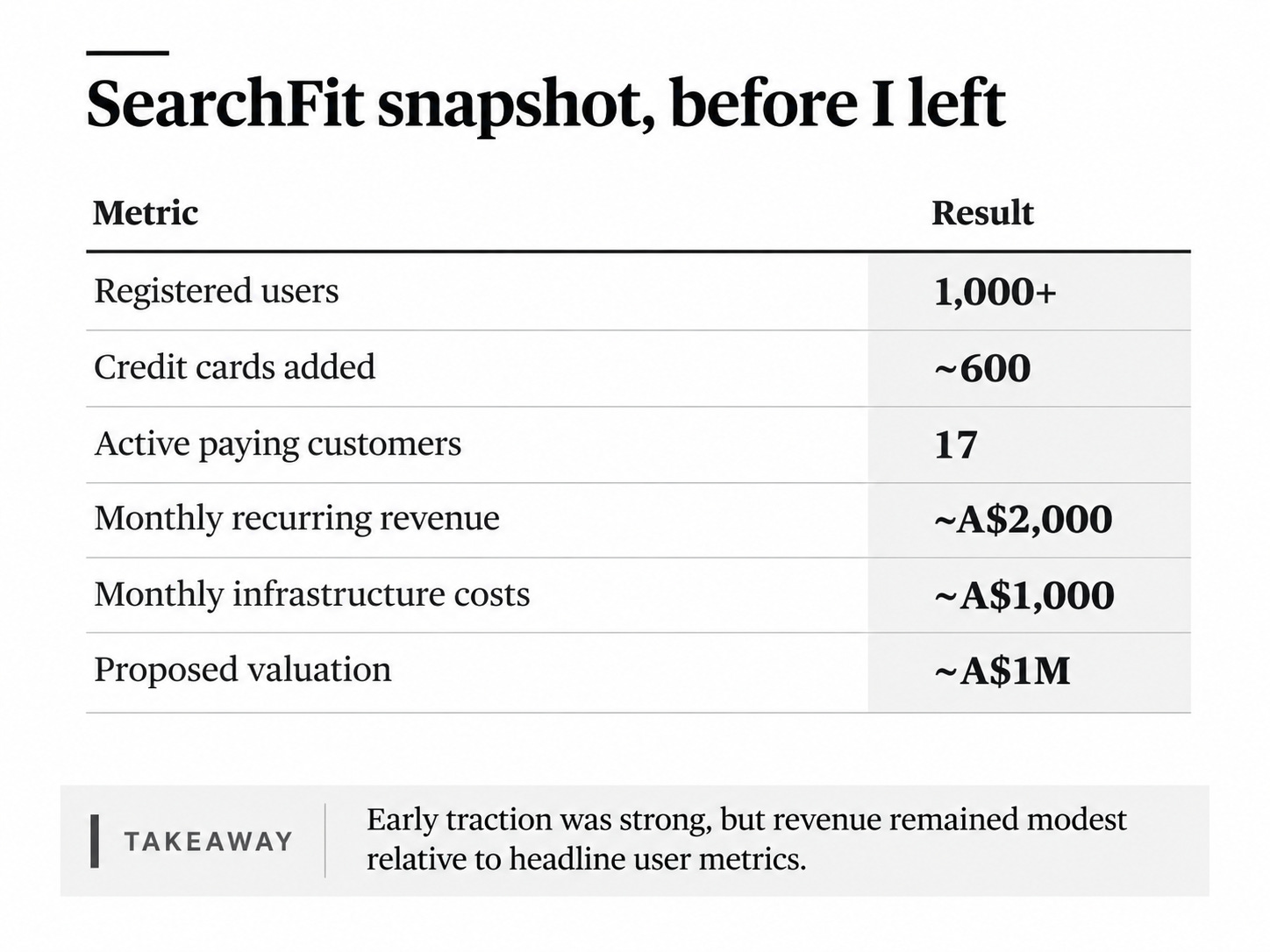
The LinkedIn version:
1,000+ users.
600 credit cards.
AI startup.
Seven-figure proposed valuation.
Investment offer on the table.
Sounds like the next unicorn.
The bank account version:
17 paying customers.
Around A$2K in monthly recurring revenue.
Roughly A$1K going straight to infrastructure.
And two founders doing the work.
Not exactly a money-printing machine.
And that A$1K remaining wasn’t profit. We still had marketing, development, support and our own time to account for.
Here’s something I learned quickly.
People entering credit card details is not the same thing as people wanting to pay you.
And people wanting to pay you once is not the same thing as building a business they’ll keep paying for.
Registrations are nice.
Revenue is nicer.
Profitable, repeatable revenue is where things start getting interesting.
3. We were selling a $100 product to the wrong people.
Our initial commercial model included pricing around US$100 per brand per month.
Reasonable, right?
Except there’s a problem with selling a $100 product.
You need a lot of customers.
Here’s the maths:
$1K MRR: 10 customers.
$10K MRR: 100 customers.
$50K MRR: 500 customers.
$100K MRR: 1,000 customers.
That’s assuming everybody pays the same price and nobody churns.
Good luck with that last part.
And those 1,000 customers all need to be acquired, activated, supported and retained.
Now, there are fantastic businesses selling $100 products.
But they usually have brilliant distribution, low acquisition costs, strong retention and efficient support.
We hadn’t proved any of those things.
We also attracted quite a few users who weren’t our ideal customers.
Freelancers. People experimenting with AI. Users from markets where $100 a month was a significant expense.
They were curious.
Curiosity, unfortunately, doesn’t pay the AWS bill.
We were getting attention without enough commercial intent.
Lesson: The wrong 1,000 users can be worth less than the right 10 customers.
And then something interesting happened.
4. A London agency changed how I looked at the entire business.
We started having conversations with marketing agencies.
Australia. New York. London.
Three agency opportunities were in the pipeline.
One agency in London was interested in managing around 50 brands.
They also wanted something we hadn’t properly built yet.
White-label functionality.
At first, it sounded like another feature request.
Then I started thinking about the economics.
An individual brand might pay US$100 per month.
An agency managing 50 brands could potentially represent US$5,000 per month at that same per-brand rate.
Same underlying technology.
Completely different commercial opportunity.
Now imagine 20 agencies paying $5,000 monthly.
That’s $100K MRR.
Instead of managing relationships with 1,000 individual customers, you’re managing 20 higher-value accounts.
Of course, enterprise and agency customers bring their own problems: longer sales cycles, more demanding requirements, account management and potentially more expensive support.
And the London opportunity wasn’t a signed $5K-per-month contract.
It was a signal.
But it was an important signal.
We weren’t necessarily building a product for brands. We might have been building revenue-generating infrastructure for agencies.
That changes everything.
Your pricing changes.
Your sales strategy changes.
Your product roadmap changes.
Your ideal customer changes.
Even the features you prioritise change.
And suddenly, you’re not selling another AI dashboard.
You’re helping an agency create a new commercial offering.
I wish we’d discovered that distinction much earlier.
5. Someone offered us A$500K. We said no.
Then came the interesting part.
We received an investment proposal.
Approximately A$500K of capital, at a proposed company valuation of around A$1 million.
For a business that had been in the market for less than six months, it was a serious conversation.
There was even a proposal for founder salaries of around A$110K each.
Which, after months of building something with very limited revenue, sounded rather appealing.
But the proposed ownership structure was the problem.
The investor wanted approximately 53% of the company.
That’s a significant amount of control and dilution to give away at such an early stage.
We started asking ourselves some uncomfortable questions.
Were we selling too much of the company too early?
Could we reach $10K MRR without external investment?
Would the extra capital actually solve our commercial problems?
What would our ownership look like after another funding round?
Were we buying growth or just funding more experimentation?
Ultimately, we rejected the offer.
Now, I know what some people will say.
You had 17 paying customers and someone offered you half a million dollars. Are you insane?
Fair question.
And I can’t tell you with certainty that rejecting it was the right financial decision.
Maybe that capital would have helped us build the agency features and accelerate growth.
Maybe we’d have spent it all proving that our assumptions were wrong.
We’ll never know.
But the experience taught me something important.
A valuation is not money. And investment capital is not revenue.
A company can have a proposed million-dollar valuation and still struggle to generate $2,000 a month.
We were living proof.
6. I finally understood opportunity cost.
This one hit me harder than anything else.
I’ve spent years working on enterprise technology and commercial transformation.
At Cisco, I worked on a $16M data and analytics program.
At AVEVA, I’ve worked on enterprise service offerings, pricing, contract performance, customer operations and margin improvement.
I’ve seen firsthand how large organisations spend money, lose money and struggle to turn technology investments into measurable results.
And then I found myself spending substantial time trying to sell a $100 subscription.
Nothing wrong with that.
But I began questioning whether it was the highest-value use of my experience.
Think about the difference.
Business A:
Sell software for $100 a month.
Need hundreds of paying customers.
Manage acquisition, churn, support, infrastructure and product development.
Business B:
Help an enterprise recover $5M in margin leakage.
Or build a new $10M revenue stream.
Or commercialise a technology investment across an entire business unit.
One well-scoped engagement could be worth hundreds of thousands of dollars.
Now, Business B isn’t automatically easier.
The sales cycle could take a year. Procurement can be painful. Delivery risk is substantial. And you need a credible team.
But the size of the economic problem is different.
And I realised that’s where I want to spend more of my professional energy.
Not necessarily building another startup from zero.
Potentially building ventures inside established companies.
Working on enterprise commercialisation.
Solving problems where the financial outcome justifies serious investment.
Or simply building my own distribution and waiting for the right opportunity.
Sometimes the smartest business decision is deciding which game you no longer want to play.
7. Seven things I’d tell anyone building an AI startup
After all this, here’s my advice.
Not from someone who sold a company for $100M.
From someone who built one, received a serious investment proposal, and still decided to leave.
1. Don’t confuse building software with building a business.
AI makes product development cheaper. It doesn’t magically create customers.
2. Find the buyer before celebrating the users.
1,000 registrations look good on a dashboard. Seventeen paying customers are a better reality check.
3. Price around the economic problem, not the cost of your software.
If your product helps a business generate $100K, why are you automatically charging $100?
You still need to prove the value, of course.
4. Distribution is probably more valuable than your next feature.
We could build features quickly. Finding the right customers was considerably harder.
5. Founder alignment matters more than the equity split.
You can agree on ownership and still disagree about time, capital, risk and ambition.
Have those conversations early.
6. Raising money is not the same thing as making money.
A $500K investment is financing.
A $500K customer contract is revenue.
A $500K profit is something else entirely.
Don’t mix them up.
7. Walking away isn’t always quitting.
Sometimes you’re just reallocating capital.
And your time is capital.
8. So, what am I doing now?
For once, I’m not rushing to start another company.
No urgent hunt for a co-founder.
No new SaaS idea I need to validate by Friday.
No plan to build seventeen AI agents and call it a business.
I’m going to focus on what I already have.
My experience.
My writing.
My professional network.
And something I’ve been building for a while:
I want to turn it into a serious independent publication about the economics of business.
The things I find genuinely fascinating:
Why Apple makes extraordinary margins on services.
Why Atlassian can raise prices and keep customers.
How companies lose millions through revenue and margin leakage.
Why some AI businesses have no defensible assets.
How companies turn technology into commercial advantage.
Where capital, infrastructure and market power intersect.
And how to build ventures without making stupid financial decisions.
I’ll be publishing the actual numbers, operating playbooks and commercial analysis.
The good decisions.
The expensive mistakes.
The stuff that doesn’t fit into a motivational LinkedIn post.
And maybe, eventually, I’ll find another business worth building.
But I’m in no rush.
I’ve learned that not every opportunity deserves your capital, even when that capital is just your own time.
One last thing
Would I build SearchFit again?
Probably.
Would I make the same commercial decisions?
Absolutely not.
Would I reject that A$500K investment again?
I genuinely don’t know.
And anyone who claims to know exactly how an unchosen startup path would have played out is probably trying to sell you a course.
For now, I’m happy with the decision.
My co-founder gets to continue building something he believes in.
I get to focus on the next chapter.
And you get to read about all the expensive lessons without paying the tuition.
Not a bad deal.
If you got something useful from this story, share it with a founder who’s currently celebrating their user numbers.
They might hate you for it.
But they’ll probably thank you later.
Until next time,
Houman
Full Stack Capitalist
Technology × Strategy × Capital
P.S. I’m curious: Would you have accepted A$500K in exchange for 53% of a startup doing roughly A$2K in monthly recurring revenue? Or would you have walked away?
I’d genuinely like to hear the arguments for both sides.