

The AI hardware stack is not one market. It is a layered system of complementary chokepoints.
Control is split across a few segments: design and much of the software stack in the United States, leading-edge fabrication in Taiwan, EUV lithography in the Netherlands, key memory in South Korea and the U.S., packaging and test in Taiwan and Malaysia, and critical-mineral processing disproportionately in China. The result is not just concentration. It is strategic fragility: a system in which a small number of firms and jurisdictions can stall entire AI build-outs because the inputs are complementary rather than substitutable.
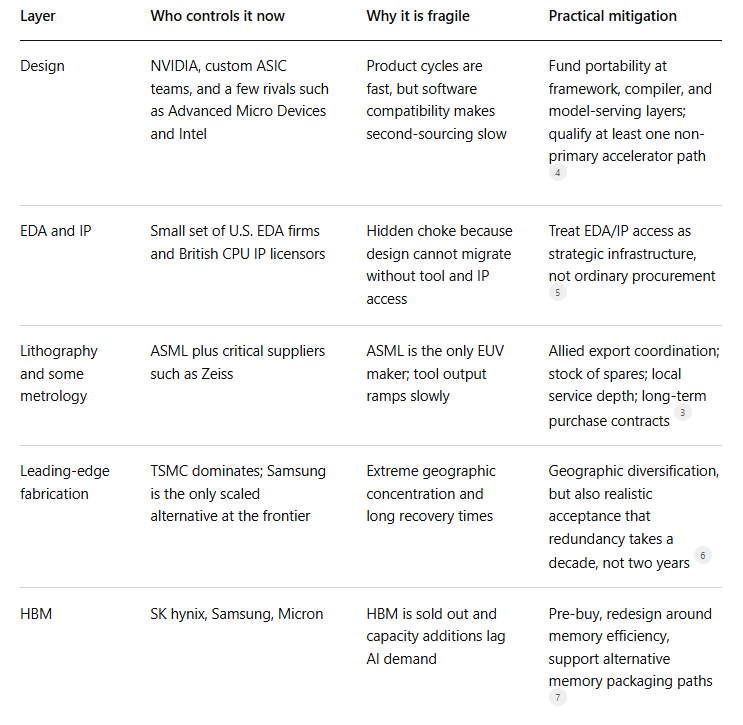
The most important 2025–2026 shift is that the binding constraint moved down the stack. In 2025, public evidence suggests advanced packaging and HBM, not logic dies, were the primary bottlenecks for frontier AI accelerators. Epoch AI estimates the four largest AI chip designers consumed roughly 90% of global CoWoS capacity and HBM supply in 2025, while consuming only about 12% of advanced logic die production. At the same time, Micron said its entire 2026 HBM supply was already committed, and Samsung Electronics reported expanding HBM sales despite “limited supply availability.” TSMC continued to report demand for 3nm and advanced packaging above current capacity.
This gives a cleaner strategic picture. The decisive power in AI hardware does not sit only with GPU designers such as NVIDIA. It sits in the interfaces between layers: lithography at ASML, HBM at SK hynix and Micron, advanced packaging at TSMC and top OSATs, and downstream cloud concentration among Amazon, Microsoft, and Alphabet. Leaders should think less in terms of “chip self-sufficiency” and more in terms of time-to-survive, substitute paths, and jurisdictional redundancy.
Current map of control and chokepoints
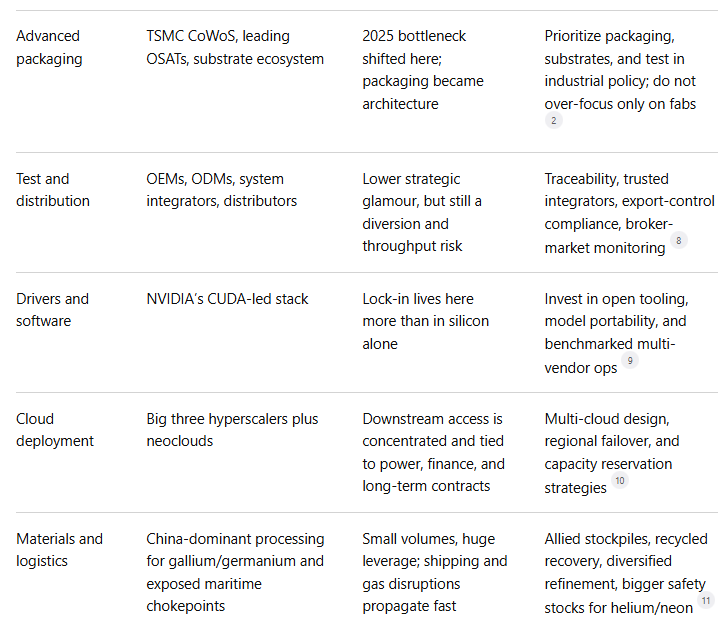
The current AI hardware chain can be summarized as a stack of bottlenecks, each with a different control logic. The front end is capital-intensive and physics-constrained; the middle is packaging- and memory-constrained; the back end is increasingly software-, cloud-, and power-constrained.
concentratedconcentratedchokepointchokepointchokepointchokepointconcentratedDesign and architectureEDA and IPEquipment and materialsLeading-edge wafer fabricationHBM productionAdvanced packagingTest and assemblySystems and server buildDrivers and software stackCloud and neocloud deploymentEnterprise and model developer useGPU and ASIC designersUS EDA and UK CPU IPEUV tools and precision opticsLeading-edge fabsHBM suppliersCoWoS, substrates, interposersBig three hyperscalers
The diagram above is a simplification, but the strategic point is simple: every step can block the next. That is why “GPU supply” is really an O-ring system, not a commodity chain.

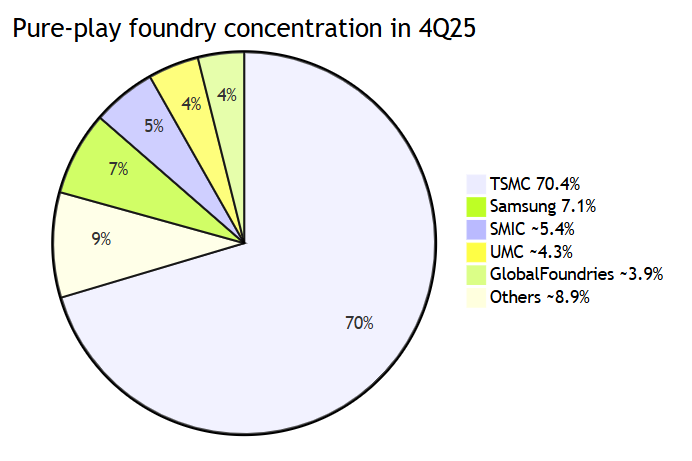
TrendForce’s 4Q25 data show how acute foundry concentration has become. The pie below uses TrendForce’s explicit market shares for TSMC and Samsung and revenue-derived approximations for the next three foundries using the stated top-10 revenue pool of $46.3 billion. The point is directional, not cosmetic: one company sits in a class of its own.
Downstream concentration is also severe. Synergy estimates that in Q4 2025 the top three cloud providers held about two-thirds of cloud infrastructure spending, with AWS at 28%, Azure at 21%, and Google Cloud at 15%. Reuters reported that major cloud firms are on track to spend more than $600 billion on data centers in 2026. So fragility is now both upstream and downstream.
Why the structure looks like this
The present stack is the cumulative result of forty years of specialization, scale economics, and policy shocks. TSMC created the dedicated-foundry model in 1987, separating design from fabrication. NVIDIA launched CUDA in 2006, turning hardware leadership into a software-and-tools moat. SK hynix introduced HBM in 2013, and advanced packaging moved from backend detail to core system architecture. Meanwhile, hyperscalers converted compute from a product market into a capacity market.

Policy accelerated the concentration story instead of reversing it. The U.S. CHIPS and Science Act and parallel subsidy programs created a global incentive race, but most announced investment still flows toward a few already-advantaged firms and ecosystems. The EU’s own auditors now say the European Chips Act is unlikely to achieve its 2030 market-share ambition under current conditions. Japan and South Korea doubled down on national champions and targeted support. Export controls reshaped flows but also made “trusted geography” a pricing premium.
The export-control arc matters. The U.S. October 2022 rule reoriented semiconductors from trade goods to strategic infrastructure. The Netherlands tightened semiconductor-equipment controls again in January 2025. BIS then issued the January 2025 AI Diffusion framework and foundry due-diligence measures, only for the AI Diffusion rule to be rescinded on May 13, 2025 before taking effect. That sequence increased uncertainty even as it reinforced the basic direction of travel: thicker borders around compute, equipment, and model infrastructure.
What this resembles in prior eras
The closest analogue is oil, not traditional manufacturing. Like oil, AI hardware relies on a few irreplaceable nodes whose disruption matters more than average market diversity. That is why the best mental frame is not price competition but chokepoint leverage. The Strait of Hormuz carries around a quarter of seaborne oil trade; similarly, frontier AI still leans on a handful of physical nodes and firms with outsize systemic importance.
It also resembles container shipping. UNCTAD reported that by May 2025 Suez tonnage was still 70% below 2023 levels. The lesson is that a highly optimized system can look robust right up until one lane closes. GPU supply works the same way. Average utilization looks efficient; single-route dependence is what kills resilience.
The software layer looks more like telecom and operating-system history. CUDA is not just a toolchain. It functions like a proprietary control plane. That is the same pattern seen in earlier platform industries: whoever controls the interfaces captures more value than whoever merely ships components.
The semiconductor analogy also matters. The old lesson was “fabs are strategic.” The 2025–2026 update is blunter: packaging, memory, power, and cloud tenancy are now just as strategic as fabs. That is the biggest strategic misconception still visible in policy.
Solutions, opportunities, and a 10–20 year plan
For governments, the cleanest mistake to avoid is fab tunnel vision. A serious resilience strategy prioritizes advanced packaging, HBM, substrates, gases, test, power, water, and workforce alongside fabs. Short-run policy should build stockpiles for helium, neon, gallium, and germanium; speed permitting for power and water infrastructure near semiconductor clusters; and coordinate allied spare capacity rather than chasing pure national autarky. Mid-run policy should fund open accelerator software, chiplet and packaging R&D, and trusted cross-border procurement frameworks. Long-run policy should aim for a genuinely multi-regional stack in which no single jurisdiction controls more than one irreplaceable node.
For enterprises, the agenda is more operational. Qualify at least one non-primary compute path. Separate model architecture from vendor-specific kernels where possible. Pre-book packaging and memory earlier than most procurement teams think necessary. Treat power, cooling, and colocation as part of chip strategy. Map tier-2 and tier-3 suppliers, not just direct vendors. And stop assuming cloud access equals supply security: the big three remain dominant, and indirect concentration in NVIDIA revenue shows how visibly the market is clustering around a small number of routes.
For startups, the opportunity set is better than it looks. The obvious GPU race is crowded; the gap industries are not. The strongest openings are packaging-aware design tools, HBM-efficiency software, interconnect and optical networking, cluster scheduling, test and traceability, secondary GPU refurbishment, substrate and thermal-management innovation, and sovereignty tooling that helps firms operate across multiple clouds and jurisdictions. That is where fragility is creating demand faster than incumbents can absorb it.
Mental models leaders should use
Leaders should use five mental models. First, the O-ring model: one missing complement can destroy total output. Second, weaponized interdependence: the most central nodes gain coercive leverage. Third, time-to-survive versus time-to-recover: resilience is about duration mismatch, not just failure probability. Fourth, war of complements: software, cloud access, power, and packaging can be as decisive as the GPU itself. Fifth, optionality premium: in a supply-constrained system, paying more for redundancy is rational, not wasteful.
Priority reading list and data gaps
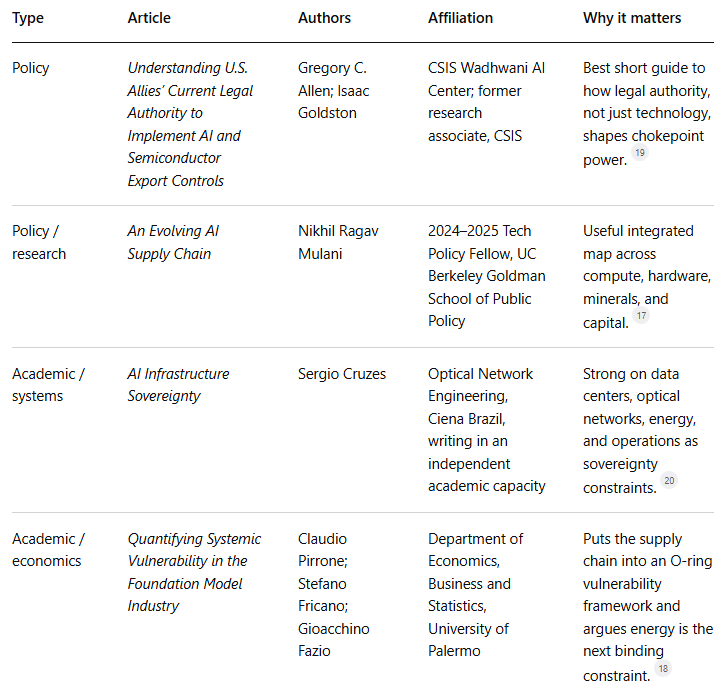
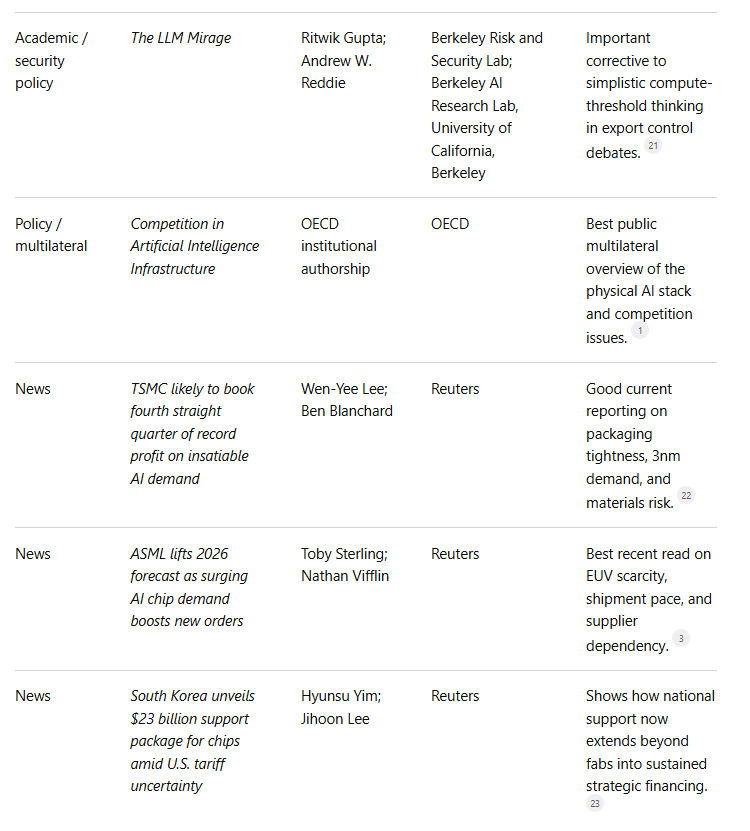
The list below is a prioritized 2025–2026 watchlist, not an exhaustive bibliography.
The main data gaps are real. Public filings do not provide standardized, comparable disclosure for CoWoS capacity, substrate allocations, or GPU cluster reservations. HBM supply shares are partly visible, but exact SKU-level commitments are opaque. Cloud providers disclose capex, but not installed accelerator inventories in a consistent way. And the real degree of software lock-in is still inferred from ecosystem behavior rather than published interoperability metrics. Those gaps do not weaken the core conclusion. They reinforce it: when markets turn strategic, the most important data are usually the least transparent.