
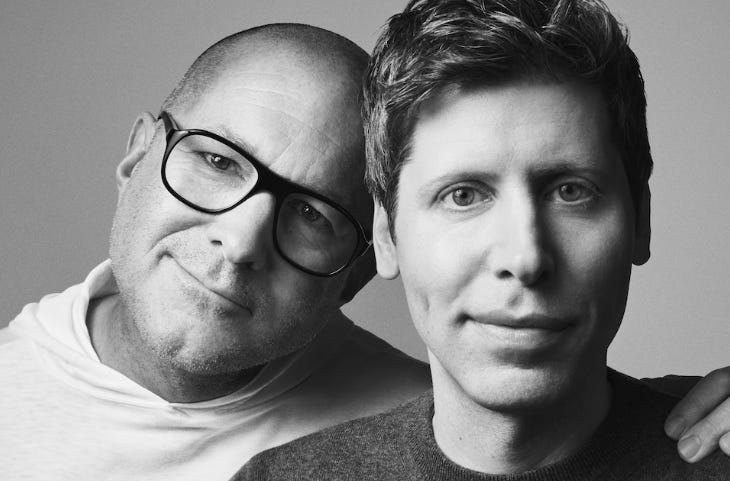
It was billed as “the coolest piece of technology the world will have ever seen,” yet when OpenAI CEO Sam Altman and legendary Apple designer Jony Ive took to a sun-drenched San Francisco café in a slickly produced video on May 21, 2025, they revealed almost nothing about the product itself. Instead, they unveiled OpenAI’s biggest bet yet: an all-stock acquisition of Ive’s one-year-old AI-hardware startup, io, for a headline price of $6.5 billion—effectively $5 billion once you net out OpenAI’s prior 23 percent stake SiliconANGLE.
Below is a deep dive into how this deal came together, what it means for OpenAI’s ambitions, and why investors, regulators and tech-industry skeptics are watching every move.
From Sketch to Startup: The Birth of io
Mid-2023: According to people familiar with the matter, the spark for io was lit when Ive’s teenage son introduced him to ChatGPT. The encounter is said to have convinced Ive that the future of computing lay in generative AI—if only the hardware could match the software’s promise.
Early 2024: Ive teamed with former Apple colleagues Scott Cannon, Evans Hankey and Tang Tan to found io Products, housed under his design collective, LoveFrom. Their mission? To create a new “family” of AI-driven devices that transcended the constraints of laptops and smartphones. No shipping products emerged, but a handful of whispered prototypes—headphones, glasses, even “ambient” home hubs—fueled Silicon Valley rumor mills.
By late 2024, OpenAI had quietly invested in io via its Start-Up Fund, taking a 23 percent slice and seeding its hardware ambitions long before the headlines Axios.
The $6.5 Billion Gamble: Deal Mechanics
On May 21, Altman posted on X that he was “thrilled to work with Jony to create a new generation of AI-powered computers.” The terms:
Headline value: $6.5 billion in stock for the remaining 77 percent of io.
Effective valuation: ~$5 billion, once you subtract OpenAI’s existing stake.
Team: Roughly 55 engineers, researchers and designers, now reporting to Peter Welinder, OpenAI’s VP of Product.
Ive’s role: LoveFrom remains independent but takes on “deep creative and design responsibilities” across OpenAI’s hardware roadmap. Ive himself won’t be on OpenAI’s payroll full time.
The transaction is slated to close this summer, pending regulatory approval—no small hurdle given its scope and the industry’s newfound unease over tech consolidation SiliconANGLEThe Guardian.
Why Hardware? OpenAI’s Strategic Imperative
1. Controlling Distribution
In the generative-AI race, distribution has emerged as the most powerful gatekeeper. Google leverages 3 billion Android devices, 1 billion Chrome users and 1.5 billion daily Google Search queries to funnel data back into its models. Apple tacks on a 30 percent cut via its App Store The Verge. OpenAI’s counterpunch: own the device, own the data, own the relationship.
2. Data and Daily Use
Larry Page’s famous “toothbrush test” still rings true: the best product is one people use every single day. By embedding AI into purpose-built hardware—offering context-aware assistants that sit in your ears, on your face or in your living room—OpenAI can capture richer, more granular usage signals, accelerating model training and opening new revenue streams beyond API fees.
3. Design as Differentiator
Few dispute Jony Ive’s track record. From the iPhone to the MacBook Pro, his minimalist yet tactile designs rewrote the rulebook on consumer electronics. OpenAI believes that its software mastery needs an equally strong hardware signature if it wants to bridge the gap between lab demos and mainstream adoption.
Market Reaction: Cautious Optimism—and Skepticism
Stock moves: Apple shares dipped about 1.5 percent on the news, as some investors fretted over a former C-suite design chief morphing into a direct competitor SFGATE.
Wall Street tone: Analysts describe the deal as “bold” but warn that hardware execution is littered with wreckage—from VR pioneer Magic Leap to Humane’s AI Pin, whose high-profile launch last year stumbled on battery and software issues.
Social media: Replies on X ranged from “acquihire” derision—arguing io’s lack of shipped products made it little more than a consultancy—to “iPhone moment for AI” excitement, reflecting the usual mix of hype and hand-wringing.
The Controversy: Startup or Side Project?
Critics have zeroed in on a few key questions:
Was io ever a “real” startup? Some argue that without consumer-ready products or meaningful revenue, io was just a vehicle for Ive’s design fees—albeit a very expensive one.
Is $6.5 billion overpaying? Even after netting out the stake, skeptics compare the price tag to an NBA “max contract,” suggesting OpenAI could have spent far less on proven hardware talent.
Regulatory risk: At a time when regulators in Europe and the U.S. are scrutinizing Big Tech deals, a tech giant snapping up a design superstar raises antitrust eyebrows.
None of these objections are trivial—but OpenAI seems willing to trade short-term critiques for a potential long-term monopoly on AI’s physical interface.
What’s on the Horizon: Roadmap to 2026
Prototype reveals: Inside sources say initial prototypes will surface at a private OpenAI event later this year—expect sleek, voice-activated headphones and possibly a “read-only” AI display that floats in space around you.
Mass-market launch: Public availability is rumored for late 2026, giving OpenAI time to iron out supply-chain kinks—assuming it partners with a major OEM in Asia.
Ecosystem bets: Beyond hardware, the deal hints at a broader OpenAI ecosystem: proprietary app stores, subscription tiers tied to on-device AI compute, and new developer tools to build “Ambient AI” experiences.
If even a fraction of these plans come to life, OpenAI will have leapt from code-only startup to full-stack hardware-software powerhouse.
The Bigger Picture: Redefining Tech’s Center of Gravity
OpenAI’s io acquisition underscores a seismic shift in Silicon Valley:
AI isn’t just software: True mainstream adoption will require physical form factors that people want to carry, wear or place in their homes.
Design matters: In a world awash with generative platforms, products that delight—and feel intuitive—will win.
Competition intensifies: Apple, Google and Meta can no longer rest on their laurels; each must decide whether to build their own AI hardware or cede ground to OpenAI.
We’re witnessing a new era where AI giants must master supply chains, manufacturing and industrial design—capabilities once the exclusive domain of hardware incumbents.
Risks Ahead: The Road to “Cool” Isn’t Easy
Manufacturing nightmares: Scaling production of custom silicon or novel form factors is rife with cost overruns and delays.
Software-hardware integration: Apple’s fussiness around vertical integration is legendary; will OpenAI replicate that cohesion, or stumble on fragmented Android-style bets?
Consumer adoption hurdles: Convincing people to buy an AI “assistant” device—beyond their phone—requires killer apps and clear privacy guarantees.
If OpenAI can’t deliver on battery life, comfort or app availability, the “coolest tech ever” risks joining the graveyard of brilliant prototypes that never sold.
Conclusion: A Watershed Moment…If It Works
By acquiring io for $6.5 billion, OpenAI has signaled that the next frontier of AI lies as much in the palm of your hand as on cloud servers. It’s a daring move to lock in design brilliance and distribution control, and it places Sam Altman squarely in the crosshairs of hardware veterans and antitrust enforcers alike.
In the end, however, the true measure of success will not be deal size or press releases, but whether those mysterious devices emerging in 2026 can shift human behavior as profoundly as ChatGPT has. If they do, this will go down as the deal that reimagined the computer for an AI-first world. If not, it will be remembered as the moment OpenAI bet the farm on the allure of Jony Ive’s name alone.
Either way, the tech world—and every investor holding an AI-play stake—will be watching.