
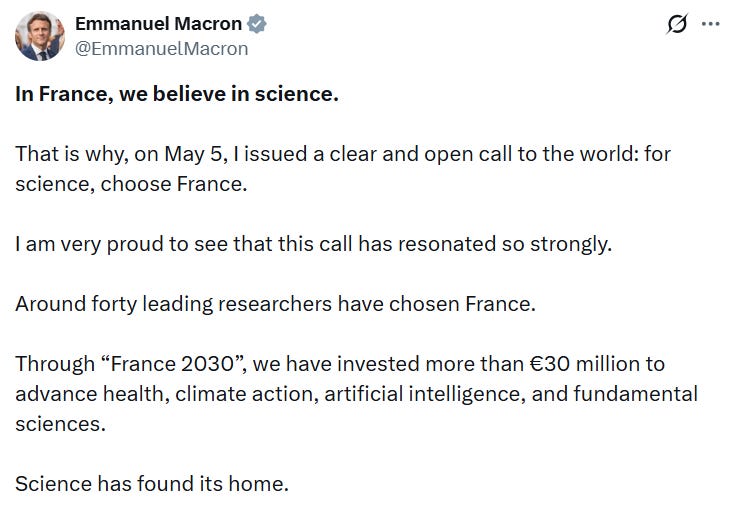
Emmanuel Macron tweets that France “believes in science.”
The proof? €30 million invested through “France 2030” to attract forty researchers across health, climate, AI, and fundamental sciences.
Forty researchers. €30 million. Four categories.
That’s €750K per researcher.
Or: about what a single GPU cluster costs to run for a few months.
Let’s Do the Math That Macron Didn’t
€30M sounds big until you compare it to literally anything:
OpenAI’s GPT-4 training run: ~$100M (conservative estimate)
DeepMind’s annual budget: ~$1B+
Meta’s AI infrastructure spend (2024): ~$30B
A decent Series A for an AI startup: $20-50M
France just allocated less than a single venture round to “win AI.”
Across an entire nation.
For comparison:
Saudi Arabia’s AI fund: $100B
UAE’s AI investment: $35B committed
Singapore’s National AI Strategy: $500M (for a city-state)
France; a G7 economy, nuclear power, historically a science superpower… just went all-in with what amounts to seed funding for a chatbot wrapper company.
What Should Have Actually Happened
Here’s the play France should have made:
1. Pick One Thing and Dominate It
Not “health, climate, AI, and fundamental sciences.”
Pick one.
The problem with Europe’s AI strategy is it’s designed by committee. Every stakeholder gets a slice. Every ministry gets a mention. Every interest group gets a line item.
Result?
Diffusion of focus. Diffusion of capital. Diffusion of talent.
Singapore didn’t spread peanut butter.
They picked: AI for financial services and logistics.
They became the hub for AI in Southeast Asia.
Israel didn’t hedge.
They went all-in on cybersecurity and defense tech.
Now every major tech company has an R&D center in Tel Aviv.
France should have picked one domain where they already have structural advantages and poured €5-10B into it over 5 years.
Options:
Nuclear + AI (energy optimization, grid intelligence, fusion simulation)
Luxury goods + AI (LVMH has more margin than most SaaS companies—why not own AI-driven personalization at scale?)
Aerospace + AI (Airbus, Dassault, Thales; this is a natural)
Instead, they picked “a little bit of everything” and funded it like a student film.
2. Build Infrastructure, Not Incentives
€30M to “attract researchers” is subsidy thinking.
It’s the same mental model that built the CAC (Common Agricultural Policy); throw money at the problem and hope smart people show up.
That doesn’t work in AI.
Why?
Because researchers don’t move for grants.
They move for:
Compute access (France has no sovereign GPU cluster at frontier scale)
Data moats (France has GDPR restrictions that make it nearly impossible to build datasets)
Talent density (Paris has good engineers, but the network effects are in SF, London, Beijing)
Speed to deployment (French bureaucracy is not optimized for iterating at AI pace)
If you want researchers, you don’t pay them to come.
You build the infrastructure so good they can’t afford to leave.
Here’s the playbook:
A. Build a National Compute Reserve
€3B commitment over 3 years
50,000+ H100-equivalent GPUs
Open access to researchers, startups, and academic institutions
Subsidized rates for French companies
This instantly makes France competitive.
Researchers care about access to compute more than salary.
B. Create a Sovereign Data Commons
France has some of the best public sector data in the world:
Healthcare (Carte Vitale = national health records)
Transport (RATP, SNCF)
Energy (EDF, smart meters)
Tax and economic data (INSEE)
But it’s locked behind privacy laws and bureaucratic walls.
Solution:
Create a privacy-preserving federated data layer that allows researchers to train models on French data without direct access.
This is what Estonia did with X-Road.
Now every AI lab in the world would want to partner with France; because they can’t get that data anywhere else.
C. Fast-Track Visa Program for AI Researchers
Not a grant. A pathway.
1-week visa approval for AI PhD holders
5-year work permits, no restrictions
Fast-track permanent residency after 3 years
Zero income tax for first 5 years for researchers in national priority areas
Estonia did this with e-Residency.
Portugal did this with D7 visas.
France has the brand. They just need the execution speed.
3. Stop Subsidizing Losers, Start Building Winners
The €30M isn’t going to startups.
It’s not going to moonshots.
It’s going to “attract leading researchers.”
Translation: it’s going to salaries and admin overhead.
This is the wrong incentive structure.
France doesn’t need forty more professors.
It needs ten companies that can compete globally.
Here’s what €30M could have done instead:
Option A: AI Sovereign Wealth Fund
€10B fund (not €30M)
Invest in French AI companies with one condition: must stay headquartered in France for 10 years
Match every euro of private VC 2:1
Outcome: France becomes a co-investor in every major EU AI startup
Option B: AI DARPA
$100M+ annual budget
Fund high-risk, high-reward AI research with commercial mandates
Not “publish a paper.” But “build a product the military/government/industry will buy.”
This is how the internet, GPS, and autonomous vehicles were born.
Option C: National AI Deployment Sprint
Deploy AI across every government function in 90 days
Automate 40% of bureaucratic workflows
Publish the playbook globally
Position France as the case study for AI-native government
This would attract researchers, capital, and talent without paying for it.
Where France and the EU Actually Are
Let’s be honest about the landscape:
France’s Position
Strengths:
Strong academic tradition (Yann LeCun, INRIA, École Polytechnique)
Decent startup ecosystem (Mistral AI is real)
Nuclear energy = competitive advantage for AI compute costs
Luxury/aerospace/defense industrial base
Weaknesses:
Regulatory overreach (GDPR killed half of EU’s data advantage)
Bureaucratic inertia (try incorporating a company in France vs. Delaware)
Brain drain (most top French AI researchers work in SF or London)
Capital scarcity (EU VC is 1/10th the size of US VC)
EU’s Position
Strengths:
Talent (some of the best universities and researchers globally)
Data (GDPR compliance = trusted data environments)
Regulatory soft power (when Brussels regulates, the world follows)
Weaknesses:
Fragmentation (27 different regulatory regimes, languages, markets)
Risk aversion (European pension funds don’t fund moonshots)
American cloud dominance (AWS/Azure/Google = 90% of EU cloud infrastructure)
The EU has spent more on regulating AI than building it.
The AI Act took years to draft.
Meanwhile:
China deployed AI across surveillance, logistics, and manufacturing
The US deployed AI across advertising, defense, and SaaS
The UAE bought compute, hired researchers, and started building
Europe wrote whitepapers.
Mental Models: Why Europe Keeps Losing Tech Transformations
This isn’t new.
Europe has missed every major tech wave since the 1980s.
Let’s review:
1. Personal Computing (1980s)
Winners: IBM, Microsoft, Apple (USA)
Europe’s response: Tried to build national champions (Olivetti, Acorn, Sinclair)
Outcome: All dead or irrelevant by 1995
Why Europe lost:
Fragmented markets (every country wanted its own “European Microsoft”)
Undercapitalized (venture capital didn’t exist in Europe at scale)
Focused on hardware, missed software leverage
2. Internet / Web 1.0 (1990s)
Winners: Amazon, Google, Yahoo, eBay (USA)
Europe’s response: Built telecom monopolies (France Télécom, Deutsche Telekom)
Outcome: Missed the entire wave. No European equivalent to Google or Amazon.
Why Europe lost:
Regulated telecom = slow internet deployment
No risk capital for “unprofitable” internet companies
Cultural: “Why would anyone buy books online?”
3. Mobile / Web 2.0 (2000s)
Winners: Apple, Google (Android), Facebook (USA)
Europe’s response: Focused on Nokia, Ericsson (both lost to iPhone)
Outcome: Zero mobile OS platforms. Zero global social networks.
Why Europe lost:
Bet on hardware (Nokia) instead of platforms (iOS, Android)
Regulatory restrictions on data = couldn’t compete with Facebook’s growth loops
VC ecosystem still 10 years behind Silicon Valley
4. Cloud Computing (2010s)
Winners: AWS, Azure, Google Cloud (USA)
Europe’s response: “Data sovereignty” initiatives (all failed)
Outcome: 90% of European cloud infrastructure runs on American providers
Why Europe lost:
Started too late (AWS launched in 2006; Europe’s response came in 2015)
Underfunded (Germany’s “Sovereign Cloud” got ~€1B; AWS spent $50B+)
Fragmented demand (every country wanted its own solution)
5. AI / LLMs (2020s)
Winners (so far): OpenAI, Anthropic, Google, Meta (USA); DeepSeek (China)
Europe’s response: Mistral AI (€600M raised), AI Act (regulatory framework)
Current status: Europe is regulating the game instead of playing it
Why Europe is losing (again):
Compute scarcity (no European GPU megaclusters)
Data restrictions (GDPR makes it illegal to train on most web data)
Capital flight (top AI researchers leave for 3-5x compensation in SF)
Risk aversion (European LPs don’t fund “cash-burning” foundation model companies)
The Pattern Is Clear
Europe’s failure mode across every tech transformation:
Optimize for incumbents (telecom monopolies, automakers, banks)
Regulate early, build late (focus on “ethics” and “safety” before deployment)
Diffuse investment (spread-thin across countries instead of concentrated bets)
Structural inertia (bureaucracy moves slower than technology)
Meanwhile, the American model:
Fund moonshots (DARPA, NSF, NIH = long-term R&D with commercial mandates)
Build infrastructure (interstate highways, ARPANET, GPS = foundational layers)
Let companies move fast (regulatory forbearance until harm is proven)
Concentrate capital (venture funds, sovereign wealth, defense budgets = all-in bets)
And now, the Chinese model:
State coordination (CCP directs capital, talent, compute toward AI)
Deployment at scale (AI in surveillance, logistics, governance = real-world testing)
Vertical integration (Alibaba, Tencent, ByteDance = own the stack)
Data abundance (no GDPR = train on everything)
Where France and the EU Should Be
If Europe wants to compete in AI, here’s the actual playbook:
Strategic Imperatives
1. Build Sovereign Compute at Scale
€50B European Compute Reserve over 5 years
500,000+ GPUs distributed across France, Germany, Netherlands
Open access model for researchers and startups
Subsidized energy costs (France’s nuclear = structural advantage)
2. Create a European Data Commons
Federated access to public sector data (healthcare, transport, energy, tax)
Privacy-preserving APIs for AI training
Incentivize private sector data contribution (tax breaks, co-ownership models)
3. Deploy AI Across Government in 12 Months
Automate 40% of bureaucratic processes
Make Europe the case study for AI-native governance
Attract global talent by proving execution speed
4. Consolidate, Don’t Fragment
Stop funding “national champions” in every country
Pick 3-5 European AI companies and go all-in
Make them globally competitive, not regionally relevant
5. Regulatory Fast Lanes
Create AI Special Economic Zones (like Shenzhen, but for AI)
Suspend GDPR restrictions for approved research projects
Fast-track immigration for AI researchers (1-week visas, 5-year permits)
The Uncomfortable Truth
€30M for forty researchers!
It’s the kind of thing politicians announce to look like they’re “doing something” while avoiding the actual hard decisions:
Reforming bureaucracy
Taking regulatory risk
Challenging incumbent interests
Spending real money
France doesn’t need researchers.
It needs:
Compute
Data
Speed
Capital
Risk tolerance
Researchers will show up after you build the infrastructure.
Not before.
The Game Play
If I were advising Macron:
Step 1: Announce a €10B AI Sovereignty Fund
Half to compute infrastructure
Half to co-investment in French AI startups
Step 2: Deploy AI across French government in 90 days
Pick 10 high-volume bureaucratic processes
Automate them with AI
Publish the playbook globally
Position France as the leader in AI governance
Step 3: Create an AI SEZ (Special Economic Zone)
Pick one city (Lyon? Toulouse?)
Suspend GDPR for approved AI research
Zero income tax for researchers
Fast-track visas
Subsidized compute access
Step 4: Build the European Data Commons
Federated access to French public sector data
Privacy-preserving training APIs
Incentivize private sector contribution
Step 5: Consolidate around 3-5 winners
Pick the top French AI companies (Mistral, etc.)
Match every euro of private VC 2:1
Require 10-year HQ commitment in France
Total cost: €20-30B over 5 years
ROI: Position France as a top-3 AI hub globally
Final Word
€30 million is what you spend when you want to look like you’re doing something.
€30 billion is what you spend when you want to actually do something.
France chose optics.
Meanwhile, the Gulf states, Singapore, and even Rwanda are making bigger bets on AI infrastructure.
The window is closing.
AI doesn’t wait for committees to finish their white papers.
Move fast or become a museum.