
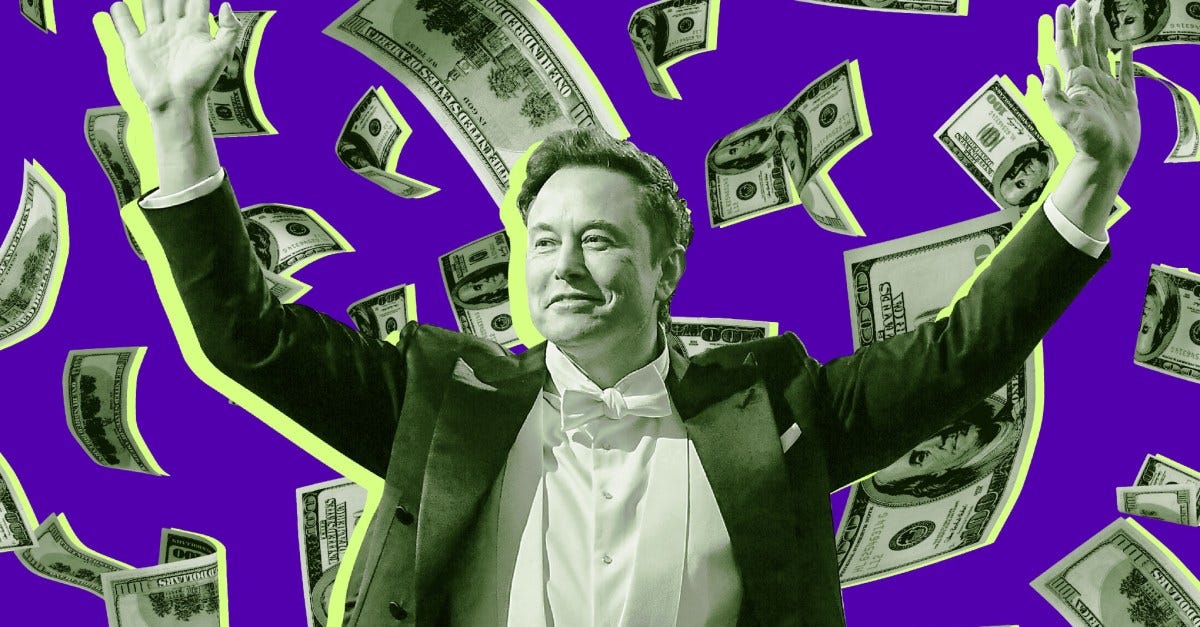
You read that and your brain does what every normal brain does:
“Wait… how the hell is Tesla making so much money they can pay one guy a trillion?”
Cue outrage. Cue confusion. Cue Reddit thread.
Let’s unpack what’s actually going on here; and more importantly, what you as a founder/entrepreneur should take away from this circus.
1. First, nobody is wiring Elon $1T like a salary
A bunch of people in the comments already hit this:
“They are not giving him $1 trillion. They’re giving him the opportunity to make $1 trillion if the company does like a 8X or something.”
That’s the core idea.
This isn’t:
A paycheck
A bank transfer
A big suitcase of money with a bow on it
It’s equity options: “If you grow Tesla from ~$1.4T to $8.5T and hit insane operational goals (20M cars, 1M robots, 1M robotaxis)… we’ll then give you stock worth up to $1T at that future valuation.”
Zero results, zero payout.
Monster results, monster payout.
Entrepreneur translation:
“If you make me $8B, I’ll happily give you $1B.”
The numbers are stupid big, but the structure is actually pretty simple.
2. Market cap is not a giant pile of cash
One of my favourite lines in the comments:
“Because the world has decided to pretend market cap is actual money.”
Market cap = price of one share × number of shares.
That’s a scoreboard, not a bank balance.
If Tesla is worth $1.4T on paper, that doesn’t mean there’s a $1.4T vault under the factory full of cash. It means at the current price, if you multiplied it across all shares, you get that number.
Important bits:
Only a small % of shares trade on any given day
If Elon tried to sell a huge chunk of stock at once, the price would tank
You can borrow against equity (so yes, market cap does feel like money if banks love you), but it isn’t instantly liquid
This is why one commenter compared it to real estate:
If one house on your street sells for $1M, suddenly everyone’s house is “worth” $1M too.
Now imagine giving your builder a deal:
“If you can get the whole suburb valued at $8M per house, we’ll give you one house.”
That’s Elon’s comp plan.
3. Tesla’s valuation is built on hopes & robots, not just cars
Another comment nailed it:
“It’s valued (literally) through hopes and dreams.”
Tesla trades at a PE ratio around 300.
Apple? ~36.
NVIDIA? ~50-ish.
So investors are paying 8x more per dollar of Tesla earnings than they pay for Apple. Why? Because they’re not just buying a car company.
They’re buying:
The promise of 20M cars a year
The promise of 1M humanoid robots
The promise of 1M robotaxis
The promise that Elon pulls another rabbit out of the hat
That’s why you see comments like:
“People buying shares in Tesla are not buying shares in an auto maker, they are buying shares in Elon Musk.”
This is where founders should pay attention:
Story + vision can massively inflate your valuation
But story without execution = pure speculation
If you build a “hype stock” culture, your life becomes a 24/7 performance review by the market
4. The incentive design is extreme… but not random
On paper, it’s actually clean:
If Tesla stays mediocre → Elon gets nothing from this plan
If Tesla becomes a $8.5T monster → shareholders become insanely rich → Elon takes a giant slice
So for the board, it feels like a leveraged bet:
“We risk nothing today, but if this guy pulls off the impossible, we’ll happily let him keep ~12% of the upside.”
That’s why some commenters say it’s a no-brainer; like giving a top sales rep a huge commission if they bring in a historic deal.
The pushback is also legit:
“Do we really need to pay this much to motivate someone who already owns ~15% of the company?”
“Isn’t his existing stake already a gigantic incentive to grow Tesla?”
“Is there any chance someone else could have delivered similar results for a fraction of this?”
This is where governance comes in.
5. Board capture: when the game is tilted before you sit down
Another spicy detail from the thread:
“A majority of the Tesla board (5/8 people) are made up of his friends and family.”
So who’s approving this “performance package”?
The same circle of people whose fortunes are tied to Elon
A board that’s not exactly a group of independent, detached referees
This doesn’t make the deal illegal.
But it changes the power dynamic.
For a normal founder:
Your board will hammer your comp
Your investors will cap your upside
You’ll get pressure to “be reasonable”
For Elon:
He is the brand
He is the story
He basically negotiates with people who are financially and psychologically aligned with him
If you’re a founder, the lesson isn’t “stack your board with cousins.”
It’s this:
The more irreplaceable you become, the more you write your own deal.
Right now, Tesla is treated as “Elon’s company.” That’s leverage.
6. The dark side: dilution, grift, and games you can play
People aren’t dumb to be suspicious.
Legit concerns from the comments:
“This is dilution. At $8.5T, he’s basically taking a big slice out of every shareholder.”
“He could hit the metrics with acquisitions, hype, or financial engineering.”
“It’s all built on the Elon cult. Demand is slowing, PE is insane, and lifetime profits are only $40B.”
There’s a spectrum between:
Aligned incentive design (“If you win big, I win big”), and
Financial cosplay (“Let’s game the metrics, pump the story, and cash out before reality hits.”)
From the outside, it’s really hard to tell which side Tesla will land on.
That’s why one commenter summed it up perfectly:
“It’s valued (literally) through hopes and dreams.”
When hope is the main asset, grift is always a risk.
7. What YOU should actually steal from this (as a founder)
You’re not getting a $1T comp package.
You’re barely getting a decent SaaS discount from Stripe.
So what can you actually take from all this?
a) Think in “if/then” upside, not fixed salaries
Structure deals like:
“If you grow this product line 5x, you get X% of the incremental profit.”
“If we hit $10M ARR, you unlock Y in equity.”
Big upside for big results.
Tiny downside if nothing happens.
b) Learn to tell a credible big story
Elon’s power isn’t just tech. It’s narrative.
Your version:
Paint a clear “10x future” for your startup
Anchor investors/customers/team on where this can go
Then back it with real milestones, not vague vibes
c) Respect the difference between valuation and value
Tesla can trade at PE 300 for a while. So can your startup.
But eventually:
Cash flow matters
Unit economics matter
Real demand matters
Don’t build your whole life on “hopes and dreams” pricing.
d) Understand who really controls the board
If you ever raise money, ask:
“If things go sideways, who actually has the power here?”
Voting shares
Board seats
Protective provisions
Most founders only learn this after they get fired from their own company.
8. The real punchline
The OP’s question was:
“How is Tesla valued, and how can they afford to give Musk a one trillion dollar package?”
Answer:
It’s not “affording” a cash payout
It’s designing a lottery ticket where the jackpot only triggers if the company reaches god-mode
The “value” is mostly the market’s belief in Elon + future robots, not current income statement reality
Existing shareholders are basically saying:
“We’re already all-in on this man. If he somehow pulls off the craziest vision in corporate history, let him keep a giant slice.”
You don’t have to like it.
You do have to understand the game.
Because while everyone else is screaming at headlines, smart entrepreneurs are quietly asking:
“What’s the scaled-down version of this I can use in my own business?”
Design upside.
Tell a big story.
Stay close to real value.
And never confuse the scoreboard for the cash register.
— Houman
Full Stack Capitalist