
Something has been bugging me all week.
Goldman Sachs now expects five companies, Amazon, Alphabet, Microsoft, Oracle and Meta, to spend about $1.2 trillion on AI infrastructure in 2027.
One year.
That is roughly 3% of US GDP, about three times the telecom buildout of the 1990s at its peak. Relative to the economy, it is the biggest investment cycle since the railroads.
So I asked myself a simple question. Who is actually paying for all of this?
Not who announces it. Not whose logo sits on the press release. Who holds the risk if the returns do not show up?
I spent the weekend pulling the thread. The answer is not what I expected. Let me walk myself through it.
First, the honest part
A big chunk of the money is real cash. Amazon lifted its 2026 capex forecast to about $220 billion. Alphabet raised its own to $195 to $205 billion. These companies generate enormous cash flow, and for years they funded the buildout out of it. Clean, boring, fine.
But here is the line from the Goldman note that stuck with me: spending has now grown past what these companies generate from operations. From here on, the buildout runs on borrowed money.
So who is lending it.
Move one: get the debt off the balance sheet
Look at Meta’s Hyperion campus in Louisiana. Meta did not borrow $29 billion to build it. It set up a joint venture instead. Pimco put in about $26 billion of debt, issued as bonds backed by the data center itself. Blue Owl put in $3 billion of equity and its funds own 80% of the venture. Meta keeps 20%, signs a long lease, and pays rent.
On Meta’s balance sheet, a giant AI data center shows up as a rent bill. The debt sits in a vehicle most shareholders will never read about. The Bank for International Settlements wrote about this structure in March and gave it a name I cannot get out of my head: shadow borrowing.
Move two: borrow against the chips themselves
Then there are the GPU clouds. CoreWeave raised about $28 billion in debt and equity over twelve months, including an $8.5 billion loan in March that became the first GPU-backed financing to earn an investment-grade rating. Read that again. The collateral is the chips.
I keep thinking about this. A loan secured against hardware that loses value every year, backed by contracts with a handful of customers. When I wrote
The Rise of GPU Landlords , my point was that the landlords own the scarce asset and everyone else rents. What I missed is that even the landlords do not really own it. The bondholders do.
xAI raised $5 billion in debt last year. Oracle plans to raise $45 to $50 billion this year to build for OpenAI, Meta, Nvidia, xAI and others.
And here is the part that should make anyone pause: $18 billion of loans tied to one Oracle data center project in New Mexico, part of its buildout for OpenAI, are already quoted at 89 to 91 cents on the dollar, because the banks trying to sell that debt on to wider investors cannot find enough buyers. Construction has not even finished.
Move three: the circle
Now the part that broke my brain when I first mapped it.
Nvidia agreed to invest up to $100 billion in OpenAI. OpenAI committed to pay Oracle $300 billion over five years for compute. Oracle spends that money building data centers full of Nvidia chips. AMD gave OpenAI warrants to buy up to 10% of AMD, if OpenAI buys enough AMD chips and the stock performs.
The chip makers are financing their own customers. When a vendor funds your purchase of the vendor’s product, the revenue on both sides of the deal is partly an IOU written to itself.
OpenAI itself told investors in February it is now targeting about $600 billion of compute spend through 2030, after Altman talked about $1.4 trillion of commitments late last year. The number moved by $800 billion in three months and almost nobody blinked.
So who actually holds the $1.2 trillion?
Here is the answer I landed on, and it is the reason I am writing this.
A Chicago Booth analysis broke down who holds the AI debt stack. About $520 billion of hyperscaler bonds, held by bond funds, insurers and pension funds. Around $250 billion of project and data center finance. Roughly $200 billion of private credit, and that is an estimate, because nobody can fully measure it. About $35 billion of GPU-secured lending. And on top of all that, S and P counts roughly $675 billion of signed data center leases that have not started yet, sitting off every balance sheet.
The analysis modeled where the first losses land if this goes wrong. Not the banks. Not the tech giants. The first losses sit with private credit funds, and behind them, their investors: pension plans, endowments, insurance platforms, and regular people who bought private credit products in their brokerage accounts.
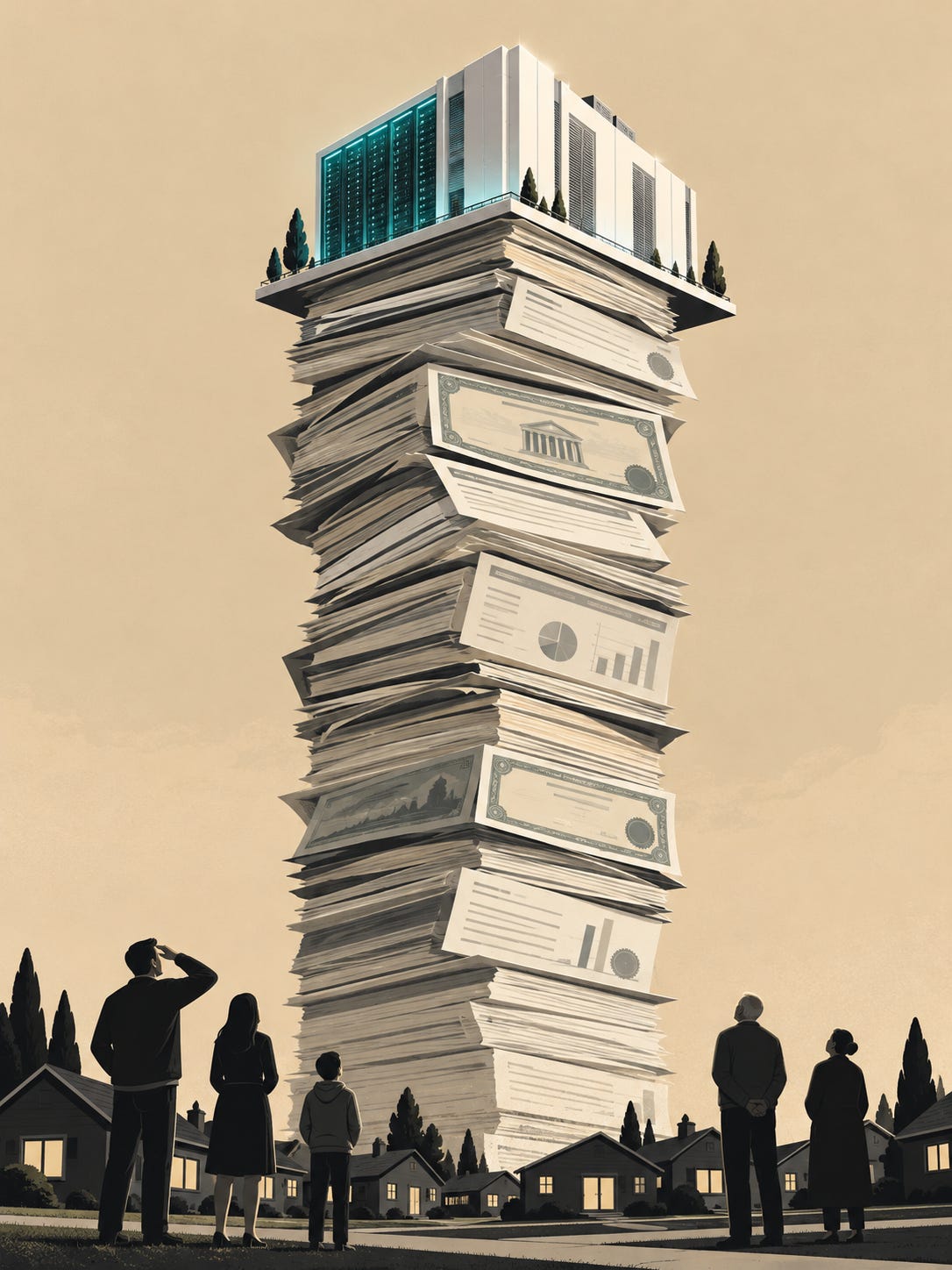
The risk of the biggest capital spending cycle since the railroads has been moved from the companies making the bets to the retirement savings of people who never placed one.
So that is the answer to my question. Who actually holds the $1.2 trillion?
You do. I do. Anyone with a pension, a super fund, an insurance policy or an index fund. The landlords engineered it so the upside is theirs and the paper is yours. I wrote that AI would create a landlord class. What I did not fully see is that the landlords do not even keep the mortgage.
Maybe the demand shows up and everyone gets paid. Goldman thinks the industry needs about $300 billion a year of AI revenue to justify the spend, and cloud revenue is growing fast. Maybe it all works out.
But if it does not, the margin call does not go to Sand Hill Road. It goes to your retirement account.
So tell me. If the returns have not shown up by 2028, whose loss is it really?