
=====================================================
Sponsored Ad.
Why I launched Hoook.io and why you should care!
One of my businesses relies heavily on SEO and content, so I decided to double down and write a blog every week; this was 3 years ago pre-AI era (still rememer that I had to do 4-5 hours of research and 2-3 hours of writing like psychopath!).
When LLMs took off, I had the superpower of writing 1–2 blogs a day. That’s next-level productivity. However, most of my blogs sucked and did not even hit the first page of Google, because I was doing the same thing…at scale!
I was a bad marketer, but now I was a bad marketer at the speed of AI!
For two years, I ground and taught myself the art and science of SEO.
Then Agentic AI happened—yet another disruption. This time I was ready. Now most of my blogs could hit the first page of Google; I was writing three blogs per day—a 600% productivity increase—and most of them hit the first page.
Results (past 12 months):
1M Google impressions
7K website visits
400 leads generated
5 deals closed
So I decided to launch Hoook.io so everyone can have a full-stack marketing machine (whether you’re an agency owner or a traditional business) to grow massively with content.
You basically copy and paste top performing marketers strategies with a few clicks… and blow the internet!
Go to our website and book a demo now.
=====================================================
1. What Happened?
Deep Dive:
Builder.ai launched in 2016 as Engineer.ai, promising to democratize app development with AI. By 2023, it had raised > $500 million—most notably a $250 million Series D led by the Qatar Investment Authority and Microsoft’s strategic check. The valuation peaked north of $1 billion. But signs of strain surfaced in early 2025. A March insider round of $75 million and a restructured $50 million debt facility barely slowed spiraling cash burn. Then, on May 20, 2025, lenders seized over $40 million of the company’s remaining cash, citing repeated covenant breaches. Within days, payroll stopped, dozens of staff were laid off, and an administrator was appointed to manage insolvency proceedings.
Summary:
Founded 2016; rebranded from Engineer.ai
Raised > $500 M, including $250 M Series D in 2023
Cash burn outpaced funding despite March ’25 insider round
May 20, ’25: Lenders seize $40 M+ → insolvency
2. The Symptoms
Deep Dive:
Sky-High Quotes: Sales decks bragged “AI-driven speed,” yet a simple fitness app cost $800K and 36 weeks—6× market rates. SMBs balked at custom-built costs disguised as “platform fees.”
Sales Inflation: An internal audit flagged > 20% of logged sales as “potentially bogus.” Revenue guidance for 2024 was slashed from $220 M to ~$55 M. Auditors were hired, but the damage to credibility was irreversible.
Human-in-the-Loop Reality: Marketing materials emphasized automation; behind the scenes, each build required 50–100 engineers in India and Ukraine. The gap between promise and delivery bred customer churn and margin collapse.
Summary:
$800K+ pricing for basic apps alienated core customers
20%+ of “sales” found bogus → 75% revenue restatement
Heavy reliance on human engineers contradicted AI promise
3. Cash Burn ≠ Growth
Deep Dive:
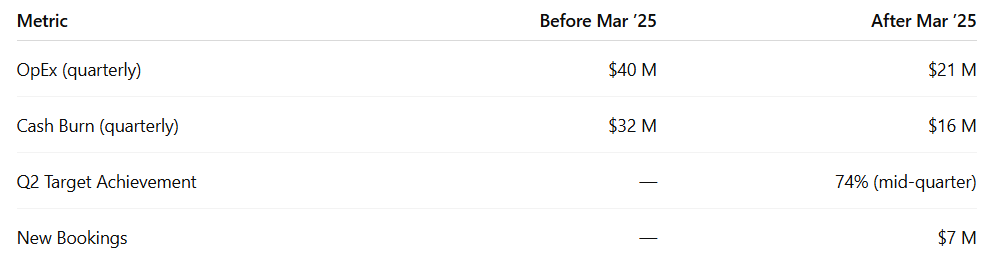
Builder.ai’s quarterly P&L told a brutal story: operating expenses hovered at $40 M, while cash burn ran $32 M. A cost-cutting push in March 2025 shaved OpEx to $21 M and burn to $16 M. Margins improved—new bookings of $7 M and hitting 74% of Q2 targets mid-quarter showed tactical wins. Yet these fixes arrived just months before lenders pulled the plug, underscoring that halving burn isn’t enough when runway is already razor-thin.
Summary:
Q1 ’25 burn: $32 M on $40 M OpEx
Post-cut: $16 M burn on $21 M OpEx
Operational improvements too late to avert seizure
4. Leadership & Lender Misstep
Deep Dive:
CEO Manpreet Ratia (appointed Feb ’25) publicly blamed lenders in a leaked memo for reneging on verbal support. Behind closed doors, governance cracks showed: a sudden CEO swap, investigations into loan-fraud allegations, and shaky covenant negotiations. Viola Credit, Attempo, and Cadma had extended a secured debt facility in late 2024—but when Builder.ai missed interest and liquidity tests, those same lenders swept the account. The result: zero wiggle room, forced insolvency.
Summary:
CEO swap & governance concerns heighten scrutiny
Lenders seize funds after covenant breaches
Public memo shifts blame—but trust already fractured
5. The Collapse Playbook (What Not to Do)
Deep Dive:
Overhype Your Tech: Claim “full AI automation,” then staff 100 engineers per project. Creates impossible expectations and margin implosion.
Cook the Books: Inflated bookings boost headline growth—but once restated, all credibility evaporates.
Misprice for SMBs: Unicorn pricing for small jobs kills your volume and churns clients.
Neglect Covenants: Treat debt covenants as optional—not negotiable deadlines. One breach means fund freeze.
Delay Turnaround: Cost cuts in March ’25 improved P&L—but the runway was already gone.
Summary:
Don’t promise 100% AI if delivering 10%
Keep sales data clean—investor trust is fragile
Align pricing with customer budgets
Proactively manage debt tests
Pivot cost structure before cash runs out
6. Why It Matters
Deep Dive:
Builder.ai’s implosion isn’t just another startup story—it’s a wake-up call for the AI/no-code boom. Investors poured $500 M+ on vision and hype, only to see fundamentals ignored. Now, “zombiecorn” warnings flood X: startups with inflated valuations but no path to profit. Builders and backers alike must learn: sustainable models > speculative rounds.
Summary:
AI/no-code hype vs. reality gap
“Zombiecorn” risk in overfunded startups
Fundamentals (unit economics, credibility) always win
7. Your Playbook
Deep Dive:
Lean Sprints: Release shippable features every 7 days—test demand, iterate fast.
Transparent Metrics: Publicly share burn rate, runway, and key KPIs in investor decks.
Tiered Pricing: Offer entry-level plans for SMBs; upsell enterprise features separately.
Covenant Discipline: Build 6 months of liquidity buffer; negotiate clear covenant cures.
Align Marketing & Ops: If you hype AI, invest R&D in real automation—don’t backtrack on the pitch.
Summary:
Ship weekly; gather feedback
Publish your numbers—build trust
Segment pricing for SMB vs. enterprise
Treat covenants like non-negotiable deadlines
Match your marketing claims with R&D reality
Bottom Line:
Builder.ai had the vision, the funding, and the fanfare. But it neglected the elemental truths of sustainable growth: honest reporting, tight cost control, and delivering on core promises. In the AI gold rush, don’t build hype castles—create durable foundations.
Subscribe to Full Stack Capitalist for more no-BS playbooks on scaling tech, raising capital, and staying solvent.