
You may think Nvidia is winning AI and nobody can reach them.
That’s partly true. But I want you to know AWS is doing something weired here.
They are trying to control the ground that every chatbot has to stand on.
That’s the binding constraint here, and once you see it, the whole AWS strategy stops looking scattered and starts looking like one of the cleanest infrastructure plays in tech history.
Here’s the simple version.
Amazon doesn’t need Claude to beat GPT, or GPT to beat Claude, or its own model, Nova, to beat either one. It just needs to be the toll road that all of them drive on.
Power contracts, chips, the software layer that connects a company’s data to a model, and increasingly the models themselves. If you want to build or run serious AI, there’s a good chance you’re paying Amazon somewhere along the way, regardless of who wins the model war.
Think of it in four layers, stacked on top of each other like a toll road with checkpoints at every mile marker.
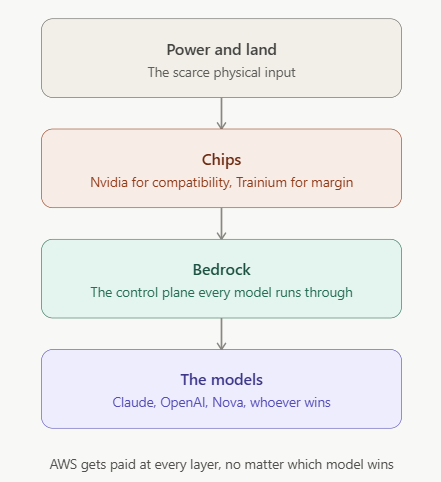
At the bottom is power and land.
AI runs on electricity before it runs on anything clever, and Amazon has been locking up power deals, nuclear capacity, and data center real estate across the US, Europe, and beyond, faster than almost anyone else. Whoever controls the electrons controls the ceiling on how much AI can actually get built.
Above that sits chips.
This is where the strategy gets interesting. Amazon still rents out Nvidia’s best hardware because customers need it and won’t switch easily.
But it’s also building its own chips, called Trainium, specifically to claw back the margin Nvidia has been keeping for itself. Anthropic is the proof of concept here, using more than a million Trainium chips and committing over a hundred billion dollars to Amazon’s infrastructure.
Amazon financing a partner who then hands the money right back to Amazon.
The third layer is called Bedrock, and it’s basically the checkout counter for AI.
Instead of picking one model and betting the house on it, Amazon lets you rent access to more than a hundred different models, including its competitors’ models, all running through Amazon’s billing, security, and data pipes.
Once your company’s tools are wired into that plumbing, switching away from Amazon gets a lot harder than switching which model you’re using.
At the top are the models themselves, Claude, OpenAI’s systems, Amazon’s own Nova family.
It’s also, honestly, the layer Amazon cares about least, because it wins either way. If your favorite model wins, it probably runs on Amazon’s chips and gets sold through Amazon’s storefront.
That’s the toll road. Amazon isn’t betting on one horse. It’s charging admission at the racetrack.
Now, this strategy isn’t bulletproof, and that’s exactly where it gets interesting from an investor and operator standpoint.
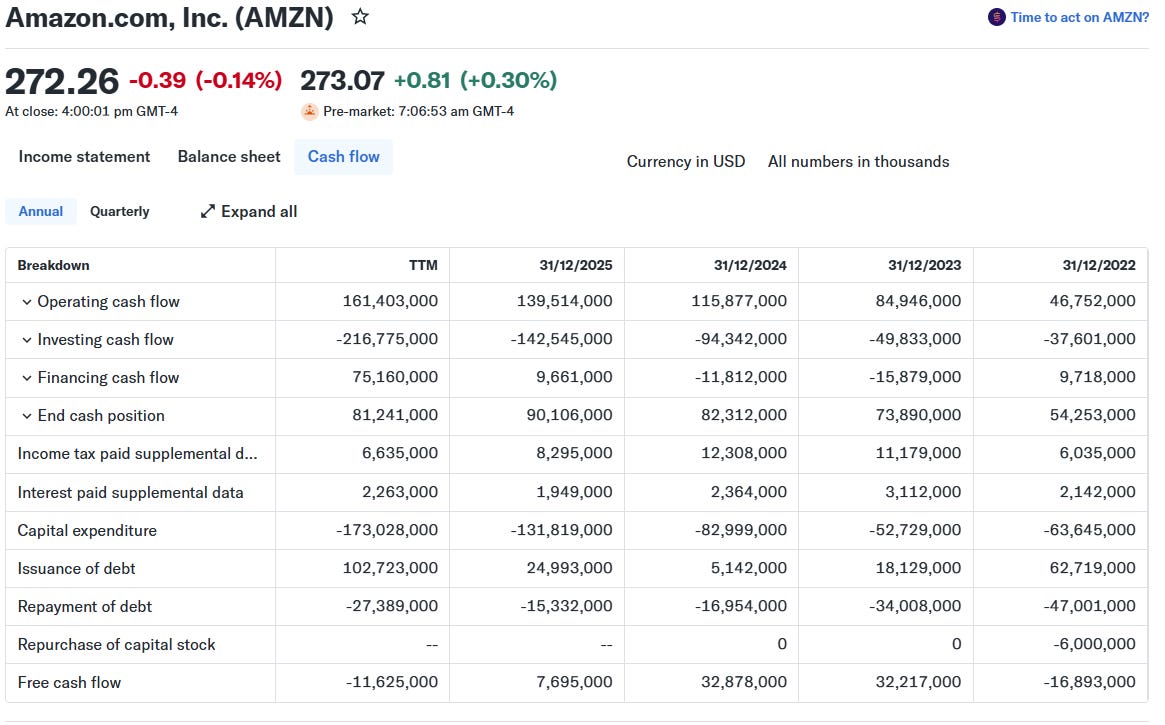
Amazon is spending an almost unbelievable amount of money to build this out, its free cash flow has actually gone negative because of it, and the bet only pays off if AI demand keeps compounding for years.
There are real cracks worth understanding: how much of Amazon’s growth is organic demand versus money it’s essentially lending to its own partners, why its custom chips face a real adoption ceiling, and why regulators in the UK have already flagged how hard Amazon makes it to leave once you’re locked in.
That’s the part I dig into in the full piece for paid subscribers: the bear case, the pricing mechanics Amazon uses to extract more from bigger customers, the anchor tenant risk with Anthropic and OpenAI, and the specific numbers on where this could break.
If you’re making capital allocation decisions, running a company that depends on cloud infrastructure, or just want to understand where the leverage in AI sits, that’s the piece to read closely.
For everyone else, the headline is this: watch who owns the road underneath AI.
AI is not software, it’s industrial revolution.