
A company raises its prices almost every year.
Its customers complain.
Then they renew.
This is not necessarily because they love the product. It’s because leaving can cost more than staying.
And few companies understand this economic reality better than Atlassian.
Look at Atlassian’s cloud pricing over the last three years.
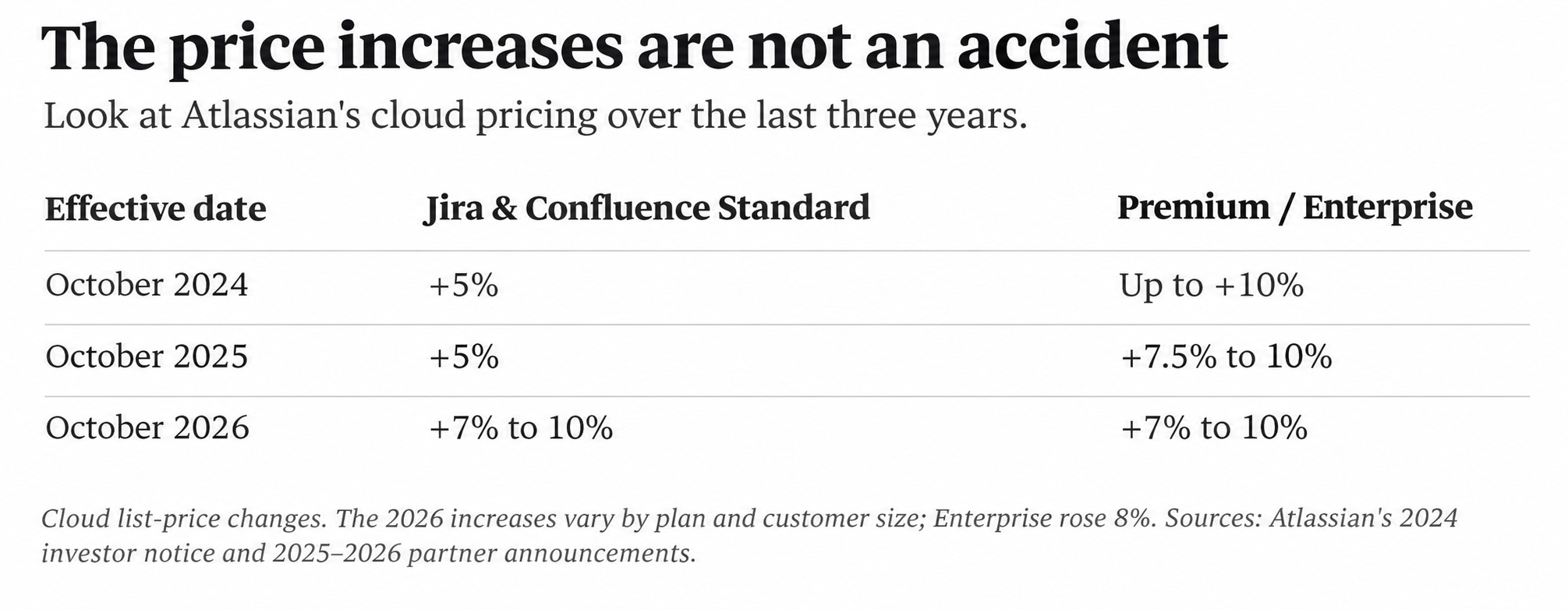
Three consecutive years of increases.
A customer experiencing 5%, 5% and 7% increases would pay roughly 18% more by the third year, before adding users, upgrading plans or purchasing additional integrations.
Meanwhile, Atlassian generated $6.57 billion in revenue in FY2026, up 26%. Its cloud business grew 28% to $4.41 billion.
More interestingly, over 90% of its FY2026 revenue came from customer accounts that already existed a year earlier.
Atlassian attributes subscription growth partly to seat expansion and higher prices.
This doesn’t prove customers are happy. It doesn’t even prove that every customer renewed.
But it tells us something about the economic machine Atlassian has built.
A company doesn’t need every customer to love it if leaving requires an internal business case nobody wants to own.
Jira is no longer just a product. It’s an institution.
Think about what happens when a company adopts Jira.
Initially, it’s a ticketing tool.
Then engineering starts using it. Product management follows. Operations builds dashboards. Executives start measuring performance through its reports.
Confluence becomes the company’s institutional memory.
Over time, these systems accumulate workflows, integrations, permissions, automations and years of decisions.
Now imagine the CIO announcing that the company is replacing Atlassian.
The software licence might be cheaper elsewhere.
But somebody must migrate thousands of tickets, preserve historical records, rebuild workflows, reconnect applications, retrain employees and demonstrate that the new system satisfies security and compliance requirements.
And somebody must accept responsibility if the migration fails.
That last part matters.
In enterprise software, the person who approves an expensive renewal is rarely judged as harshly as the person who approves a failed migration.
Atlassian isn’t only selling software anymore. It’s selling the avoidance of organisational disruption.
And that is a much stronger commercial position than simply having a better product.
The second business is the ecosystem
Atlassian has another advantage that doesn’t get enough attention: its Marketplace.
By June 2026, more than 40% of Atlassian customers had installed at least one Marketplace app. Its cloud ecosystem included more than 6,000 apps.
These are not just cosmetic add-ons.
They handle testing, reporting, compliance, time tracking, specialised workflows and integrations.
Every additional dependency makes an organisation more invested in the platform.
The interesting economics happen in two directions.
First, customers increasingly depend on the ecosystem.
Second, ecosystem developers depend on Atlassian’s distribution.
In October 2026, Atlassian increased its commission on Marketplace Connect apps from 20% to 25%, after already increasing it from 15% in April.
That means Atlassian has pricing power over both the businesses buying its software and many of the developers extending it.
There is a risk vendors eventually pass those higher costs to customers, though the commission increase itself does not automatically raise app prices.
This is the economic power of owning the platform rather than merely participating in it.
Atlassian gets paid for the software. Its ecosystem helps make that software harder to replace.
The pricing formula
Let’s say an enterprise spends $500,000 annually on Atlassian.
A 10% increase costs another $50,000.
Finance complains.
Procurement negotiates.
But replacing Atlassian might require a hypothetical $1 million migration project, six months of internal work and significant operational risk.
Even if a competitor offers the same functionality for 30% less, the annual saving is only $150,000 against the original subscription.
Ignoring other costs, it could take nearly seven years to recover that $1 million migration investment.
These are illustrative numbers, not Atlassian customer data. But the economic mechanism is real.
The decision is no longer about whether Jira is worth $500,000.
It’s about whether saving $150,000 a year justifies a million-dollar transition.
And that’s before considering the possibility of failure.
The more expensive a company makes itself to replace, the less sensitive its customers become to moderate price increases.
Economists call this switching costs.
I think of it as accumulated organisational dependency.
But dependency is not loyalty
This is where people confuse brand equity with lock-in.
A customer who renews because they love your product is different from a customer who renews because migration would be painful.
Both generate recurring revenue.
But they don’t deserve the same valuation in our minds.
Genuine loyalty creates advocacy, expansion and voluntary preference.
Dependency creates predictable renewals, at least until the economics change.
Atlassian probably benefits from both. Its product investments, integrations and growing cloud usage suggest it delivers genuine utility. But its public financial results cannot tell us precisely how much retention comes from customer satisfaction versus switching costs.
And there is a danger in confusing the two.
Every price increase improves short-term economics, but it can also improve the business case for competitors.
AI makes this especially interesting.
If AI significantly reduces the cost of migrating historical tickets, reconstructing workflows, mapping integrations and retraining users, one of Atlassian’s biggest structural advantages becomes weaker.
Not overnight. Governance, accountability and operational risk don’t disappear because an AI agent can write migration scripts.
But the cost of leaving could fall.
And when switching costs fall, customers regain negotiating power.
The bigger lesson
Atlassian’s CFO said in February 2026 that the company still saw substantial room for further price increases, pointing to innovation, customer value and pricing below many software peers.
That’s a revealing statement.
Atlassian isn’t simply asking how much its software costs to develop.
It’s evaluating how much value customers receive, what alternatives exist and how much more the market will tolerate.
This is where brand, product, distribution and commercial power converge.
The strongest enterprise software companies don’t merely acquire customers.
They become embedded in how those customers operate.
But there is a limit.
A company can charge a premium because customers want to stay, or because customers cannot afford to leave.
The financial statements may look similar for years.
The difference becomes obvious when a credible exit finally appears.
The ultimate test of brand equity isn’t whether your customers renew when leaving is expensive.
It’s whether they still choose you when leaving becomes cheap.