
In 2007, Steve Jobs introduced the iPhone and changed the economics of the mobile phone industry.
Nearly two decades later, Apple has built something arguably more valuable than the iPhone itself.
A business that makes money long after the customer leaves the Apple Store.
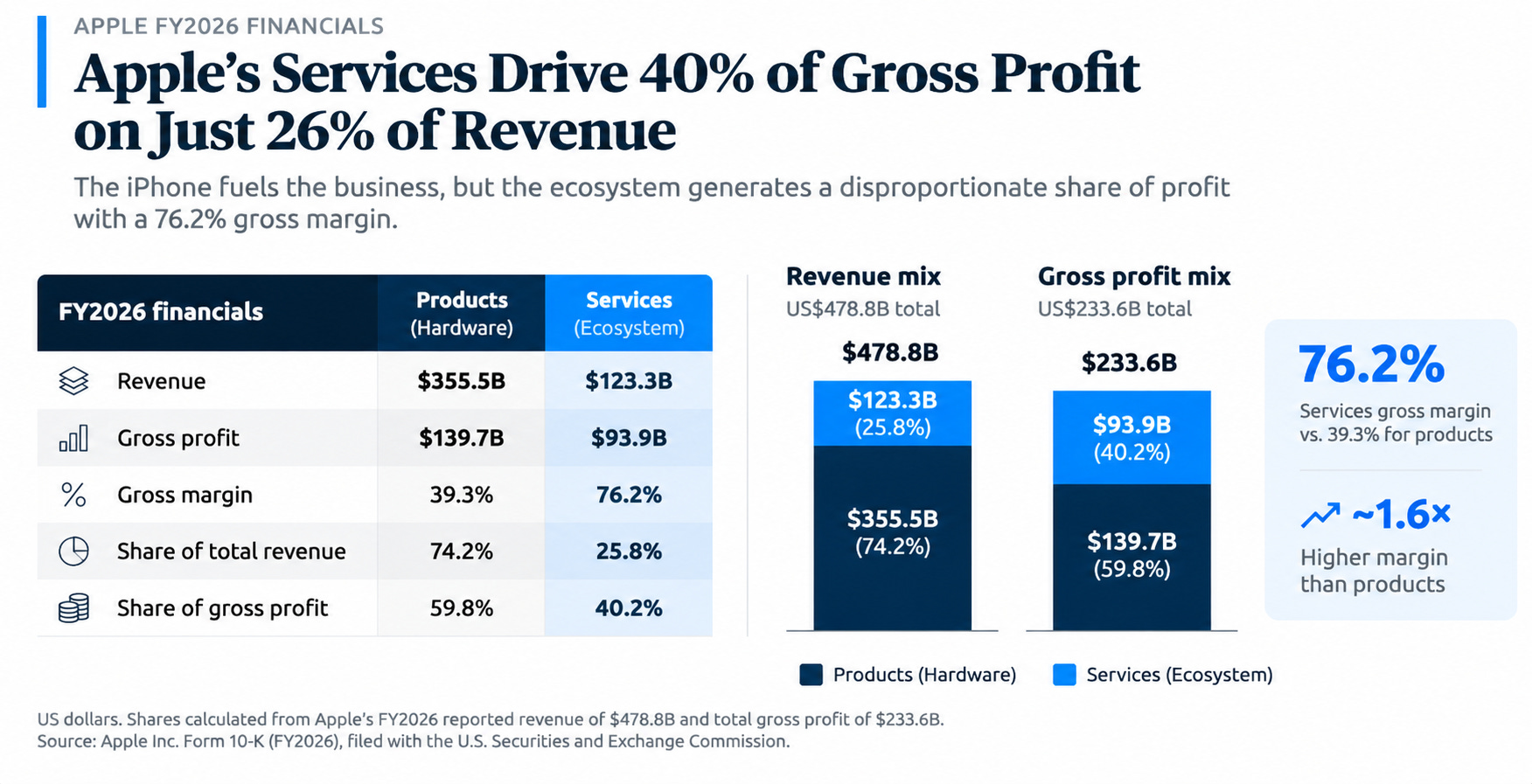
In fiscal year 2026, Apple generated US$123.3 billion in Services revenue, up 13% from the previous year. More importantly, its Services business delivered a 76.2% gross margin.
Compare that with Apple’s hardware products, which generated a 39.3% gross margin.
For every $100 of recognised Services revenue, Apple retains roughly $76 after the direct cost of delivering those services, before research and development, corporate expenses, taxes and other costs.
This is where Apple’s business becomes particularly interesting.
Most people still understand Apple as a hardware company. It designs beautiful devices, charges premium prices and convinces millions of people to replace them every few years.
That’s true, but incomplete.
Apple has built a commercial system where selling hardware establishes a relationship, and that relationship creates multiple opportunities to generate recurring revenue.
The iPhone was the product. The ecosystem became the business model.
And the difference matters far beyond Apple.
Because what Apple has built is a lesson in how brand equity can be converted into infrastructure, distribution power, recurring revenue and eventually market power.
1. The economics hidden behind the Apple logo
Let’s look at Apple’s 2026 numbers.
Look closely.
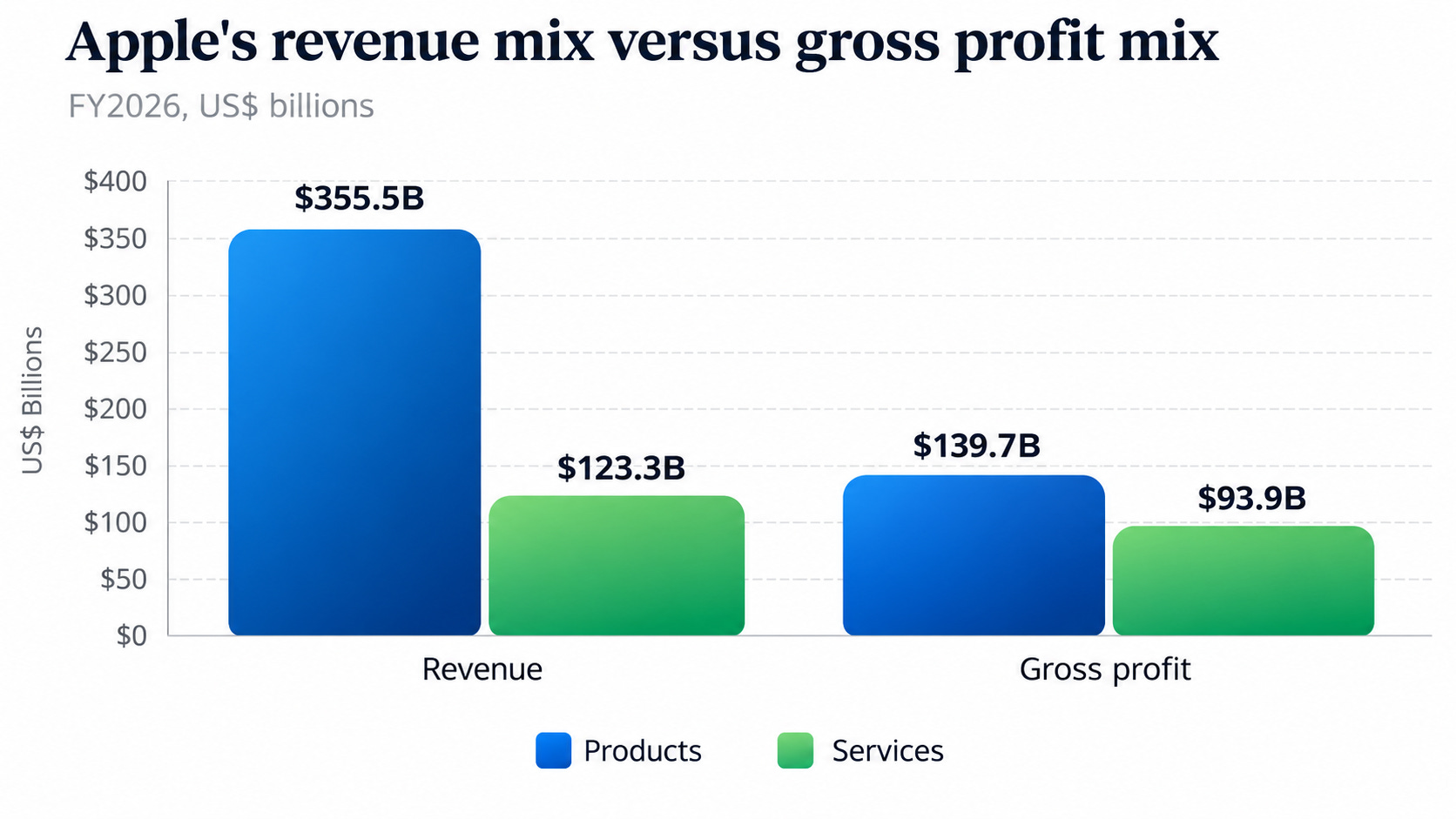
Services account for only about a quarter of Apple’s revenue, yet contribute more than 40% of its gross profit.
That’s a disproportionate amount of economic value coming from a business that doesn’t require Apple to manufacture and sell another physical device every time it earns revenue.
But there’s another number worth paying attention to.
In FY2024, Services generated $96.2 billion. In FY2025, $109.2 billion. In FY2026, $123.3 billion.
That’s approximately $27 billion in additional annual Services revenue in two years.
Meanwhile, the Services gross margin rose from 73.9% to 76.2%.
Apple isn’t merely growing its Services business. It is generating more revenue from it while improving the gross economics of the business mix.
This is the kind of business investors love.
A large customer base. An established distribution channel. Recurring usage. High gross margins. And customers who have more reasons to stay with every additional product or service they adopt.
Yet calling Apple a Services business would also be a mistake.
The company generated more than $254 billion in iPhone revenue alone during FY2026.
The hardware business is still enormous. In fact, iPhone revenue grew 21% that year.
Apple hasn’t abandoned its original economic engine.
It has built a second one on top of it.
And that’s arguably even more powerful than simply transitioning from hardware to software.
2. Apple doesn’t just sell products. It owns the commercial environment around them.
Consider what happens when you buy an iPhone.
You activate it with an Apple Account. You download applications through the App Store. You store your photos in iCloud. You might subscribe to Apple Music, pay for additional storage, buy AppleCare or use Apple Pay.
Eventually, you might buy an Apple Watch because it works particularly well with your iPhone.
Then AirPods.
Then a MacBook.
Before you know it, your devices, photos, passwords, payment methods, applications and subscriptions are connected through one ecosystem.
Apple’s genius is not that it sells all these products separately.
It’s that every additional product or service can make the entire ecosystem more useful.
And potentially more difficult to leave.
There are five important commercial layers here.
First, subscriptions. Apple Music, Apple TV, Fitness+, Arcade and other subscriptions generate ongoing revenue instead of relying on a new device purchase.
Second, cloud services. iCloud makes storage and synchronisation part of everyday life. The more photos, files and backups you accumulate, the more valuable that continuity becomes.
Third, the App Store. Apple operates a distribution platform connecting developers with customers, with commissions and other fees attached to certain transactions.
Fourth, advertising and licensing. Apple monetises attention and access through its advertising platforms and commercial arrangements, including search distribution agreements.
Fifth, payments and protection. Apple Pay, Apple Card and AppleCare extend Apple’s commercial relationship into transactions, financial services and device support.
All of these fall within Apple’s broader Services category, although they have very different business models and cost structures.
This distinction is important.
Apple doesn’t disclose an individual gross margin for every service. We cannot claim that Apple Music or Apple TV independently earns a 76.2% margin.
Content licensing, original productions, cloud infrastructure and repair services have real costs.
Advertising and certain licensing arrangements can have very different economics.
The 76.2% is the gross margin of the combined Services portfolio.
And Apple’s 2026 filing is particularly revealing because it identifies advertising and cloud services as the primary drivers of Services revenue growth that year.
That tells us something.
Apple is increasingly monetising both the customer’s digital activity and the infrastructure supporting it.
The iPhone gives Apple a place in the customer’s life.
The Services portfolio gives Apple multiple ways to monetise that position.
3. Brand equity becomes switching costs. Switching costs become pricing power.
I think this is the most misunderstood part of Apple’s success.
People often describe Apple’s customers as loyal.
And many genuinely are.
They appreciate the design, privacy, reliability, software experience and integration between devices.
But loyalty and dependency are not the same thing.
If someone prefers an iPhone because they love the product, that’s brand loyalty.
If someone wants to switch to Android but hesitates because their family uses shared iCloud storage, their photos are integrated across devices, and their Apple Watch won’t work the same way, that’s a switching-cost problem.
Both can produce customer retention.
But they have very different economic foundations.
Apple has been particularly successful at combining them.
Imagine a customer who owns only an iPhone. Switching to another phone might be relatively straightforward.
Now imagine someone who owns an iPhone, an Apple Watch, AirPods and a MacBook, uses iCloud for family storage and has paid applications distributed through the App Store.
The decision is no longer about replacing a phone.
It’s about changing an entire system.
How ecosystem economics compound
Hardware adoption
iPhone, Mac, iPad, Watch
Integrated services
Cloud, apps, payments, subscriptions
Greater convenience and switching costs
Data, workflows, habits, connected devices
More opportunities for recurring revenue
Retention, transactions, subscriptions, upgrades
Conceptual model of Apple’s ecosystem economics, not a reported Apple financial metric.
This creates pricing power, but not unlimited pricing power.
Customers may tolerate a higher subscription price or the cost of staying with the ecosystem because the alternative involves inconvenience, relearning and migration.
That’s not necessarily an irrational choice.
Convenience has economic value.
Integration has economic value.
Time has economic value.
The question is how much of that value the company can capture without damaging the trust that created it.
The strongest brands don’t merely convince customers to buy. They make the relationship increasingly valuable after the original purchase.
Apple has spent years turning that principle into a business model.
4. Apple has become a toll collector, not just a manufacturer.
There is another layer to Apple’s economics that deserves more attention.
Apple has positioned itself between consumers and businesses that want access to those consumers.
Consider app developers.
A software company wants to reach iPhone users. Apple’s App Store offers distribution, discovery, payment infrastructure and customer trust.
In exchange, Apple can earn revenue through commissions and other commercial arrangements.
Or consider search.
Google wants users to search through its engine.
Apple controls important search access points across its devices and software.
Google and other search providers have paid Apple for distribution arrangements.
Apple’s 2026 annual report explicitly recognises revenue from these licensing agreements.
That’s an extraordinary position.
Apple doesn’t need to build the world’s dominant search engine to monetise search access on its devices.
It doesn’t need to own every successful application to generate revenue from parts of the app economy.
It doesn’t need to produce every piece of digital content consumed through its ecosystem.
It can earn money by providing the infrastructure, distribution and customer access that other businesses depend on.
This is how distribution power becomes economic power.
But we need to be precise.
Apple is not collecting a fee on every activity occurring on an iPhone. Many applications, purchases and services generate no direct transaction fee for Apple.
And the economics of App Store commissions, cloud subscriptions and search licensing are not interchangeable.
Still, the overall commercial structure is remarkably powerful.
Apple has moved from selling products to also monetising access to the customers those products attract.
A manufacturer earns money when a customer buys something.
A platform can earn money when customers interact with other businesses.
Apple does both.
5. The hidden risk: When an ecosystem becomes too profitable, regulators start asking questions.
There is a dangerous side to this model.
The same integration that makes Apple attractive to customers can also create barriers for competitors.
The same distribution network that helps developers reach customers can give Apple substantial influence over commercial terms.
And the same switching costs that improve retention can reduce competitive pressure.
This is where brand equity and market power begin to overlap.
Regulators are increasingly concerned about the difference between building an excellent integrated product and using control over that integration to restrict competition.
In April 2025, the European Commission found Apple in breach of the Digital Markets Act’s anti-steering requirements and imposed a €500 million fine. Apple has contested the regulatory action.
Shaping Europe’s digital future
The argument is straightforward.
If a developer can offer a cheaper subscription outside Apple’s payment system, should Apple be allowed to prevent the developer from informing customers?
Apple argues that its platform policies help protect security, privacy and the quality of the customer experience.
Regulators argue that some restrictions undermine competition and customer choice.
Neither concern should be dismissed.
Security and integration are legitimate sources of customer value.
But they do not automatically justify every commercial restriction imposed by a platform owner.
And this is no longer a theoretical debate.
In its FY2026 filing, Apple acknowledged that regulatory and court-ordered changes affecting App Store commissions could materially affect its revenue, gross margins and financial performance. It also identified risks involving Google’s search distribution arrangements.
Think about the implication.
Part of Apple’s most profitable business model depends on commercial and regulatory structures it does not entirely control.
The ecosystem has become an enormous competitive advantage.
It has also become a regulatory target.
The irony is that Apple’s success created both outcomes.
6. The next battle isn’t the iPhone. It’s who controls the intelligence inside it.
There’s another question investors should be asking.
What happens to Apple’s ecosystem economics when AI becomes the primary interface between customers and digital services?
For years, the smartphone has been an application-based environment.
You want music, you open an application.
You want a restaurant, you search.
You need software, you visit an app marketplace.
You need a service, you navigate to its interface.
Apple’s distribution position is extremely valuable in this world.
But AI agents could change how customers discover products, access services and complete transactions.
Imagine telling your AI assistant:
Find a hotel in Melbourne, compare the best available options, book a room and organise transport.
The assistant might interact directly with booking services, payment providers and transport platforms.
The customer may never open the individual applications.
Now ask a commercial question.
Who captures the economic value of that transaction?
The hotel platform?
The payment provider?
The AI assistant?
Or the company controlling the operating system and device?
That is the next platform battle.
Apple has enormous advantages here: hardware integration, operating-system control, established customer relationships, payment capabilities and access to personal context with the user’s permission.
But those advantages do not guarantee that Apple will dominate AI-driven services.
A third-party AI agent might become the interface customers prefer.
An independent service could increasingly bypass traditional app discovery.
Regulation could also limit how Apple privileges its own services over competitors.
And AI infrastructure introduces new costs.
Apple’s 2026 filing shows research and development expenses rising 32% to $45.8 billion, with higher infrastructure-related costs, including AI investment, among the main drivers.
That’s important because software economics are changing.
Historically, the marginal cost of distributing an additional software product could be extremely low.
AI services involving substantial inference and compute requirements may be more expensive to deliver.
A 76% gross margin in Apple’s current Services portfolio does not guarantee similar economics for every future AI service.
The commercial opportunity is enormous.
So is the uncertainty.
My view is that Apple does not necessarily need to build the world’s best AI model.
It needs to make sure the iPhone remains one of the most valuable places for AI services to reach customers.
In other words, the strategic question may not be who owns the intelligence.
It may be who owns the customer relationship when intelligence becomes the interface.
That is an entirely different contest.
Full Stack Capitalist examines the intersection of brand equity, commercial power, technology and the economics behind the world’s most influential businesses.
Primary sources: Apple FY2026 Form 10-K, US Securities and Exchange Commission · European Commission, Digital Markets Act decision