
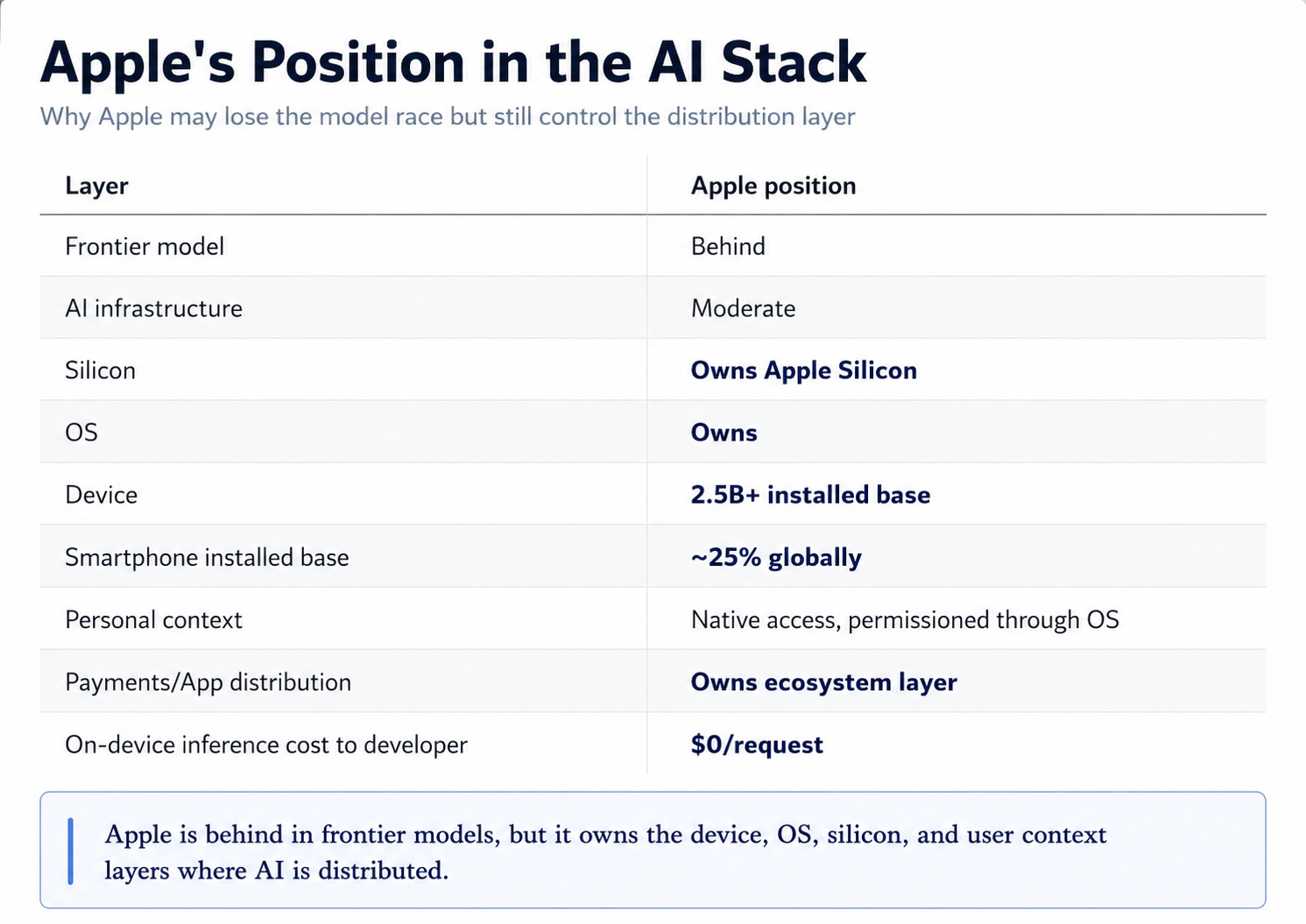
Are you still thinking Apple missed AI?
And on the surface, sure, that story writes itself. No frontier model. Siri has been a punchline for two years. OpenAI, Google, and Anthropic get all the headlines while Apple shows up late to its own keynote.
But I think that story is looking at the wrong scoreboard.
Here’s the simpler way to think about it. In any system, the thing that actually determines who wins is the binding constraint, the one resource everyone else needs and can’t easily get around.
Right now the industry treats “best model” as that constraint. Whoever has the smartest AI wins. That’s the assumption baked into almost every AI headline you read.
Apple’s bet is that this assumption is wrong. Apple thinks the binding constraint isn’t going to be intelligence. It’s going to be access. Who gets to sit between you and the AI. Who owns your phone, your identity, your payments, your camera roll, your location, and the little permission prompt that decides whether an app gets to touch any of it.
If that’s the real constraint, Apple already owns it. Two billion devices worth of it.
Let’s walk through this.
Apple stopped trying to build the one best model
At its developer conference this June, Apple rebuilt its whole AI framework around a simple idea: don’t force one model to do everything. Apple’s Foundation Models system now lets any outside model plug in, including “Anthropic’s Claude and Google’s Gemini, through a shared protocol any model provider can build against”. A developer can start with Apple’s own on-device model and swap in a different provider with barely any code changes.
That is a genuinely strange thing for Apple to do. This is a company that has spent forty years trying to control every layer of its stack, chips, software, glass, aluminum, all of it. And here it is, essentially saying, we don’t care whose model answers the question, as long as it answers it inside our house.
That’s the tell. Apple isn’t trying to win the model race anymore. It’s trying to make the model itself replaceable.
The Google deal makes the point even harder to miss
In January this year, Apple did something that would have been unthinkable a few years back. It signed a multi year deal to run the new Siri on “a custom 1.2 trillion parameter Gemini model, roughly eight times larger than what Apple’s own cloud models were running”, reportedly paying “something in the neighborhood of a billion dollars a year for the access”.
Read that again. Apple is paying its biggest search rival to power its own voice assistant. That is not the move of a company trying to out build Google on model quality. That’s a company saying, fine, license the smartest available brain, and let us keep the thing that actually matters, which is the wrapper the brain sits inside.
And here’s the part that really shows the strategy. The Gemini model doesn’t even show up as Gemini. Apple runs it through its own private cloud, under its own branding, invisible to the user. You’ll just think it’s Siri. The supplier gets swapped out like a part in an engine, and the driver never notices.
Meanwhile the old partner is getting quietly demoted
Back in 2024 Apple leaned on OpenAI to give Siri a boost for complicated questions.
That relationship is clearly cooling. Apple’s new Siri, launching this fall, runs on Google’s models instead, and one analyst summed up the shift bluntly, saying “the Google deal pushes OpenAI into a supporting role, with ChatGPT sticking around for complex, opt in requests rather than being the default brain behind the phone”.
Apple hasn’t cut OpenAI off completely. But it’s telling that the company that used to be the star player is now riding the bench.
And then it gets messy. Really messy.
OpenAI knows exactly what Apple is doing, which is why it’s trying to become Apple
Here’s the other half of the story, and it’s the half that turns this into a genuinely great essay instead of just a tech news recap.
OpenAI’s president, Greg Brockman, confirmed that the company is building what he called a family of devices, physical hardware designed to be the way people talk to ChatGPT, not just an app you open on someone else’s phone. He said the products are coming soon, without giving a date, and he’s been clear that “the goal is a much more natural way to talk to a machine, with voice as the focus rather than a screen”.
This didn’t come out of nowhere. Last year OpenAI bought Jony Ive’s design studio, io, in a deal worth somewhere around $6.5 billion dollars, paid entirely in OpenAI equity.
Ive is the guy who designed the iPhone. Bringing him in wasn’t a talent hire. It was OpenAI trying to buy the one thing it doesn’t have, which is a seat at the hardware table.
Why would a software company that just wants to sell you a chat subscription spend billions building a physical gadget? Because Brockman and Altman clearly understand the same thing Apple understands. If ChatGPT only ever lives inside Apple’s phone, as a feature Apple can promote or bury whenever it wants, then Apple owns the relationship with the customer, not OpenAI. The only way out of that trap is to stop being a guest in someone else’s house and build your own house instead.
So you’ve got this beautiful mirror image happening. Apple is trying to turn frontier models into an interchangeable commodity that plugs into its ecosystem. OpenAI is trying to build its own ecosystem so it never has to be anyone’s commodity again.
Apple wants OpenAI to become a supplier. OpenAI is racing to become the next Apple before that happens.
And now there’s a lawsuit that makes the whole thing feel personal
In July, Apple actually sued OpenAI. Not over anything to do with AI models. Over hardware. Apple’s complaint accuses OpenAI of running a systematic campaign to recruit more than four hundred former Apple employees, and of walking off with confidential product designs and manufacturing details in the process.
The filing goes after OpenAI’s chief hardware officer by name, and it alleges that some of the stolen material touched on Apple’s proprietary metal finishing techniques, the kind of manufacturing know-how Apple guards as closely as anything it makes.
Interestingly, the lawsuit is careful to leave Jony Ive’s name out of it entirely, even though his studio, io, is named as a defendant. Nobody quite knows why. Maybe there isn’t enough evidence tying him directly to the recruiting, maybe Apple doesn’t want the optics of suing its own former design chief by name. Either way, it’s a strange, almost respectful omission in an otherwise aggressive filing.
Apple didn’t have to file this lawsuit. Filing it while OpenAI is heading toward what’s expected to be a massive IPO is a very deliberate kind of pressure.
Apple defending the one thing it has that OpenAI desperately wants and doesn’t have yet, which is decades of knowing how to design and manufacture a physical object people are willing to put in their pocket.
So what’s the actual fight here
It’s tempting to frame this as Apple versus OpenAI on model quality. That’s not it.
Apple has basically conceded that fight already, which is exactly why it licensed Google’s model instead of grinding away trying to out build it internally.
The real fight is over who owns the interface. Who decides which AI gets to see your messages, your photos, your location, your calendar, your face when you unlock your phone. Whoever holds that position doesn’t need to have the smartest model in the room. They just need to control the door the smartest model has to walk through to reach you.
Apple’s bet is that it already owns that door, and that the smartest move now is to keep the door and stop worrying about which brain sits on the other side of it. OpenAI’s bet is that owning a brain isn’t enough, and that it needs to build its own door before Apple’s door becomes the only one that matters.
Neither company can fully win this without controlling the layer the other one owns. That tension, more than any benchmark score, is the actual AI story happening right now.
If you’re building anything in this space, the lesson generalizes. Don’t ask whether your product is the smartest one out there. Ask who owns the interface your product has to pass through to reach a real customer. That’s usually where the leverage actually sits, and it’s usually not where anyone’s paying attention.