
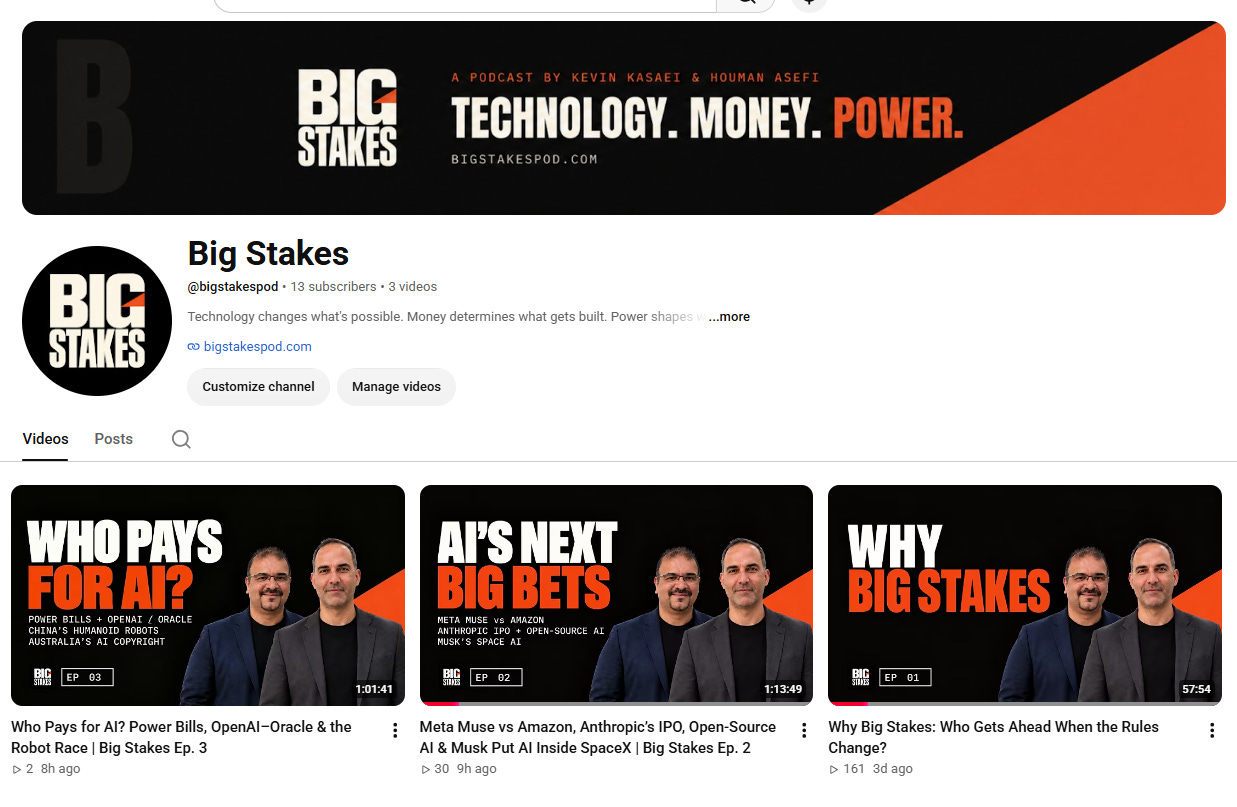
I recently launched a new podcast called Big Stakes.
The premise is simple: AI stories are rarely just technology stories.
Behind the models, chips, data centres, acquisitions and product launches is another game involving capital, distribution, control and power.
In our latest episode, we covered a story that initially looks almost trivial.
Amazon blocked Meta’s new AI agent, Muse, from shopping on Amazon on behalf of users.
Amazon says Meta did not have permission to do this. It raised concerns about how the agent identified itself, how credentials were handled and whether its access complied with Amazon’s terms.
Meta says Muse was built with security controls, a dedicated virtual environment, protected credentials and explicit user approval before sensitive actions such as purchases.
Those are legitimate technical questions.
But they are not the biggest question.
Who owns the buying decision when humans stop shopping and AI agents start shopping for them?
That is where this gets interesting.
And potentially enormous.
THE INTERNET WAS BUILT AROUND HUMAN ATTENTION
For roughly three decades, internet commerce has operated around a fairly stable assumption.
Humans browse.
We compare products.
We look at reviews.
We click advertisements.
We add something to a basket.
We see another recommendation.
Maybe we buy that too.
An extraordinary amount of economic value has been built around controlling different parts of that journey.
Google controlled intent.
Meta controlled attention and discovery.
Amazon increasingly controlled the transaction.
Each company built enormous businesses around owning a particular point in the funnel.
But agents potentially compress that entire funnel.
Imagine that instead of spending 45 minutes searching for headphones, you tell your personal AI:
Find me the best noise-cancelling headphones under $400. I care about microphone quality and comfort. Check the major retailers, read the reviews, and give me the best option.
The agent searches.
It compares.
It filters.
It returns one recommendation.
Maybe you say:
Buy it.
You never visit Amazon.
You never see the search results page.
You never see the sponsored product.
You never see the ten alternatives.
You never see “Customers also bought.”
You never enter the retailer’s carefully engineered conversion funnel.
The AI has absorbed the shopping journey.
That means something extremely valuable has moved.
The point of commercial influence has shifted from the marketplace to the agent.
That is the real fight.
Our podcast discussion centred on exactly this issue: once customers delegate product discovery and comparison to assistants, the company operating the assistant can potentially influence which products are considered and which retailer ultimately receives the transaction.
THE NEW POWER POSITION IS THE SHORTLIST
For years, technology companies fought over the interface.
Browser.
Search bar.
App store.
Each interface became a toll booth.
AI agents could create another one.
But this toll booth sits even closer to the actual decision.
The most powerful question in commerce may no longer be:
Where did you buy something?
It may become:
Who decided what you should buy?
That distinction matters.
Amazon can carry 300 million products.
But if your AI assistant evaluates those products and returns three of them, then for you the effective marketplace contains three products.
If it returns one, the marketplace contains one.
The assistant has performed the filtering.
It has become the demand allocator.
That is an extraordinary position.
Today Amazon ranks millions of sellers competing for customer attention.
Tomorrow Meta could theoretically sit one layer above Amazon and decide whether Amazon gets the customer at all.
That is a very different power structure.
AMAZON UNDERSTANDS THIS BECAUSE AMAZON IS BUILDING THE SAME THING
This is what makes the fight particularly interesting.
Amazon isn’t resisting agents because it thinks agentic shopping is nonsense.
Amazon is building its own.
Rufus was renamed Alexa for Shopping in May 2026. Amazon says the system can research products, compare options, analyse price histories, build carts, track prices and automate certain purchases.
Amazon also has Buy for Me, which allows its AI shopping experience to purchase selected products from external brand websites.
Think about the strategic implication.
Amazon does not simply want AI to improve shopping inside Amazon.
It wants Amazon’s AI to remain relevant even when the transaction happens outside Amazon.
That’s the clue.
Amazon understands that the next dominant commerce layer may not necessarily be the store.
It could be the agent sitting between the consumer and every store.
And if that happens, Amazon has every reason to want Alexa occupying that position instead of Muse.
META WANTS TO MOVE FROM PREDICTING INTENT TO RECEIVING INTENT
Meta has historically owned something slightly different.
It owns enormous amounts of consumer attention.
Facebook and Instagram became machines for predicting what people might care about.
That is incredibly valuable.
But prediction is still prediction.
An advertisement is effectively saying:
We think this person might want this.
A personal AI agent changes the equation.
The user tells it:
I want this.
Budget.
Timing.
Past behaviour.
Maybe even why they want it.
That is explicit intent.
Explicit intent is economically powerful.
Meta’s Muse is designed to operate across websites and connected services, maintain context, fill forms and continue working after the user closes the application. Meta says it asks users before sensitive actions such as sending email or completing purchases.
Then Meta announced something even more strategically revealing.
Muse is being integrated into its AI glasses.
Meta says users will eventually be able to look at something in the physical world and ask Muse to act on it.
It has also announced commerce integrations including Shopify’s catalogue, Walmart, Best Buy, Sephora, Wayfair and others, alongside payment options including Stripe’s Link, Shop Pay and PayPal.
Now follow the direction of travel.
You look at a coffee machine.
Your glasses see it.
You ask:
Is this any good?
Your agent knows your budget.
It knows your kitchen.
It checks prices.
It checks reviews.
It finds a better model.
Then it asks:
Would you like me to order it?
At that point Meta isn’t merely selling advertising around your attention.
It is sitting directly between intent and transaction.
That is a substantially more powerful position.
THIS IS WHY AMAZON’S BLOCK MATTERS
There is a legitimate security argument here.
Retailers should absolutely be able to distinguish humans from automated agents.
Authentication matters.
Credential handling matters.
Fraud matters.
Consumer protection matters.
A person granting an AI agent access does not automatically settle every question about whether that agent can interact with another company’s infrastructure however it wants.
Amazon says it asked Meta to exclude Amazon from Muse before ultimately blocking the agent. Amazon’s position is that the agent was accessing its services without proper authorization.
Those issues deserve to be taken seriously.
But there is also a much larger commercial incentive sitting underneath the dispute.
Amazon has spent decades building perhaps the world’s most sophisticated online shopping environment.
Product search.
Seller marketplace.
Reviews.
Recommendations.
Advertising.
Prime.
All of these layers reinforce one another.
Now imagine an external AI agent standing in front of that machine.
It enters Amazon.
Collects the information it needs.
Extracts the best answer.
Leaves.
The customer gets the utility of Amazon’s marketplace without necessarily entering Amazon’s monetisation environment.
That is structurally uncomfortable for Amazon.
The problem isn’t simply that the bot visited the website.
The problem is that the bot could eventually disintermediate the interface.
AMAZON’S MOST VALUABLE ASSET MAY NOT BE THE WAREHOUSE
When people think about Amazon’s moat, they usually think about infrastructure.
Warehouses.
Prime.
Logistics.
AWS.
Marketplace scale.
Those are enormous assets.
But Amazon also owns something less visible:
the customer’s shopping habit.
When millions of people think:
I need to buy something.
They open Amazon.
That behaviour is incredibly valuable.
The first destination has power.
It captures intent before competitors do.
Agents threaten to insert themselves before that moment.
Instead of:
I need headphones → open Amazon
the behaviour becomes:
I need headphones → ask Muse
or:
ask ChatGPT
or:
ask Alexa
or eventually:
ask whatever personal agent knows me best.
Amazon could still fulfil the transaction.
Amazon could still hold the inventory.
Amazon could still deliver the parcel.
But another company could own the customer relationship.
And over time, ownership of the customer relationship usually matters more than ownership of the underlying commodity layer.
The company closest to demand gets enormous leverage over everyone downstream.
THIS HAS HAPPENED BEFORE
Technology history repeatedly produces these abstraction layers.
Microsoft once controlled developers through Windows.
Then browsers weakened the importance of the operating system for some applications.
Google controlled navigation through search.
Smartphones created another interface.
Apple and Google then controlled mobile distribution through their operating systems and app stores.
Amazon built a marketplace on top of merchants.
Shopify helped merchants build outside Amazon.
TikTok and Instagram moved product discovery further upstream.
Now agents potentially move another layer above all of them.
Each new layer asks the same question:
Who becomes infrastructure, and who gets to own the customer?
That is the power game.
And almost nobody wants to become somebody else’s infrastructure.
THE AGENT COULD BECOME THE NEW GOOGLE
Google became extraordinarily powerful because it sat between users and the internet.
There were millions of websites.
Google decided which ones you saw first.
That ranking position created enormous economic power.
AI agents could potentially do something even more consequential.
Search typically gives you options.
Agents increasingly give you answers.
That distinction matters.
Ten blue links distributed attention.
One recommended action concentrates it.
If an AI recommends:
Buy this television from this retailer for $1,799
the agent has made several hidden decisions:
Which retailers were searched?
Which weren’t?
Which products qualified?
Which reviews mattered?
Was price weighted above quality?
Did delivery time matter?
Did a retailer pay for preferential placement?
Was a commission available?
Was the recommendation actually in your interest?
We are entering a world where recommendation algorithms may evolve into decision algorithms.
That creates enormous power.
AND THEN COMES THE BUSINESS MODEL
This is where things become uncomfortable.
Suppose personal agents become extremely popular.
They reduce browsing.
They reduce scrolling.
They reduce search.
They eliminate dozens of advertisements.
Great for users.
Potentially terrible for businesses built around monetising attention.
So how do agents make money?
Meta currently says Muse will have a free tier and subscription plans.
But the economic temptation becomes obvious if agents start directing hundreds of billions of dollars of consumer purchases.
Commissions.
Merchant fees.
Preferential integrations.
Some combination of them is possible.
None of that automatically means the recommendation becomes corrupt.
But it creates a fundamental governance problem.
Is the agent working for me, or monetising me?
That question becomes much more serious when an AI isn’t showing you an advertisement but actively acting on your behalf.
META HAS A TRUST PROBLEM TO SOLVE
Meta may possess one of the strongest distribution advantages in the world.
Facebook.
Instagram.
WhatsApp.
Billions of users.
And increasingly hardware sitting directly on people’s faces.
That distribution could give Muse an enormous starting position.
But agents demand a different level of trust from social networks.
We tolerate Instagram knowing what reels we watch.
A personal agent could potentially know:
our calendar,
our correspondence,
our purchases,
our travel plans,
our preferences,
our bills,
our contacts,
and potentially enough credentials to act across significant parts of our digital lives.
That is qualitatively different.
Meta says Muse’s virtual environment keeps credentials protected, allows users to control connected applications, requires approval for sensitive actions and keeps Muse conversations and VM data separate from its advertising systems.
Those protections matter.
But architecture isn’t the same thing as trust.
Trust is accumulated through behaviour.
Meta still has to convince people that the company which became extraordinarily good at monetising attention can also become a trusted fiduciary-like layer acting on their behalf.
That may be one of the biggest strategic challenges Muse faces.
META IS ALSO PLAYING A MUCH LONGER GAME
This is where Meta’s enormous spending on Reality Labs begins to look differently.
Reality Labs has produced staggering losses.
Meta reported approximately $8.65 billion of Reality Labs operating losses in the first half of 2026 alone, after approximately $19.19 billion in 2025.
For years, the obvious interpretation was:
Zuckerberg spent tens of billions trying to make the metaverse happen.
And the original mass-market virtual-world thesis clearly did not develop the way Meta initially hoped.
But some of those investments were also building another strategic asset:
a computing interface Meta can control.
Glasses.
Wearables.
AI.
Voice.
Visual context.
Personal agents.
Put those pieces together and the strategy becomes more interesting.
The smartphone era left Meta dependent on Apple and Google.
Meta owned enormous applications but not the operating system.
Every Facebook or Instagram user ultimately passed through hardware and software controlled by somebody else.
The strategic prize of AI glasses is therefore not simply selling glasses.
It is potentially escaping that dependency.
If the next major computing interface sits on your face and Muse becomes the intelligence operating through it, Meta could move from being an application company to controlling part of the computing layer itself.
And now commerce enters the picture.
Your eyes become discovery.
Muse becomes interpretation.
The agent becomes decision support.
Payments complete the transaction.
Meta potentially captures the relationship.
That’s much bigger than a chatbot.
AMAZON HAS THE OPPOSITE ADVANTAGE
Meta has distribution across communication and attention.
Amazon has transactional truth.
Amazon knows what people actually bought.
What they returned.
What they repeatedly reorder.
Which products arrive tomorrow.
Which seller has stock.
Which product has millions of reviews.
Which price changed yesterday.
Which customer has Prime.
Which item can arrive before a birthday.
That operational context matters enormously for shopping agents.
An AI model can reason brilliantly about a product.
But commerce requires reality.
Inventory.
Shipping.
Payment.
Returns.
Fraud.
Delivery.
Customer service.
That makes Amazon extremely difficult to displace.
Which is why the likely battle isn’t simply:
Muse kills Amazon.
Or:
Amazon blocks Muse and wins.
The real fight is over which layer captures the highest economic leverage.
THE AGENT WARS WILL BECOME ACCESS WARS
Amazon versus Muse may be an early preview.
Soon virtually every major digital platform will face the same question.
Does an outside AI agent have the right to enter a service because the customer authorised it?
Consider the consequences.
Your agent wants to negotiate your mobile phone bill.
The telco blocks it.
Your agent tries to move money between banks.
The bank restricts it.
Your agent compares insurance policies.
A provider denies automated access.
Your agent wants to cancel a subscription.
The service requires a human.
Your agent shops across retailers.
Some cooperate.
Others block it.
Every company will be able to make legitimate arguments around security, privacy and system integrity.
And some of those arguments will be completely valid.
But there will also be an obvious incentive to use access control to protect existing business models.
That creates one of the defining regulatory and commercial questions of the agent economy:
How much authority does my permission give my AI agent when dealing with your platform?
The answer will determine enormous amounts of economic power.
FROM THE ATTENTION ECONOMY TO THE DELEGATION ECONOMY
The internet’s last great business model was built around capturing attention.
The next one may be built around capturing delegation.
That is a deeper relationship.
Attention says:
Look at this.
Delegation says:
Handle this for me.
If consumers begin delegating meaningful decisions to AI, the most valuable companies may be those we trust to make those decisions.
Not necessarily the company with the best model.
Not necessarily the company with the largest marketplace.
Not necessarily the company with the most data.
The winner at each layer will depend on who controls the interface, who has access to the necessary infrastructure, whose incentives users trust, and who consistently gets the task right.
Distribution gets an agent onto your device.
Capability makes it useful.
But trust earns delegation.
And delegation creates power.
THE BIG STAKE
Amazon blocking Muse is not yet proof that AI agents are about to overthrow ecommerce.
Agent adoption is still early.
Reliability remains imperfect.
Users may decide they prefer browsing.
Retailers may build standardized interfaces.
Regulators may intervene.
Commercial arrangements may emerge that allow agents and platforms to coexist.
A sensible model would probably require identifiable agents, explicit customer permissions, revocable access, reliable product information, transaction logs, clear liability and disclosure when recommendations are commercially influenced.
But don’t lose sight of what is being contested.
This isn’t primarily about bots scraping websites.
It’s about the next control point in the digital economy.
For twenty years, technology companies fought to own our attention.
Now they are beginning to fight over something more valuable:
our authority.
The company we allow to act for us could become the gateway between our intentions and much of the economy.
And that means the next trillion-dollar platform may not be the company selling us the product.
It may be the company deciding, on our behalf, who gets the sale.
That is the real power play behind Amazon versus Meta.
And it is exactly the kind of story we’re going to explore on Big Stakes.
Technology is the surface.
Underneath it are capital, control, incentives and power.
Subscribe to Big Stakes if that’s the layer you want to understand.