
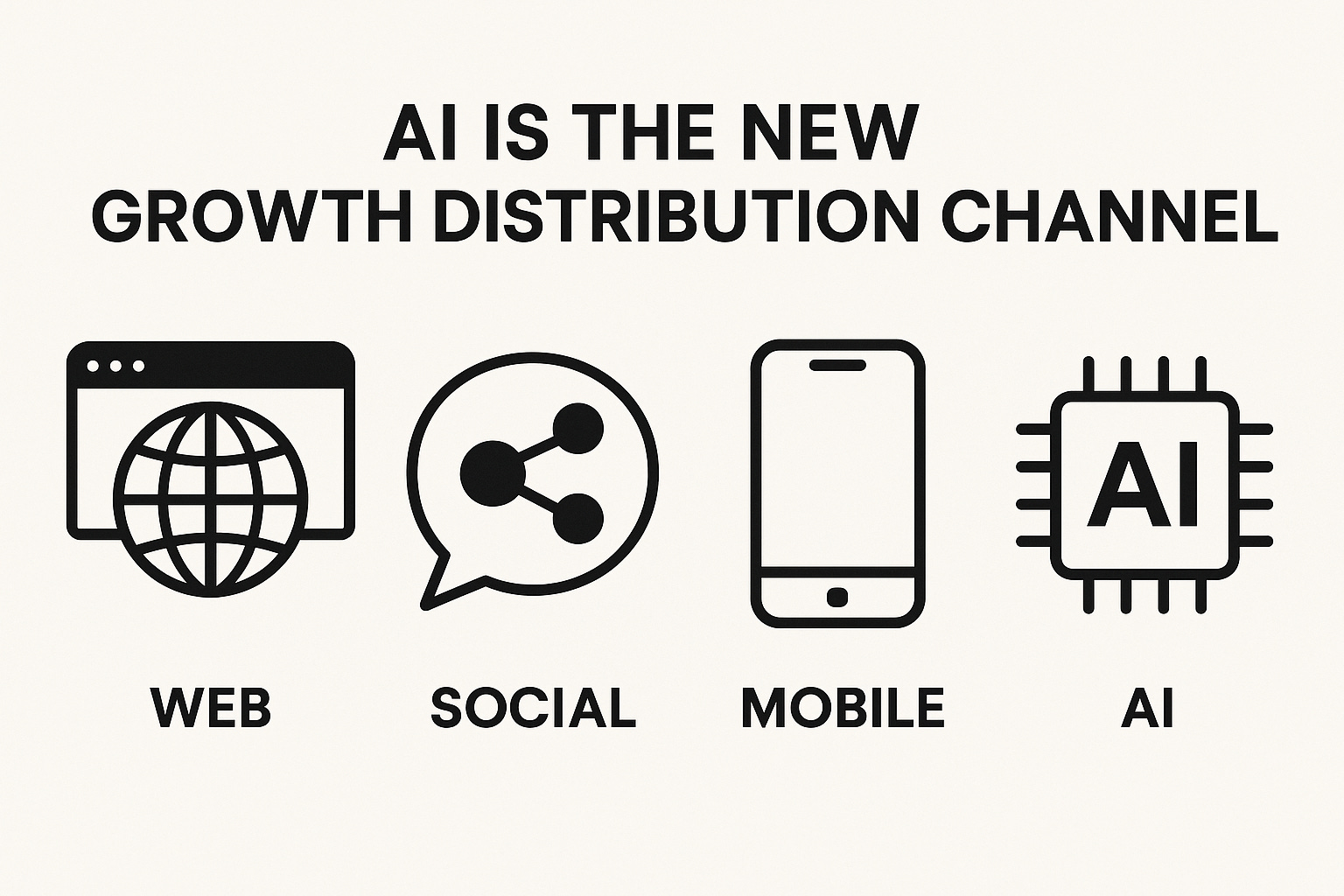
Every era is defined by a new distribution channel.
Web → Social → Mobile → AI.
The winners always show up early, learn the rules fast, and build moats while everyone else debates semantics.
This is your playbook to treat AI as distribution…not just a feature. I’ll compare past eras, extract the laws that don’t change, point out what’s different this time, and give you a step-by-step plan to build brand, demand, and defensibility inside AI systems (AI SEO + product placement).
1) History Doesn’t Repeat, But Distribution Rhymes
Web (1998–2010)
Gatekeepers: Search engines.
Playbook: Publish useful pages, earn links, capture intent.
Moats: Domain authority, backlinks, direct traffic, email lists.
Latency: Minutes to crawl, weeks to rank.
Unit: The page.
Social (2010–2016)
Gatekeepers: Feeds & followers.
Playbook: Ship snackable content, trigger shares/comments, build audience.
Moats: Audience graph, creator-brand affinity.
Latency: Seconds.
Unit: The post.
Mobile (2012–2020)
Gatekeepers: App stores & push notifications.
Playbook: Solve a high-frequency job, nail Day-1 activation, retention loops.
Moats: Installed base, notifications, OS integrations.
Latency: Instant once installed.
Unit: The app.
AI (2023–…)
Gatekeepers: Assistants, AI search, copilots, agents.
Playbook: Be the best answer and the safest action. Expose truth via structured data + APIs.
Moats: First-party data, verifiable facts, agent integrations, feedback loops.
Latency: Milliseconds to answer; your updates propagate as soon as models can retrieve them.
Unit: The answer (and the action it triggers).
2) What’s the Same (So You Don’t Overcomplicate It)
Early movers compound. New channels are attention-rich, supply-poor. Ship early, iterate faster.
Truth beats hype. Useful, specific, verifiable content wins the ranking/placement algorithm—then and now.
Moats = distribution + data. The combo remains undefeated.
3) What’s Different (So You Don’t Get Smoked)
Zero-click by default. AI answers in-line. You must optimize for Answer → Action, not Click → Page.
Models choose you. Placement isn’t just popularity; it’s confidence + safety + availability via API.
Action inside the answer. The result isn’t a link; it’s a booking, a purchase, a draft contract, a workflow.
Entity-first, not keyword-first. Models map entities and relationships. If you’re not a clean entity with structured facts, you don’t exist.
Freshness without farming. Real-time or near-real-time retrieval rewards maintained truth over content mills.
4) The AI Distribution Map (Where You Can Show Up)
AI Search: Assistants that cite sources and summarize (think: “what’s the best X?”).
General Assistants: Chat apps that recommend, plan, and execute (answer + tool use).
Vertical Copilots: In docs, code, CRM, design—where work happens.
Agent Marketplaces: Agents that shop, book, schedule, troubleshoot.
System Surfaces: OS-level assistants (desktop, mobile, car, home).
Voice & Wearables: Hands-free, task-first discovery.
Your job: be discoverable (answer), be callable (action), be attributable (track).
5) AI SEO = Entity SEO + Actionability
Classic SEO optimized for strings. AI SEO optimizes for things.
Make your brand a first-class entity
Canonical About, Pricing, Specs, Comparisons, FAQs—kept fresh.
Structured data: product catalogs, availability, return policies, T&Cs.
Public evaluation pages that prove performance (benchmarks, case studies, JSON blobs with citations).
Encode answers in machine-readable form
Publish clean JSON for facts customers ask for (prices, SKUs, compatibility, shipping times).
Add Q&A bundles with variations the model will see (“cost,” “price,” “estimate,” “how much”).
Provide verifiable sources: PDFs, docs, whitepapers—stable URLs, consistent facts.
Be callable
Expose simple endpoints for core actions:
POST /quote,POST /book,POST /buy.Publish LLM integration guides with example prompts + request/response transcripts.
Offer a rate-limited public API key tier just for assistants/agents.
6) AI Product Placement (How Models Put You on the Shelf)
Think of assistants like supermarkets. You want eye-level shelf space.
Models prefer vendors that are:
Accurate (consistent facts everywhere),
Low-risk (clear SLAs, refunds, safety guardrails),
Available (fast, public endpoints with docs),
Attributable (UTM-like tokens, success webhooks),
Up-to-date (fresh inventory, pricing, or content).
Give assistants a “Placement Kit”:
Facts Pack: canonical JSON of your brand, products, policies.
Action Pack: minimal API + examples for 3 top tasks with test credentials.
Evidence Pack: case studies, benchmarks, testimonials, return rate, uptime.
Safety Pack: data handling, consent flows, refund policy—clear and machine-readable.
7) Mental Models (Decision Frameworks You Can Reuse)
Aggregator 3.0: Assistants aggregate demand at the task level. The “homepage” is a prompt. Your job is to become the default action for key tasks.
JTBD Zoom-In: Map top “hire moments.” If the user is “hiring” an assistant to do X, you must be the lowest-risk, fastest path to done.
ARO (Action-Rate Optimization): New north star. % of AI answers that trigger your action.
Entity Gravity: The cleaner your entity graph (facts + relationships), the more often models orbit around you.
Prompt as Packaging: A great, shareable prompt that reliably triggers your product is modern shelf art.
Agent Shelf Space: Becoming a pre-configured tool/action inside popular assistants is the new app-store ranking.
Data Flywheel: Users → task data → better prompts/models → higher placement → more users.
8) Step-by-Step: Build a Business with AI as Distribution
Week 0–2: Choose your wedge and map intents
Pick a money task you can own (high frequency, high pain, clear success).
List 25 real prompts users would type to solve it. Cluster by intent.
Week 2–4: Publish the Answer Graph
Create canonical Answer Pages (one page per intent).
Add Q&A blocks with synonyms and edge cases.
Attach proof: screenshots, receipts, ROI math, customer quotes.
Release a public Facts JSON (brand, prices, SKUs, shipping, SLA).
Week 3–5: Ship the Action Surface
Build 3 minimal endpoints that assistants can call (quote, book, buy).
Publish an LLM Integration Guide with copy-paste examples.
Add webhooks for completed actions to attribute AI referrals.
Week 4–6: Seed the models
Get your facts into high-trust directories and docs (industry associations, standards bodies, GitHub READMEs).
Release a mini-dataset or benchmark the space needs.
Encourage customers to ask assistants to do the task with you (prompts inside onboarding emails).
Week 6–8: Optimize for ARO
Track: Answer Impressions (cited mentions), Action Rate, Conversion.
A/B test answer structure (order of facts, number of steps).
Tighten error handling and refund flows (models weight safety).
Week 8–12: Expand shelf space
Package your endpoints as a tool/action wherever possible.
Spin up vertical prompts for specific niches (enterprise, SMB, geo).
Launch co-pilot templates and “one-click” automations that include your brand by default.
9) Practical Tactics (Copy-paste to your backlog)
Entity kit:
/brand.json,/pricing.json,/policies.json,/catalog.jsonat predictable URLs.Answer format: Start with the decision (price, availability), then steps, then caveats.
Citations hack: Host source-of-truth pages that consolidate data; keep them short, factual, and updated.
Telemetry: Use unique assistant tokens in endpoints, e.g.,
X-Assistant: alpha-v1.Prompt PR: Publish “Do X in 30 seconds” prompts that call your endpoints; encourage sharing.
Comparisons: Maintain honest “vs” pages; models love balanced comparisons with clear tradeoffs.
Refund math: State refund/return policies clearly in both human text and JSON. Trust boosts placement.
Latency budget: Sub-500ms responses for core actions. Slow vendors get skipped.
10) Team & Org Changes (So This Doesn’t Die in a Doc)
Owner: “Head of AI Distribution” (half product, half growth).
KPIs: ARO, AI-attributed revenue, answer share, action latency, assistant NPS.
Cadence: Weekly placement review…what we got cited for, what actions fired, what failed.
Budget: Treat LLM eval + retrieval infra like SEO tooling circa 2012. Mandatory.
11) Risks & Mitigations
Platform risk: Don’t rely on one assistant. Spread your Placement Kit widely.
Hallucinations: Reduce with crisp facts, consistent URLs, and fast corrections.
Attribution gaps: Close with tokens, webhooks, and explicit “Referred by assistant?” in checkout.
Compliance: Document data flows. Publish safety/consent policies in plain language and JSON.
12) 30/60/90 Plan (Single-Product Example)
30 days
Ship entity kit + 10 answer pages.
Expose 3 action endpoints + LLM guide.
Add telemetry & refunds. Hit <500ms.
60 days
Land first agent/action integration.
Publish a public mini-benchmark.
Reach 10% ARO on top 3 intents.
90 days
3 assistants consistently citing you.
20% ARO, measurable AI-sourced revenue.
Expand to 2 new vertical intents.
TL;DR (Pin This)
AI is distribution. Treat answers and actions like you treated pages and apps.
Be the best entity and the safest action. Clean facts, clear policies, callable APIs.
Optimize for Action-Rate. “Did we get the click?” is dead. “Did we complete the task?” is king.
Move first, move clean. Early shelf space compounds.
Want help turning your brand into an AI-native distribution machine?
Subscribe to Full Stack Capitalist for more playbooks like this, or ping me and we’ll turn this into a 90-day execution plan.