
Let’s say this slowly, because people are drunk on demos and press releases.
AI looks like magic.
But economically, most of it is a capital recycling machine pretending to be a productivity revolution.
Here’s the loop:
You pay $200/year for an AI app.
That app burns $500 on OpenAI tokens (with $300 subsidized by VC money).
OpenAI burns $1,000 on Microsoft compute (again, half VC-subsidized).
Microsoft burns $5,000 buying GPUs from Nvidia.
Everyone reports “growth.”
No one reports physics.
This isn’t a value chain.
It’s a money carousel.
The truth: AI isn’t profitable; it’s financed
We’re not in a SaaS cycle.
We’re in a capital distortion cycle.
Old world (SaaS reality):
70–90% gross margins
Usage ≈ cost
Revenue funded growth
Capital amplified efficiency
AI world (today):
Margins are synthetic
Usage explodes costs
Growth optics beat unit economics
VC money patches holes at every layer
This is why every AI app is:
Bundling features like crazy
Pushing annual prepay plans
Running away from usage-based pricing
Slapping “copilot” on everything
Not because it’s better.
Because usage pricing exposes the lie.
The stack-level delusion (who actually makes money)
Let’s kill another myth while we’re here.
❌ “AI startups are just SaaS with a twist”
No. They’re compute resellers with branding.
❌ “OpenAI is a software company”
No. It’s a compute broker with an API.
❌ “Nvidia is a chip company”
Absolutely not.
Nvidia is a toll booth on the road everyone is forced to drive.
✅ The only structurally profitable layers (right now):
GPUs
Power
Data centers
Distribution with real demand
Scarcity-controlled infrastructure
Everything else is fighting thermodynamics.
You can’t pitch-deck your way out of physics.
Why this can all go wrong (fast)
Here’s the failure mode people are underestimating:
Capital gets tighter
Subsidies disappear
Inference costs don’t magically drop
Customers notice prices rising
Usage gets throttled
Growth stalls
Valuations implode
AI doesn’t kill businesses.
Bad unit economics do.
If your product only works when:
compute is cheap
capital is free
customers don’t check invoices
You’re a temporary.
Traps for AI founders (read this twice)
If you’re building AI apps, here’s where most founders are lying to themselves:
1. “We’ll fix margins later”
No, you won’t.
If your margins depend on:
future model price drops
hypothetical custom silicon
“OpenAI will get cheaper”
You’re building on hopium, not strategy.
2. “We’re differentiated”
If your differentiation is:
prompts
wrappers
UI
chaining APIs
You’re one OpenAI release away from irrelevance.
3. “Growth proves product-market fit”
No.
It proves subsidized demand.
True PMF survives price increases.
Fake PMF collapses the moment subsidies fade.
4. “Everyone else is doing it”
That’s not comfort.
That’s systemic risk.
Traps for buyers & enterprises adopting AI vendors
If you’re buying AI, here’s what to watch before you sign a multi-year deal:
🚩 Red flags
Pricing that makes no sense economically
Flat fees hiding explosive usage costs
No clarity on inference economics
Vendor can’t explain cost structure
Heavy dependency on a single model provider
“We’ll pass savings on later” language
Ask these questions:
What happens to pricing if inference costs double?
Who absorbs cost spikes; us or you?
Can this product exist without VC subsidies?
What’s the vendor’s cash runway without growth assumptions?
How portable is our data and workflow if they die?
Assume some of your AI vendors will not exist in 24 months.
Plan accordingly.
Traps for investors (especially early-stage)
If you’re investing in AI startups:
Stop asking:
“How fast is it growing?”
Start asking:
“What happens when compute costs normalize?”
“Who controls demand in this system?”
“Where is the bottleneck, and who owns it?”
“Does this company reduce costs; or just repackage them?”
Most AI startups today are leverage without control.
That’s not venture-scale upside.
That’s fragility with a logo.
Who actually wins in this AI cycle
Winners won’t be the ones shouting about AGI.
They’ll be the ones who:
Control distribution
Reduce inference costs materially
Own proprietary data with real demand
Move compute closer to the edge
Or sit on unavoidable bottlenecks
Everyone else is just passing VC money in a circle and calling it innovation.
Final thought (read this carefully)
AI is real.
AI is powerful.
AI will reshape industries.
But the current AI business model?
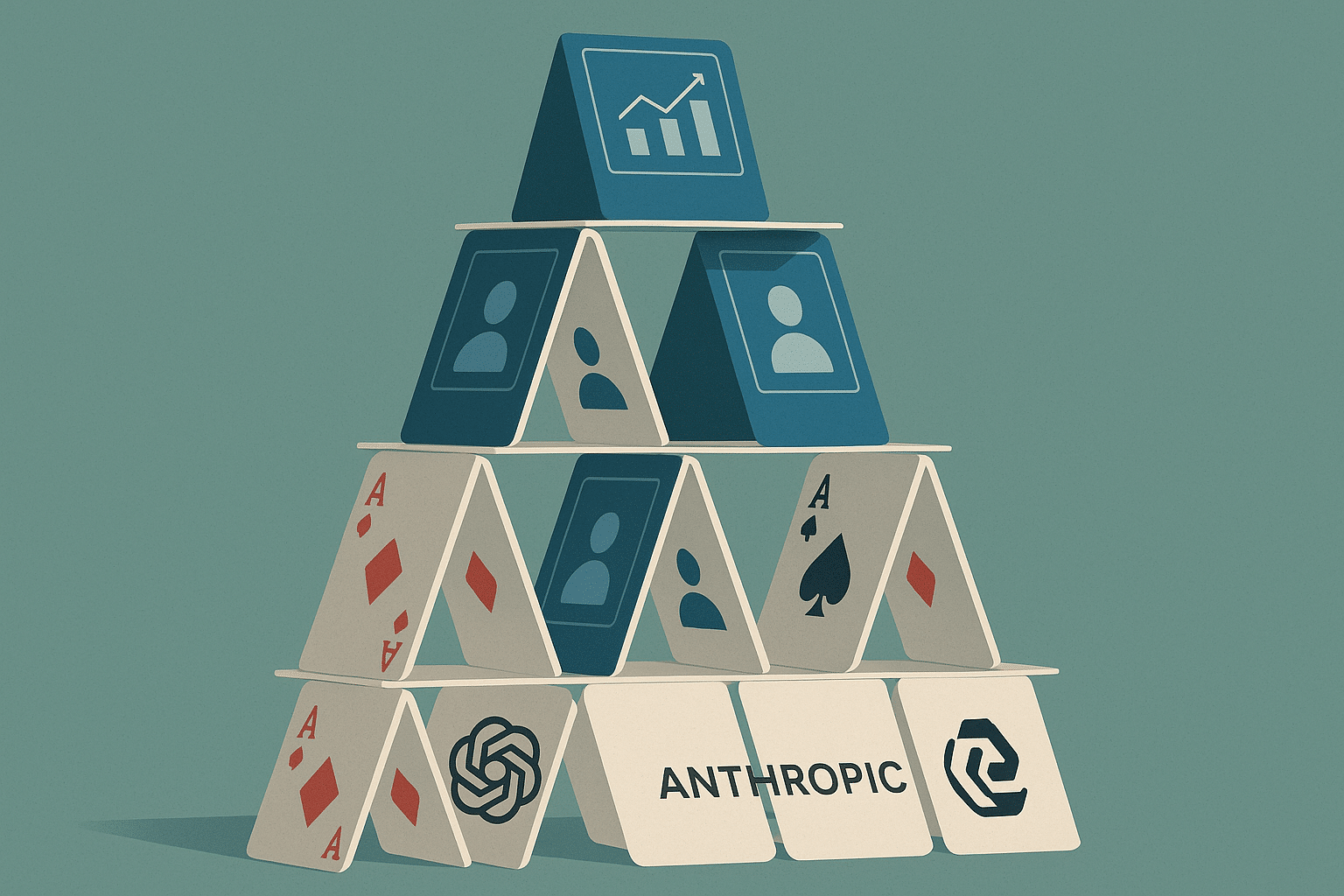
It’s a house of cards propped up by cheap capital, subsidized compute, and suspended disbelief.
When capital tightens, gravity returns.
Build like physics matters.
Buy like vendors can disappear.
Invest like margins actually exist.