
The thesis in one sentence: Scaling AI nationally is about who can add GW-scale firm power + transmission fast while funding compute capex. Only the US and China can plausibly do this. Everyone else scales under hard constraints.
Why This Matters Now
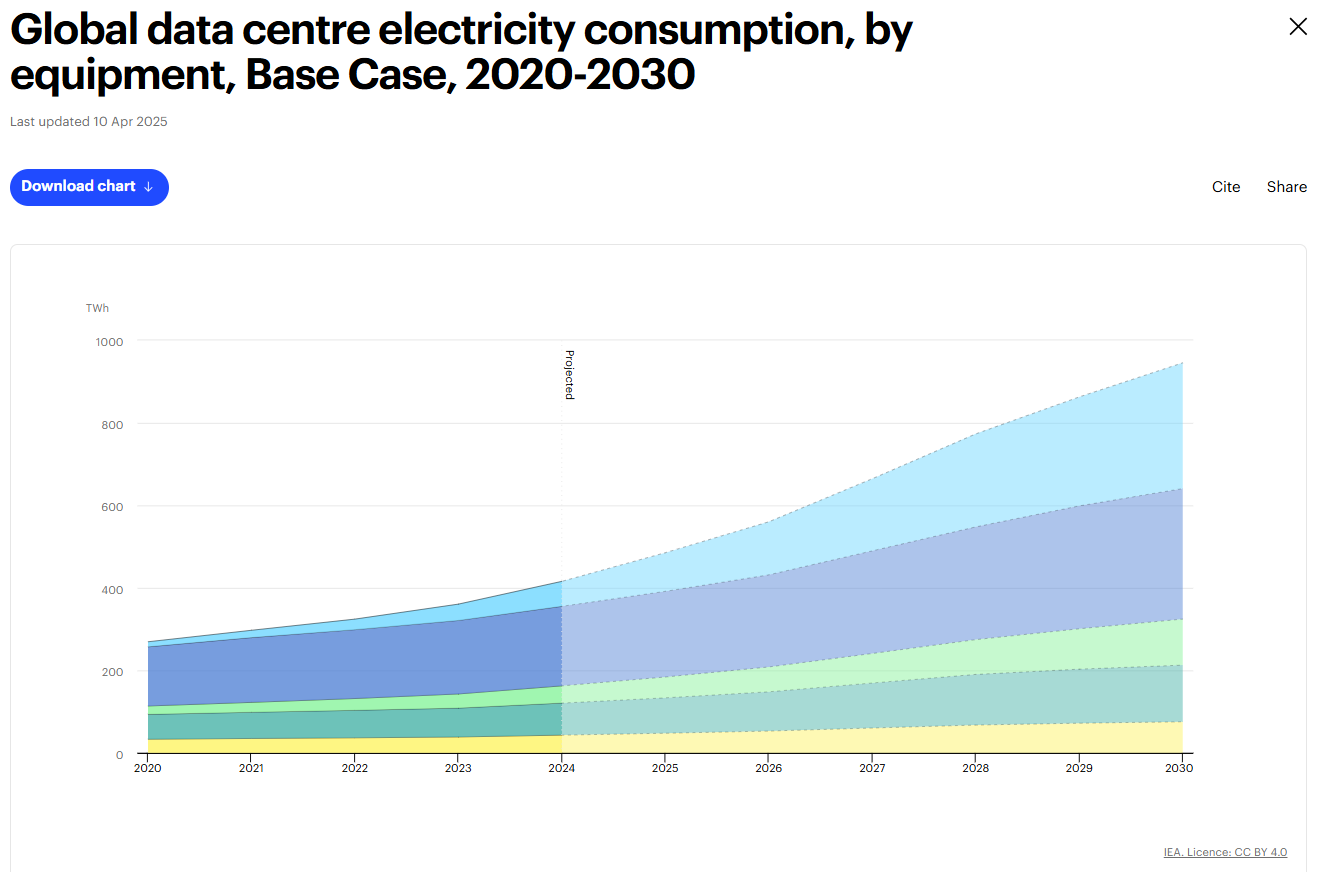
The IEA projects global data center electricity demand doubling from 415 TWh (2024) to 945 TWh (2030). That’s not a marginal load bump; it’s a new macro cycle that will define energy markets, grid buildouts, and geopolitical leverage for the next decade.
For the top 10 economies by nominal GDP, here’s the uncomfortable truth: AI national leadership requires three simultaneous capabilities:
Energy system scale. Enough absolute throughput and generation capacity to absorb multi-GW increments.
Capital + industrial depth. Ability to finance generation, transmission, and data center buildout at speed.
Permitting + supply chains that actually move. This kills more AI scaling plans than energy scarcity ever will.
Most advanced economies have #3. Only two have all three.
The Tier System
Tier A: “Can Brute Force” — US & China
These two countries have enough absolute energy throughput, industrial horsepower, and capital formation to add substantial data center load while expanding generation and grids.
The catch: They still face real chokepoints.
US: Grid connection queues, transformer shortages, local permitting delays. Reuters reports US utilities need to invest >$1.1T (2025–2029) just to keep up. The IEA flags “power availability” as a top concern for data center operators. But the US is a modest net energy exporter now (–9% net imports), has 18% nuclear in the mix, and has the deepest private AI capital pool ($109.1B in 2024). Tech/data center firms have already procured ~86 GW of renewable capacity since 2015. Message: Bottleneck is grid infrastructure, not fuel.
China: Clean energy investment >$625B in 2024, ~$88B in transmission/distribution planned for 2025, plus continued coal investment (>$54B in 2025) for reliability. The IEA notes China is fighting grid congestion, curtailment issues, and the reliability-vs-decarbonization tradeoff. China is a net importer (24%), relies heavily on coal (61% of electricity), but has the installed capacity (1653 GW) and the state capacity to build at speed. Message: Constraint is grid congestion, not capital.
Investment signal: Both countries are treating grid expansion as a top-tier priority. Both are competing for hyperscaler placement. This is real.
Tier B: “Conditional Scalers” — Germany, France, Italy, UK, Japan
All have world-class grids, capital markets, and strong clean energy commitment. All face a structural problem: they’re net energy importers (except France, which is only 47% dependent due to its nuclear dominance).
CountryNet Energy ImportsElectricity MixConstraintJapan87%33% gas, 28% coalExtreme import exposure. Land-constrained.Italy80%45% gas, 54% coal+oilExtreme import exposure. High fuel volatility.Germany71%79% fossil, 50% renewables/otherPermitting slowness. Grid expansion lagging buildout.UK44%35% gas, 47% renewables/otherBetter positioned. Permitting + capital available.France47%64% nuclearStructural advantage. Firm, low-carbon baseline.
The real constraint: Permitting and political speed. Germany has the capital but faces years of grid connection delays. Italy/Japan face fuel price sensitivity that makes data center margins volatile. France’s nuclear mix is the outlier—it’s the one European play.
What’s not constraining them: Money. All have deep capital markets.
Tier C: “Growth Scaler” — India
Third-largest power capacity growth globally (after China, US) in the past five years. 83% of power-sector investment went to clean energy in 2024. Non-fossil capacity share: ~44%, targeting 50% by 2030.
The reality: Huge opportunity; massive execution bar. India’s per-capita energy use is 2,055 kgOE vs 6,364 (US) and 9,118 (Japan). Grid buildout is the limiting reagent, not desire or capital direction.
IEA framing: India must “build the grid while scaling compute.” That’s feasible but not trivial. This is a 2030+ play, not a 2026 play.
Tier D: “Energy-Rich but Blocked” — Canada & Russia
CountryNet Energy ExportsEnergy Self-SufficiencyActual ConstraintCanada–89.6%High. Hydro-heavy (57% of electricity).Siting, transmission expansion in a huge geography. Attracting compute capital at GW scale.Russia–75.1%High. Large energy exporter.Geopolitics + tech access. Chips, capital integration, global supply chain.
Canada’s energy profile is nearly ideal. The constraint is whether it can actually attract and retain multi-GW compute clusters. Russia has the fuel but can’t access the chips or capital.
What the Data Actually Says
Energy Import Dependence Is the Quiet Killer
High import dependence = higher sensitivity to fuel shocks + price volatility. For a data center operator, that translates to operating cost risk.
High risk (>70% net imports): Japan, Italy, Germany. All three would feel a supply shock immediately in their data center economics.
Moderate risk (40–50%): France, UK, China, India.
Insulated (negative/low imports): US, Canada, Russia.
The geopolitical implication: Energy-rich countries get leverage. The EU’s post-2022 energy security panic is real, and it’s shaping investment priorities away from data center siting toward energy independence. That’s not bullish for hosting European AI clusters.
Electricity Mix Matters More Than Primary Energy Mix
Data centers buy electrons, not “energy in the abstract.”
France’s 64% nuclear: Firm, low-carbon, high-utilization-compatible. Huge advantage for AI load.
Canada’s 57% hydro: Also firm-ish, but seasonal and weather-dependent.
China’s 61% coal: Clean energy push is real, but coal is still the backbone. AI scaling there means coal-to-clean substitution while adding load. That’s hard.
India’s 74% coal: Same problem, worse.
US mix (42% gas, 18% nuclear, 17% “other”/renewables): Diversified, manageable.
The implication: France and Canada have structural electricity advantages. China and India have structural electricity headwinds (coal dependence). The US is balanced.
Private AI Investment Is Hyper-Concentrated
US: $109.1B (2024)
China: $9.3B
UK: $4.5B
Everyone else: unspecified (meaning negligible)
This matters because private capital funds data center buildout and determines where clusters actually form. The US has ~12x the private AI investment of China and ~24x the UK.
If private capital concentration persists; and there’s no reason to think it won’t; then “national AI scaling” will also remain concentrated in the US and China.
The Investment Reality
Global data center capex: ~$0.5T in 2025. Tying to energy transition investment and grid buildouts explicitly.
Global energy investment: $3.3T (2025), with clean energy ~2x fossil.
Grid spending gap: Persistent. Generation is growing faster than grid investment. This is the actual bottleneck everywhere.
CountryWhat’s Being BuiltSpeed SignalChinaGrid + storage + coal/clean mixVery fast. State capacity.USGrid + renewables PPAs + SMRs (~26 GW agreements) + geothermal (~265 MW)Fast, but permitting constrained. Utilities investing >$1.1T (2025–2029).EU~$390B energy investment (2025). Germany €30B “Deutschlandfonds” for energy transition.Medium. Permitting is the brake.India83% of power investment to clean; renewables surge.Fast relative to baseline, but grid buildout is the constraint.Japan92% of energy investment to clean. Heavy focus on supply adequacy for advanced industry.Medium. Nuclear restarts + LNG + grid hardening needed.CanadaStrong net exporter, hydro-heavy.Medium. Siting + transmission the constraint, not fuel.RussiaNet exporter, energy-rich.Geopolitical risk dominates. Access to chips/capital is the constraint.
So Who Actually Wins?
Tier A: US & China (Likely Winners)
Why: They can add GW-scale capacity and fund compute capex and access chips.
The catch: Both face real grid bottlenecks. The US has a permitting/transformer supply problem. China has a grid congestion + reliability-tradeoff problem. Neither is insurmountable, but both are real.
The investment implication: Grid infrastructure companies and transmission are going to have exceptional ROI in both countries over the next 5–7 years. This is a secular tailwind.
Tier B: France (Only Advanced Economy with Real Upside)
Why: 64% nuclear (firm, low-carbon baseline) + capital + grid infrastructure. No energy import shock vulnerability like Germany/Italy/Japan.
The catch: Still faces permitting timelines on new nuclear + grid expansion. Slower than China, but structurally better positioned than peers.
The investment implication: If France can move permitting needles (politically hard), it could capture marginal European AI cluster growth. That’s conditional on policy speed, which is not France’s historical strength.
Tier B: Germany, Italy, UK, Japan (Conditional, Slower)
All have capital and grid quality. All face import exposure (Germany/Italy/Japan worse than UK). All face permitting constraints. All will scale, but incrementally, and under higher cost of capital due to energy price sensitivity.
The implication: These are not AI scaling anchors. They’re secondary/tertiary compute locations.
Tier C: India (Long-Term Opportunity)
Clear direction of travel. Grid buildout is the rate limiter. This is a 2030+ story, not a 2026 story.
Tier D: Russia & Canada (Energy ≠ Compute)
Russia: Energy is not the constraint. Geopolitics + tech access is. Not happening without sanctions relief + capital reintegration.
Canada: Energy is genuinely not the constraint. Siting + capital attraction is. Could become a serious secondary hub if compute capital wants geographic diversification from the US. But that requires deliberate corporate strategy, not energy advantage.
What Matters Next
Grid buildout rate. Interconnection queues, transformer lead times, T&D capex. The IEA treats this as a bottleneck in the US and an urgent priority in China/EU. Watch utility capex announcements and grid operator queue times.
Firm low-carbon supply. SMRs, geothermal, long-duration storage, hydrogen-ready gas. France’s nuclear dominance shows what’s possible; the US is emerging as a SMR/geothermal play. Watch deployment rates.
Private AI capital location. If the $109B US concentration holds, compute clusters will also concentrate. China will push public capital to counterbalance. Everyone else gets crumbs.
Data center demand growth trajectory. IEA says global doubling by 2030. New training paradigms, inference growth, and enterprise AI will add to that baseline. If the trajectory steepens, grid constraints everywhere become more acute.
Geopolitical energy leverage. Import dependence is leverage. Watch Germany, Italy, Japan fuel prices relative to US/China. Energy shocks → data center cost volatility → competitive advantage shifts.
The Bottom Line
For investors/operators: If you’re betting on national AI scaling, bet on US and China. Both have constraints (grid in both; permitting in US; congestion in China), but both have the system-level horsepower to solve them. France is the only other play in advanced economies, and only if permitting accelerates.
For everyone else: You’re constrained by energy imports, permitting speed, or both. You’ll still scale AI; but you’ll do it slower, under higher cost of capital, and without the cluster advantages of the US/China. Expect secondary hub dynamics: London, Singapore, Tokyo as satellite compute, not anchors.
For geopolitics: Energy security is the quiet killer variable for AI scaling. Europe’s post-2022 energy panic is now baked into grid + permitting prioritization. Russia’s locked out by geopolitics. Canada could be a relief valve if the US runs into siting constraints, but that requires strategic compute capital diversification, not just energy abundance.
The macro: AI scaling is inseparable from grid buildout, generation deployment, and energy security. For the next decade, “who scales AI” and “who scales energy” are the same question. Only two countries have the capacity to answer it in the affirmative. Everyone else is executing a “conditional scaling” or “secondary hub” strategy.
Watch grid infrastructure, permitting timelines, and energy supply chains. That’s where the leverage is.