
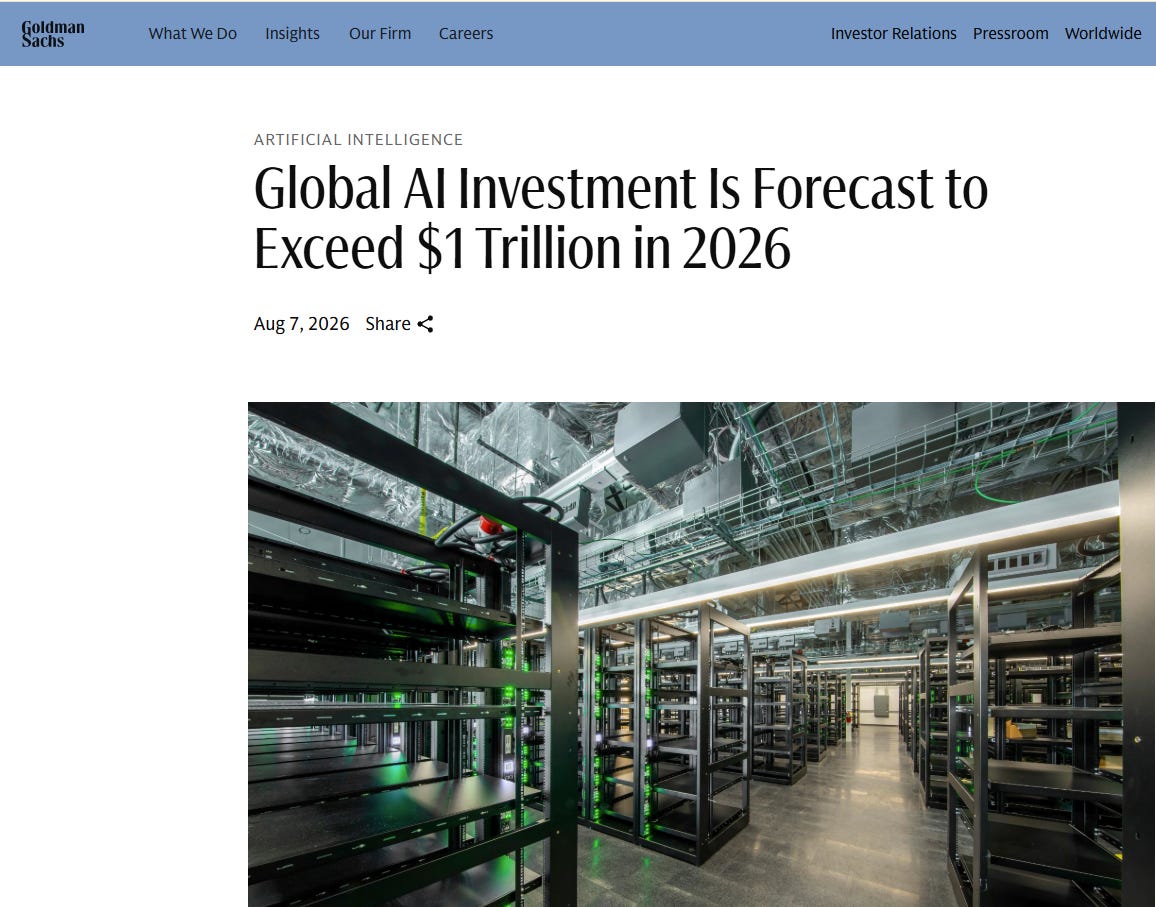
Goldman Sachs put a number on the AI buildout that finally makes the scale legible.
Global AI investment will cross $1 trillion in 2026, with $581 billion of that landing inside the United States.
By 2028, on Goldman’s own extrapolation, AI capex reaches 2.8 percent of US GDP.
Say that number a different way. One dollar in every 36 the American economy produces will be spent building the physical guts of artificial intelligence. Transformers, turbines, copper, land, concrete, switchgear, and the electricians and linemen who install all of it.
Looks like bubble? Whether the valuations hold, whether the revenue shows up, whether Microsoft and Meta and Oracle can actually earn a return on the debt they’re taking on to build it.
That’s the first order question, and it’s the one every analyst on financial television is paid to answer. It’s also, for our purposes, the less interesting one.
What happens to everything else while this is happening. Because 2.8 percent of GDP does not appear out of thin air. It has to come from somewhere.
Capital that goes into a transformer for a data center in northern Virginia is capital that does not go into a transformer for a semiconductor fab in Arizona, a housing development in Texas, or a grid upgrade in Ohio. A construction crew pouring concrete for a hyperscale campus is a construction crew that is not pouring concrete for an apartment building. This is not a hypothetical. It is already showing up in the data, and it is going to reshape which industries get funded and which get starved for the rest of this decade.
The Binding Constraint Has Moved, and It Keeps Moving
The Full Stack Capitalist lens on any technology buildout is simple. Find the thing that is actually scarce, not the thing that gets the headlines, and trace who captures the rent from controlling it. For most of 2023 and 2024 the scarce resource was GPUs.
That constraint is largely gone. TSMC has repeatedly expanded advanced packaging capacity, and chip allocation is no longer the thing standing between a hyperscaler and a bigger cluster.
The constraint moved to power, and specifically to the physical equipment needed to deliver power.
Power transformers were averaging roughly 128 weeks of lead time by 2026, with generator step up units stretching to 144 weeks and the highest capacity units quoted four to five years out.
Before 2020 the same transformer shipped in under two years, often in a matter of weeks. Of the roughly sixteen gigawatts of data center capacity announced for 2026 in the US, only about five gigawatts was actually under construction, with analysts estimating that 30 to 50 percent of the announced pipeline would be delayed or cancelled outright because of transformer and switchgear shortages, not because the money wasn’t there.
That last clause is the whole essay in miniature. Not because the money wasn’t there. This is a capital abundant, physical infrastructure scarce economy. The hyperscalers have functionally infinite access to debt and equity markets. What they cannot do is manufacture grain oriented electrical steel faster, and China controls roughly 60 percent of the world’s transformer manufacturing capacity, which means the bottleneck is also a geopolitical one.
When the binding constraint is a slow moving industrial input rather than a fast moving financial one, the excess capital doesn’t sit idle. It goes looking for the next scarce thing and bids the price up. That’s copper, and it’s construction labor, and increasingly it’s the electricity itself.
Copper Is the Cleanest Proxy for What’s Being Bid Away
A single one gigawatt AI facility requires on the order of 50,000 metric tons of copper.
At current buildout paces of roughly fifteen gigawatts of new capacity a year, data centers alone are adding somewhere around 750,000 metric tons of incremental copper demand annually, and that’s before counting the copper needed for the substations, transmission lines, and grid upgrades required to actually deliver the power, which several analysts now believe will exceed the copper used inside the buildings themselves.
Copper prices have risen more than 60 percent since early 2025 and have repeatedly traded above $13,000 to $14,500 a metric ton, levels that used to be considered crisis pricing.
Copper is inelastic in a way most commodities aren’t.
You can’t substitute your way around a high voltage application the way you can swap aluminum into a low stakes consumer product. So every other industry that needs copper, electric vehicle manufacturing, grid modernization for reasons that have nothing to do with AI, home electrification, general industrial construction, is now bidding against hyperscalers with functionally unlimited balance sheets for a metal whose supply grows at roughly 1.4 percent a year against demand growing far faster.
Mine permitting timelines run 15 to 17 years from discovery to production. Supply cannot respond to price. Demand, backstopped by trillion dollar capex budgets, doesn’t have to care about price. That’s a structural transfer of purchasing power from every copper consuming industry that isn’t AI, straight into the AI buildout, and it happens silently, through a commodities market, without anyone voting on it.
Manufacturers Are Losing to Data Centers for the Same Megawatts
This is the part of the story that gets the least attention and matters the most, because it’s happening at the level of individual grid interconnections, not abstract GDP shares.
In regions across the country, manufacturers are discovering that the power capacity they assumed would be available has already been claimed by a data center campus down the road.
PJM, the regional grid operator spanning thirteen states and Washington DC, received more than 800 project applications totaling roughly 220 gigawatts in its most recent interconnection cycle, a queue that was never designed to process anything close to that volume.
This is not an abstract crowding out story. It is the reshoring story colliding head on with the AI story, and AI is winning. Every speech about bringing semiconductor fabs and battery plants and industrial capacity back to American soil assumed those factories would be able to get power on a normal timeline.
They can’t, because the queue in front of them is now dominated by hyperscale data center requests that arrived with more capital and, often, more political priority attached. Eaton, Vertiv, and Schneider Electric have all announced new manufacturing capacity for the switchgear and transformers everyone needs, but new factories take years to reach output, which means the equipment shortage outlasts the current wave of expansion plans on both sides.
The bottleneck has migrated from the substation to the factory floor of the companies that build substations, and there is no version of that sentence that is good news for a reshoring agenda that depends on getting industrial power online this decade rather than next.
There’s a second casualty inside the power story that shows up on household bills rather than corporate balance sheets.
PJM’s electricity suppliers paid $14.7 billion at a recent capacity auction to guarantee they’d have enough power for their customers, up from $2.2 billion the year before, a nearly sevenfold jump driven substantially by the slow moving interconnection queue that data center demand has helped clog. Ratepayers, most of whom have no stake in the AI trade whatsoever, are the ones covering that spread. That is a direct, traceable transfer from households to the AI buildout, mediated by a grid queue nobody outside the industry is watching.
Credit Markets Are the Newest Front, and It’s Bigger Than People Realize
The capex crowding story usually gets told through physical inputs. The credit market version is just as real and less discussed.
Hyperscaler capex in 2026 is consuming close to 100 percent of operating cash flow, compared with a ten year average closer to 40 percent, which means the era of AI being funded out of Big Tech’s spare cash is over.
The five largest hyperscalers issued around $121 billion in US corporate bonds in 2025, more than four times their 2020 to 2024 annual average, and issuance has accelerated further this year, with Goldman projecting roughly $250 billion in hyperscaler bond sales for 2026 rising toward $400 billion in 2027. Technology has climbed to roughly 10 percent of the Bloomberg US Corporate Index and, in several major benchmarks, has overtaken banking in weight for the first time in the index’s history.
That reshuffling matters beyond the tech sector because investment grade credit markets are not infinitely deep in any given window.
Overall US corporate bond issuance is expected to hit $2.46 trillion in 2026, and passive bond funds that track investment grade indexes will mechanically absorb more hyperscaler debt as the weighting shifts, which means every other investment grade borrower, industrials, utilities, healthcare systems, is now competing for spread and investor attention against the highest quality, most aggressively marketed issuers in the market.
AI debt is also colliding with a federal government running toward a $2 trillion annual deficit and no longer backstopped by a Federal Reserve willing to buy Treasuries at scale, which means every dollar of capital markets appetite is being split three ways between sovereign debt, AI infrastructure debt, and everyone else. Early signs of investor fatigue are already visible.
A recent Amazon bond sale needed to offer 18 to 21 basis points of extra yield to clear, with orders covering the deal only 2.5 times versus 3.2 times earlier in the year. When the most creditworthy borrowers on earth have to sweeten the deal to move paper, that’s the credit market’s way of saying the well has a bottom.
Who Actually Gets Defunded
Put the physical and financial constraints together and a pattern emerges. The industries that lose in this environment are the ones that share AI’s inputs but not its capital access.
Reshored manufacturing loses because it needs the same transformers, the same grid interconnections, and the same skilled electrical labor, but arrives at the queue with a fraction of the balance sheet.
Housing and general construction lose because they compete for the same copper, the same construction crews, and increasingly the same land near power infrastructure, without the pricing power to bid AI campuses off a site.
Mid tier industrial and healthcare borrowers lose in the credit markets because investment grade capacity that used to flow to them now flows through indexes increasingly weighted toward hyperscaler paper. Utility ratepayers lose directly, through capacity auction costs that get passed straight to household bills.
And clean energy and grid modernization projects that have nothing to do with AI, projects that in a fairer queue would be interconnecting today, sit for five years or more behind data center requests that jumped the line with bigger checkbooks.
None of this required anyone to make a decision to defund those sectors.
That’s what makes it a genuine economic phenomenon rather than a policy failure with an obvious villain. It’s what economists mean by crowding out, capital and physical inputs flowing toward the highest expected return sector in a supply constrained system, with everyone else absorbing the opportunity cost whether they had a vote in the matter or not.
The externality here isn’t carbon or noise. It’s every other capital intensive industry in the country discovering that its cost of capital, its equipment lead times, and its construction timelines just got worse because of a buildout it has no stake in.
What This Means If You’re the One Bidding, or the One Losing the Bid
If you’re a founder building anything that touches physical infrastructure, energy, industrial equipment, construction, manufacturing, treat 2026 through 2028 as a period where your input costs are structurally elevated regardless of what your own sector is doing. Transformer and switchgear lead times aren’t a data center problem you can ignore. They’re now your problem too, and the companies solving for it, whether through behind the meter generation or vertically integrated equipment supply, are building a genuine moat.
If you’re an operator running a company that depends on grid interconnection, get in the queue earlier than you think you need to, and underwrite your project assuming the equipment timeline, not the permitting timeline, is your critical path. The site with land control and zoning is worthless if the transformer arrives in 2029.
If you’re an investor, the interesting trade isn’t only the hyperscalers or the chipmakers everyone already owns. It’s the picks and shovels one layer further down, the transformer and switchgear manufacturers, the copper producers who can actually bring new supply online inside a normal timeframe, and the credit story itself, where investment grade spread widening on hyperscaler paper is a signal worth watching closely rather than dismissing as noise from AA rated borrowers.
If you’re in government, the reshoring agenda and the AI agenda are currently fighting each other for the same substations, and pretending otherwise doesn’t change the interconnection queue. Any serious industrial policy in 2026 has to reckon with the fact that a semiconductor fab and a hyperscale data center are now direct competitors for the same transformer order book, and a queue that runs first come, first served with no strategic prioritization will keep handing the win to whichever project has the biggest balance sheet, not the one that matters most to national competitiveness.
The trillion dollar number was never really about AI. It’s about what an economy looks like when one sector can outbid every other sector for the physical and financial inputs all of them need at once.
Something has to give. The Goldman Sachs report just told you the size of the bill. It didn’t tell you who’s paying it. That part you have to work out yourself, and increasingly, the answer is everyone who isn’t in the room.