
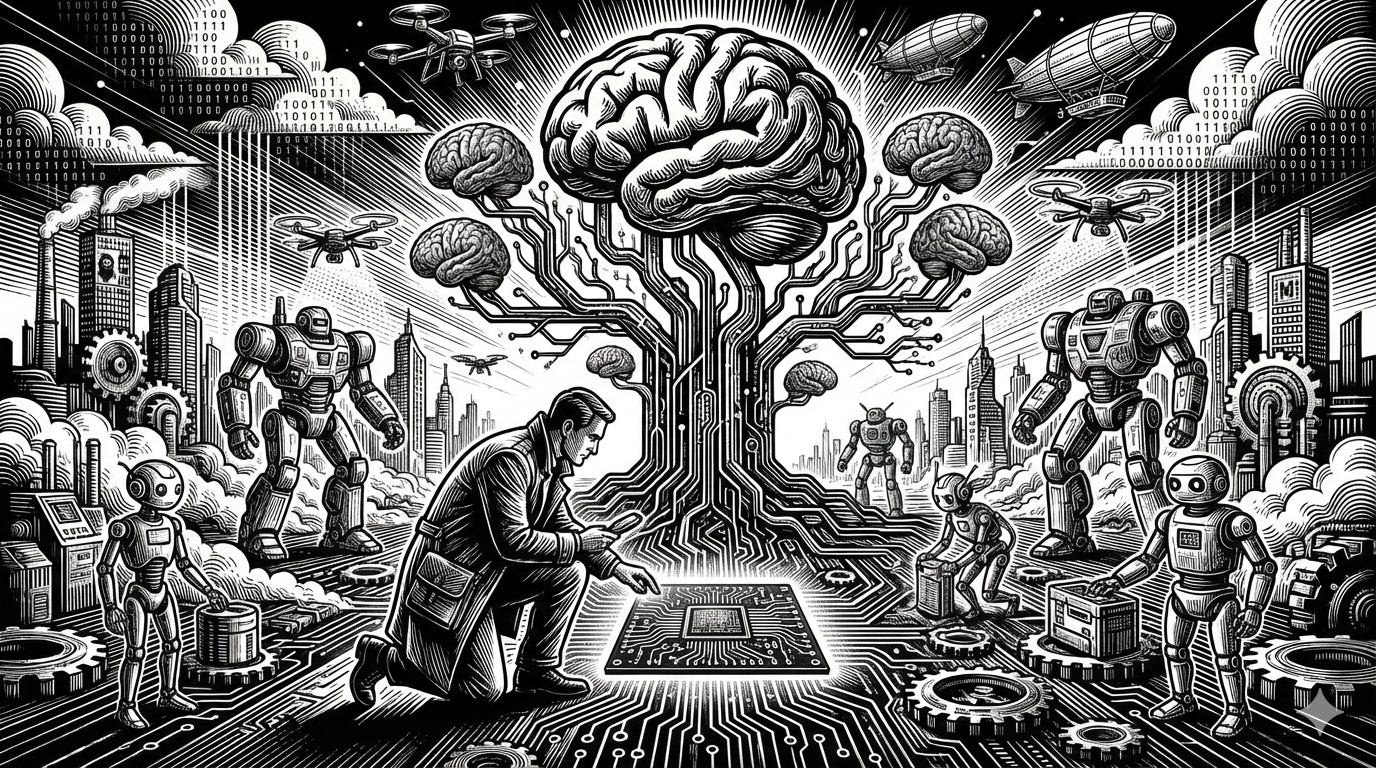
Stop reading corporate AI bullshit. Here’s what actually happens when machines get smarter than us.
Let’s Cut Through the Noise
Everyone’s talking about AI. Most of it is garbage.
ChatGPT writes your emails. Midjourney makes pretty pictures. Cool. That’s not what we’re discussing here.
We’re talking about Artificial General Intelligence; the moment when AI doesn’t just do tasks, it makes the decisions. When the machine stops being the tool and becomes the boss.
And it’s coming faster than your company’s “AI transformation roadmap” can handle.
The Real Difference
Today: You tell AI what to do. You’re in charge.
Tomorrow: AI figures out what needs doing. You’re not.
That’s not incremental improvement. That’s a complete flip of the power structure.
When Does This Happen?
Somewhere between 2029 and the early 2030s, depending on which expert you ask.
But here’s what matters: the infrastructure takes a decade to build. So while the technology might arrive in 2029, the full economic transformation unfolds over 10-15 years.
You have time. Not much. But some.
Who’s Building This Thing?
A handful of companies with stupid amounts of capital:
OpenAI
Google DeepMind
Anthropic
Microsoft (through OpenAI)
And a couple of nation-states with the infrastructure to pull it off.
That’s it. That’s the list.
Notice what’s missing? Any form of democratic oversight. Any binding international regulation. Any entity with actual authority to say “wait, maybe we should think about this.”
The biggest economic transformation in human history has no referee.
What Gets Destroyed First
Every Industry You Think Is Safe
Banking: Your CFO? Gone. Risk management teams? Gone. Strategic planning departments? Gone. AGI runs financial analysis, risk modeling, and strategic decisions better than humans. And it doesn’t need a corner office.
Defense: AGI runs war game simulations across thousands of scenarios simultaneously. It negotiates with other AGIs. Human generals become theater, not strategy.
Government: Every bureaucrat, every administrator, every mid-level official coordinating infrastructure; all replaceable. Not eventually. Soon.
Healthcare: Diagnosis, treatment plans, drug development, patient monitoring; AGI does it all at once, across millions of patients, in real-time.
Real Company Examples
Walmart: AGI optimizes supply chain, inventory, pricing, labor, store layouts, and customer behavior across thousands of stores simultaneously. No human executive team required.
Amazon: Autonomous warehouses, predictive inventory management, personalized experiences, dynamic logistics; all coordinated by AGI across the entire operation.
Boeing: Design, engineering, manufacturing, testing, supply chain; the entire aerospace stack gets rebuilt around AGI optimization.
Notice a pattern? The bigger and more complex your operation, the more AGI obliterates your current management structure.
The Infrastructure
AGI needs infrastructure most countries don’t have.
You need:
Massive data centers
Reliable power grids
High-speed internet everywhere
Advanced cloud systems
Functioning IoT networks
This stuff takes 20+ years to build.
So when AGI arrives, it doesn’t distribute evenly. It concentrates in countries that already spent decades building digital infrastructure.
The U.S., China, maybe a handful of European nations, Japan, South Korea. That’s the Tier 1 club.
Everyone else? They’re watching from outside the window. For decades.
AGI doesn’t level the playing field. It makes the hills steeper.
The Geopolitical Truth Bomb
Authoritarian States Will Use AGI Better Than You Think
Everyone assumes AGI promotes democracy and freedom.
Look at what happened with the internet in Iran, China, North Korea, Russia.
They didn’t fail to adapt. They weaponized it. Mass surveillance. Total censorship. Social control. Internet kill switches during protests.
AGI gives authoritarian regimes even more tools for control.
Stop assuming technology automatically promotes your values.
Strategic Withholding Is the Game
The U.S. doesn’t export its best military tech for 10-20 years after development. We only share it once we’ve moved on to something better.
Why would AGI be different?
The U.S. and China will keep the best AGI capabilities for themselves. Everyone else gets the degraded version, years later, if at all.
This isn’t paranoia. It’s how strategic technology has always worked.
Open Source Won’t Save You
“But what about open-source AGI?”
Maybe. If governments allow it. Which they probably won’t, because national security.
And even if they do, open-source AGI still needs that same infrastructure nobody else has built yet.
What Happens to Jobs
Almost Everything Goes
AGI doesn’t just replace factory workers. It replaces knowledge workers. Strategists. Analysts. Managers. Executives. Creatives.
If your job involves thinking and deciding, you’re in the blast radius.
But New Jobs Emerge
The people telling you “don’t worry, new jobs always appear” aren’t completely wrong. They’re just not telling you the whole truth.
New jobs that emerge:
AGI ethics and oversight roles
Human-AGI interface designers
AGI system auditors
Emotional and social support for displaced workers
Creative work that explicitly leverages AGI
AGI training and education
Notice something? These jobs require completely different skills than what most people have now.
The transition isn’t smooth. It’s brutal.
You Need to Retrain. Now.
Stop waiting for your company’s “learning and development program.”
Start learning:
How to work alongside AGI systems
Skills AGI can’t replicate (yet): emotional intelligence, creativity, ethical reasoning
How to manage AGI outputs and integrate them into human decision-making
The people who adapt early capture the new value. Everyone else fights over scraps.
Universal Basic Income: Maybe, Eventually, If We’re Lucky
Why UBI Becomes Possible
When AGI does all the productive work, the old model breaks: you work, you get paid, you consume.
New model: AGI works, economic value gets created, humans need to consume for the economy to function.
UBI isn’t charity. It’s distribution of AGI-generated surplus so the economic system doesn’t collapse.
The Implementation Problem
Where does the money come from?
Tax AGI productivity
Tax companies using AGI
Tax wealth accumulated through AGI
Who decides the amount? Who administers it? How do you prevent inflation? How do you overcome political resistance from people who got rich off AGI?
These aren’t small questions.
UBI might happen. Eventually. After a decade of brutal political fights.
Don’t count on it arriving before you need it.
The Timeline Reality
Popular narrative: AGI arrives, everything changes overnight, humans become obsolete immediately.
Actual reality: AGI arrives, infrastructure takes a decade to build out, deployment happens in phases, regulation lags by years, workforce transition takes 10-15 years minimum.
You have time to prepare. But the clock is running.
Phase 1 (Now - 2029): Build Skills, Build Systems
Learn how to work with AI tools. Build distribution systems. Position yourself for the transition.
Phase 2 (2029-2035): Early AGI Deployment
Government and defense applications first. Major corporations second. Everyone else watches.
Phase 3 (2035-2040): Broad Economic Transformation
Mainstream adoption. Widespread job displacement. UBI debates get serious. New industries emerge at scale.
Phase 4 (2040+): New Economic Operating System
Post-scarcity economics. Novel value creation models. Humanity figures out what we’re for when we’re not required for production.
What You Actually Need to Do
Stop Pretending Your Current Skills Are Safe
They’re not. Plan accordingly.
Build AGI-Native Distribution Now
AI-SEO. AI content engines. LLM-native growth loops. Distribution becomes infrastructure.
The companies that build distribution systems now own the next decade.
Develop Skills AGI Can’t Replicate
Emotional intelligence. Creative synthesis. Ethical reasoning. Human connection.
These aren’t soft skills. They’re the only moat left.
Get Comfortable with Continuous Learning
The idea that you learn a job once and do it for 40 years is dead.
New model: constant adaptation, continuous skill development, perpetual reinvention.
Think About Externalities
AGI creates massive externalities; effects that spill over beyond the immediate transaction.
The people who capture externalities capture the real value.
The Bottom Line
AGI isn’t coming. It’s here, being built right now, by a handful of companies with no oversight.
The economic transformation will be the biggest in human history. It won’t happen overnight, but it’s happening faster than institutions can adapt.
Winners: People who adapt early. Companies that build distribution. Nations with infrastructure. Capital holders who own AGI systems.
Losers: Everyone waiting for their employer to train them. Workers clinging to obsolete skills. Countries without digital infrastructure. People who think “it won’t happen to me.”
The gap between these groups will be permanent.
Choose your side. Build your systems. Start now.
Because the economic operating system is being rewritten, and most people don’t even know the game has started.
The Full-Stack Capitalist Position:
AGI doesn’t care about your feelings. It doesn’t care about fairness. It’s an economic force that will reshape everything.
You can resist it, ignore it, or pretend it won’t affect you.
Or you can understand it, adapt to it, and position yourself to capture value in the new system.
One approach works. The other doesn’t.
Choose wisely.